
A Vehicle Lands on Mars and Explores Its Surface: What Happens to Its Weight?
A vehicle landing on Mars is an impressive achievement in space exploration. Robotic vehicles called Mars rovers are designed to travel across the planet, examine rocks and soil, take photographs, and collect scientific information. However, a Mars landing also provides an interesting example of physics, particularly the relationship between gravity, weight, and normal force.
The question “a vehicle lands on mars and explores its surface” is also associated with an AP Physics 1 multiple-choice problem. It asks students to understand how a vehicle’s weight behaves while it descends towards Mars and how its weight compares with its weight on Earth.
To understand the problem, it is important to distinguish between mass, weight, gravitational force, and normal force.
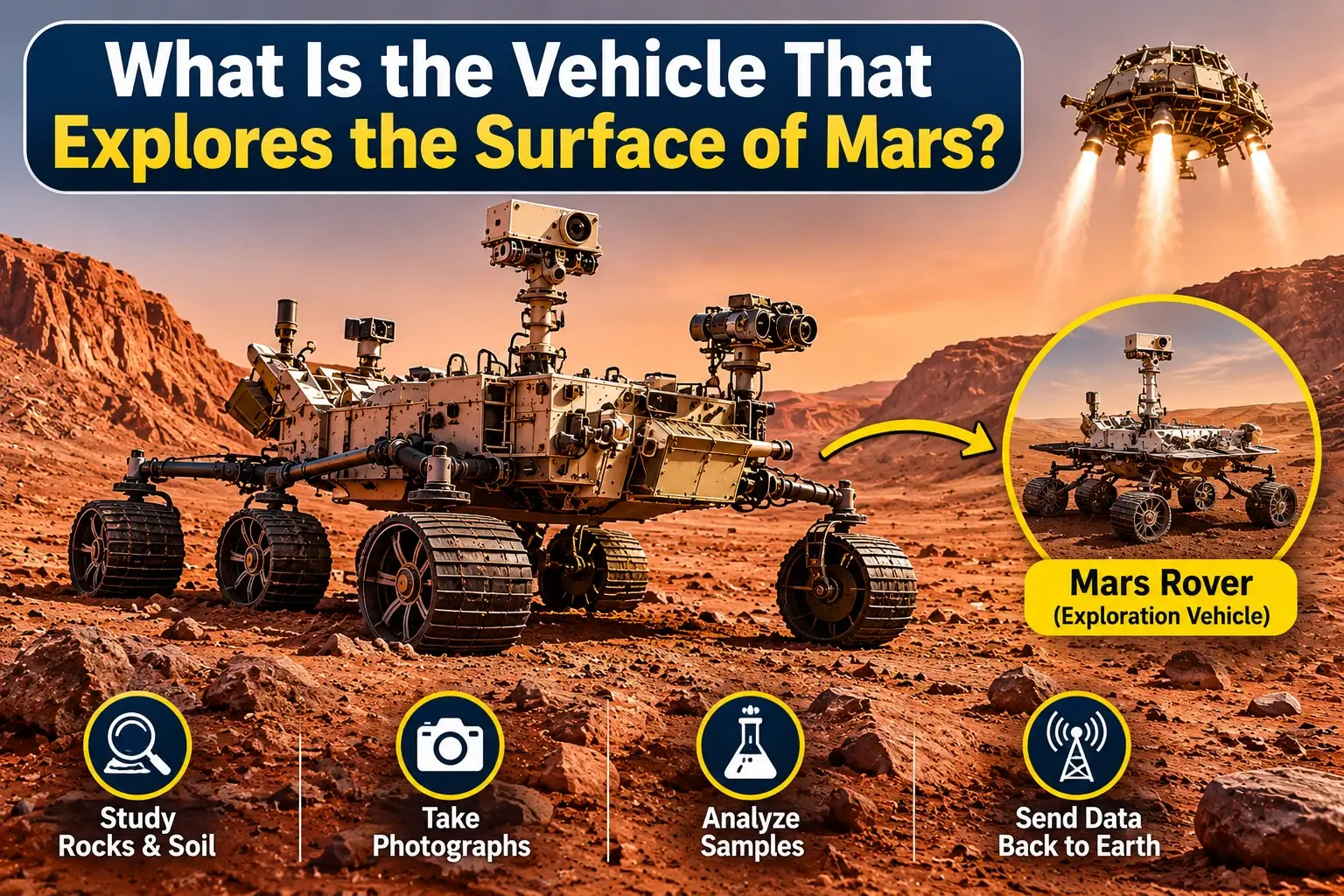
What Is the Vehicle That Explores the Surface of Mars?
The vehicle used to explore Mars is called a Mars rover. It is a robotic vehicle equipped with wheels, cameras, scientific instruments, and communication systems.
Modern robotic exploration also shares some technology concepts with autonomous vehicles, including cameras, sensors, and automated navigation. These technologies are also used in autonomous vehicle technology to help vehicles understand and respond to their surroundings.
Unlike a stationary lander, which remains at its landing location, a rover can move across the Martian surface and investigate different areas. This mobility allows scientists to study rocks, soil, geological formations, and evidence of ancient environmental conditions.
NASA’s Sojourner, Spirit, Opportunity, Curiosity, and Perseverance are examples of Mars rovers. Perseverance landed in Jezero Crater on February 18, 2021, to investigate the region’s geology and search for signs of ancient microbial life.
How Does a Vehicle Land on Mars?
Landing a robotic vehicle on Mars is difficult because the spacecraft must slow down from extremely high speeds without damaging its scientific equipment.
The landing process generally involves several stages:
- Atmospheric entry: The spacecraft enters the Martian atmosphere at high speed. A protective heat shield helps protect it from the heat generated during entry.
- Parachute deployment: A parachute slows the spacecraft as it travels through the atmosphere.
- Powered descent: Rocket engines provide additional braking to reduce the spacecraft’s speed.
- Touchdown: The landing system places the rover safely on the Martian surface.
For larger rovers such as Curiosity and Perseverance, NASA used a system known as the sky crane. A rocket-powered descent stage lowered the rover towards the surface using cables before flying away after touchdown.
This technology allows a rover to begin its exploration after landing safely.
Understanding Gravity on Mars
Gravity is the force that attracts objects towards a planet. However, gravitational acceleration is different on different planets.
The average gravitational acceleration on Mars is approximately 3.7 m/s², while Earth’s average surface gravity is approximately 9.8 m/s².
This means an object with the same mass experiences less gravitational force on Mars than it does on Earth.
| Planet | Approximate surface gravity |
|---|---|
| Earth | 9.8 m/s² |
| Mars | 3.7 m/s² |
The gravitational field strength on Mars is approximately 3.7 newtons per kilogram (N/kg). This value is important when calculating the weight of a vehicle on the planet.
What Is the Difference Between Mass and Weight?
Mass and weight are related, but they are not the same physical quantity.
Mass measures how much matter an object contains. It is measured in kilograms (kg) and does not change when an object moves from Earth to Mars.
Weight is the gravitational force acting on an object. It is measured in newtons (N) and depends on the gravitational field strength.
The formula for calculating weight is:
Weight = Mass × Gravitational field strength
[W = m \times g]
Where:
- (W) = weight in newtons
- (m) = mass in kilograms
- (g) = gravitational field strength in N/kg
Because Mars has weaker gravity than Earth, a vehicle weighs less on Mars even though its mass remains unchanged.
What Happens to a Vehicle’s Weight While Descending to Mars?
When a vehicle travels towards the surface of Mars, gravity acts on it. In the simplified physics model used in the AP Physics question, the gravitational field strength near the planet’s surface is treated as approximately constant.
Therefore, the vehicle’s weight is considered constant during its descent in this model.
This is an important distinction: weight is the gravitational force acting on the vehicle, not the force that the landing surface exerts on it.
The actual gravitational field changes slightly with altitude, but introductory physics questions often use a constant gravitational field approximation when the altitude difference is small compared with the planet’s radius.
Is Weight the Same as Normal Force During Landing?
No. Weight and normal force are different forces.
Weight is the gravitational force pulling the vehicle towards Mars.
Normal force is the contact force exerted by a surface on an object touching it. It acts perpendicular to the contact surface.
When a vehicle is resting on a level surface without vertical acceleration, the normal force balances its weight.
However, during landing, the vehicle may accelerate or decelerate vertically. In that situation, the normal force does not necessarily equal the vehicle’s weight.
For example, if a vehicle is slowing down while moving downwards, its upward acceleration affects the relationship between the two forces.
This is why it is incorrect to assume that normal force always equals weight throughout the landing process.
Example: Calculating a Vehicle’s Weight on Mars
Suppose a robotic vehicle has a mass of 1,000 kg.
The gravitational field strength on Mars is approximately 3.7 N/kg.
Using the weight formula:
[W = m \times g]
Substitute the values:
[W = 1000 \times 3.7]
[W = 3700\ N]
Therefore, the vehicle’s weight on Mars is approximately 3,700 newtons.
Now calculate its weight on Earth:
[W = 1000 \times 9.8]
[W = 9800\ N]
The same vehicle weighs approximately 9,800 N on Earth and 3,700 N on Mars.
Its mass remains 1,000 kg on both planets. Only its weight changes because the gravitational field strength is different.
AP Physics Question: Which Two Statements Are Correct?
The 2018 AP Physics 1 practice exam includes a question about a vehicle that lands on Mars and explores its surface. It provides the average gravitational field strength of Mars as 3.7 N/kg and asks students to select two correct statements about the vehicle’s weight.
The options are:
- A: The vehicle’s weight was constant until it reached the surface of Mars.
- B: The vehicle’s weight increased while it was descending to the surface of Mars.
- C: The vehicle’s weight always equals the normal force exerted by Mars on the vehicle while it is landing.
- D: The vehicle weighs less on the surface of Mars than on the surface of Earth.
Correct answers: A and D.
Here is why:
- Option A — Correct: In the simplified model used by the question, the gravitational field near Mars is treated as constant. Therefore, the vehicle’s weight remains approximately constant during its descent.
- Option B — Incorrect: The question uses a constant gravitational field approximation, so the vehicle’s weight is not considered to increase during descent.
- Option C — Incorrect: Normal force and gravitational force are different. They are not necessarily equal when the vehicle has vertical acceleration during landing.
- Option D — Correct: Mars has a weaker gravitational field than Earth. Since weight depends on gravitational field strength, the vehicle weighs less on Mars.
Understanding these differences makes it easier to solve questions involving gravitational fields, forces, and planetary exploration.
Why Are Mars Rovers Important?
Mars rovers help scientists understand the planet’s geological history and investigate whether its environment could once have supported microbial life.
Their main contributions include:
- Studying rocks and soil: Scientific instruments examine the chemical composition of Martian materials.
- Taking photographs: Cameras capture landscapes, rock formations, and surface conditions.
- Investigating ancient water: Scientists study geological evidence that may indicate past rivers, lakes, or other water-related environments.
- Collecting samples: Perseverance collects and stores rock and soil samples for possible future return to Earth.
- Testing new technology: Rover missions help engineers develop systems that could support future robotic and human exploration.
These missions provide valuable information about Mars while helping scientists understand how planets change over time.
Advances in robotics and vehicle technology also influence the automotive industry’s future, particularly developments in autonomous driving technology and intelligent mobility systems.
Frequently Asked Questions
What is the vehicle called that lands on Mars and explores its surface?
It is called a Mars rover. A rover is a robotic vehicle designed to land on Mars and travel across its surface to conduct scientific investigations.
What is the gravitational field strength on Mars?
The average surface gravitational field strength on Mars is approximately 3.7 N/kg, equivalent to a gravitational acceleration of about 3.7 m/s².
Does a vehicle weigh less on Mars than on Earth?
Yes. A vehicle with the same mass weighs less on Mars because Mars has weaker surface gravity than Earth.
Does mass change when a vehicle travels from Earth to Mars?
No. Mass remains the same regardless of location. Weight changes because gravitational field strength varies between planets.
What are the correct answers to the AP Physics Mars vehicle question?
The correct answers are A and D under the simplified constant-gravity model used in the question. The vehicle’s weight is treated as constant during descent, and it weighs less on Mars than on Earth.
Is normal force always equal to weight during landing?
No. Normal force equals weight only under appropriate conditions, such as when an object rests on a level surface without vertical acceleration. During landing, vertical acceleration can make the two forces different.
Conclusion
A vehicle that lands on Mars and explores its surface is known as a Mars rover. These robotic explorers help scientists investigate the planet’s surface, examine rocks and soil, and understand its geological history.
The same situation also demonstrates important physics principles. Mass remains unchanged when a vehicle moves between planets, but weight depends on gravitational field strength. Since Mars has weaker gravity than Earth, a vehicle weighs less on Mars.
For students studying physics, understanding the difference between weight, mass, and normal force is essential for answering questions about planetary motion and gravitational fields.
References and Further Reading
- NASA – How We Land on Mars
- NASA – Mars 2020: Perseverance Rover
- NASA – The Mars Rovers
- NASA Glenn Research Center – Mars: Gravity and Planetary Information
- NASA National Space Science Data Center – Mars Fact Sheet
Educational note: The AP Physics question uses a simplified constant-gravitational-field model. The explanation above follows that model when discussing the vehicle’s weight during descent.
