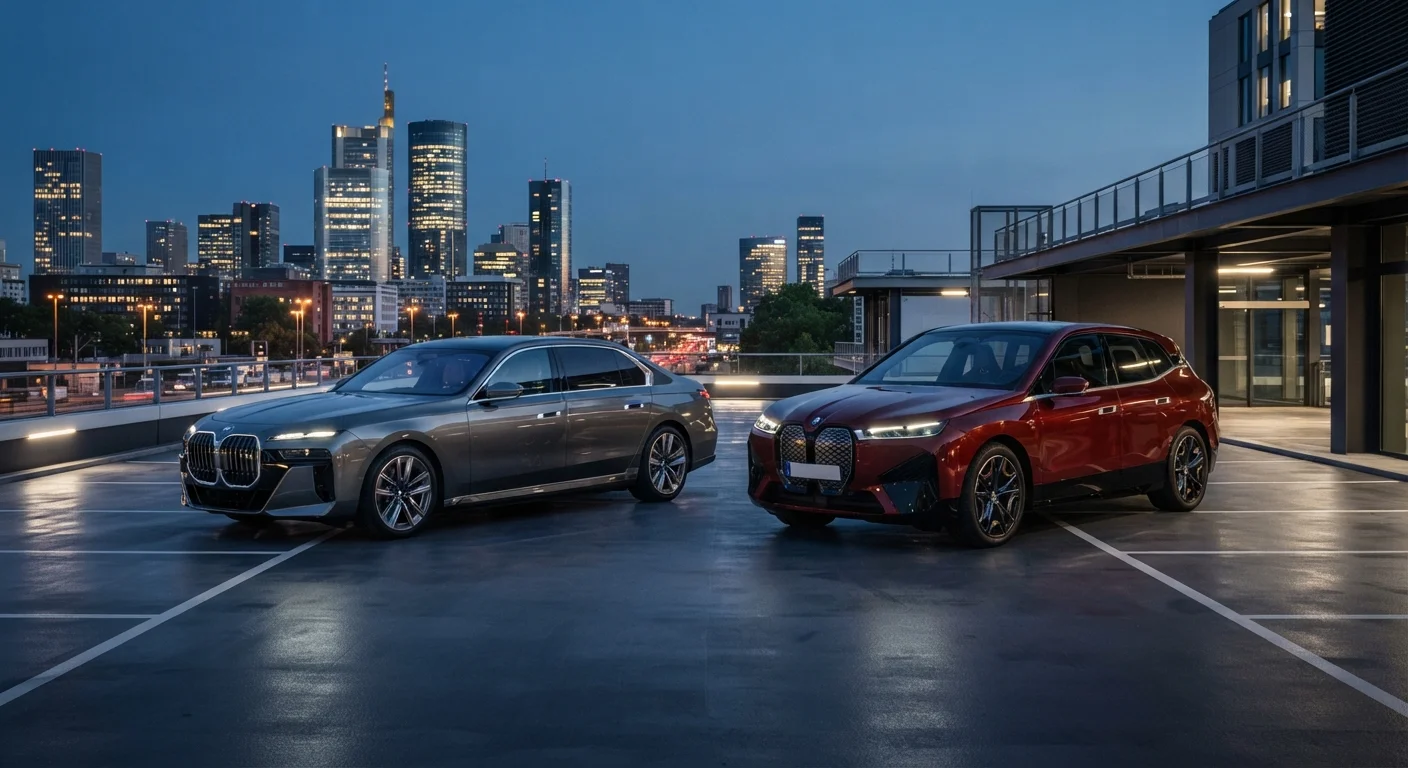
If you’re cross-shopping BMW’s electric range, you’ve probably narrowed it down to two very different choices: the BMW i7 and the BMW iX. Both deliver premium electric performance, advanced technology and a high level of comfort, but they are designed for different needs.
The BMW i7 is a full-size luxury sedan focused heavily on rear-seat comfort, executive travel and high-end features, including its available 31.3-inch BMW Theatre Screen. The BMW iX, meanwhile, is an electric SUV that puts more emphasis on versatility, interior space and everyday practicality.
So, which one makes more sense for you? This guide compares the BMW i7 vs BMW iX across price, range, performance, interior space, cargo capacity, charging and everyday usability, helping you understand the key differences before choosing between these two electric BMWs.
BMW i7 Vs BMW iX
In short: the BMW i7 is a full-size electric saloon aimed at executive and chauffeur use, with a smoother ride and more rear-seat luxury. The BMW iX is an electric SUV with a higher driving position, more everyday practicality, and a slightly lower entry price.
If you want a car to be driven in, choose the i7. If you want a car to drive school run, dog in the boot, occasional off-road track choose the iX.
| Header Label | BMW i7 | BMW iX |
|---|---|---|
| Body style | Full-size executive saloon | Mid-to-large SUV |
| UK price from (approx.) | Low-to-mid £100,000s | Mid £70,000s |
| WLTP range | Roughly 330–450 miles depending on model | Roughly 265–425 miles depending on model |
| Best for | Rear-seat comfort, business use, chauffeuring | Family use, versatility, higher driving position |
| Boot space | Saloon boot, less flexible | SUV-style, more usable with folding seats |
What Are The BMW i7 And BMW iX?
The BMW i7 is a fully electric luxury sedan [6.6], while the BMW iX is a fully electric mid-size SUV [6.6]. Both are flagship electric vehicles from BMW [6.6] designed for zero-emission driving [6.6], but they cater to different styles and needs [6.6].

BMW i7: definition
The BMW i7 is the fully electric version of BMW’s 7 Series, the brand’s flagship saloon. It shares its body with the petrol and plug-in hybrid 7 Series but runs exclusively on battery power, positioning it against the Mercedes-Benz EQS and, at a stretch, the top-end Audi A8 range.
BMW iX: definition
The BMW iX is a standalone electric SUV, built on a bespoke EV platform rather than converted from a combustion model. It sits at the top of BMW’s SUV-style EV line-up, competing with the Mercedes EQE SUV, Audi Q6 e-tron, and Porsche Macan Electric.
Key difference: the i7 was engineered from an existing saloon platform, while the iX was designed as an EV from the ground up. That’s why the iX has a more radical, unconventional design it wasn’t constrained by having to look like a existing petrol car.
Price And UK Trim Levels
Pricing on both cars varies significantly by trim, wheel size and options packs, and BMW UK updates list prices regularly, so always check bmw.co.uk or a dealer for the current on-the-road figure before budgeting.
BMW i7 (approximate UK RRP range):
- Entry-level rear-wheel-drive models start in the low £100,000s
- Mid-range all-wheel-drive versions push toward £130,000–£150,000
- The performance-focused M70 flagship tops the range at around £160,000–£200,000
BMW iX (approximate UK RRP range):
- Entry-level xDrive45 starts in the mid-to-high £70,000s
- The longer-range xDrive60 sits around £95,000–£105,000
- The M60 performance flagship is priced from roughly £115,000–£125,000
Takeaway: even in its cheapest form, the i7 costs more than a well-specced iX. If budget is tight but you still want a flagship BMW EV, the iX is the more attainable route in.
Starting Price Comparison
| Model | Approx. UK price from | Positioning |
|---|---|---|
| BMW iX xDrive45 | ~£75,000 | Entry-level electric SUV |
| BMW i7 eDrive50 | ~£100,000+ | Entry-level electric saloon |
| BMW iX xDrive60 | ~£95,000–£105,000 | Long-range SUV |
| BMW i7 xDrive60 | ~£120,000–£140,000 | Long-range saloon |
| BMW iX M60 | ~£115,000–£125,000 | Performance SUV |
| BMW i7 M70 | ~£160,000+ | Performance saloon flagship |
Range, Battery And Charging Compared

How it works: both cars use large lithium-ion battery packs (roughly 100kWh or more, depending on version) paired with one or two electric motors. Officially quoted WLTP range varies by trim, wheel size and drivetrain:
- BMW i7: official WLTP range typically spans around 330 to 450 miles, depending on the model year, motor configuration and wheel size. Real-world testing from UK motoring publications has generally found actual range noticeably lower than the official figure often by 60 to 100+ miles which is normal for large, heavy premium EVs.
- BMW iX: official WLTP range typically spans around 265 to 425 miles. The entry xDrive45 and performance M60 versions sit toward the lower end, while the xDrive60 offers the longest range in the line-up.
Charging (both models):
- DC rapid charging is available at up to roughly 195kW on most versions, enabling a 10–80% top-up in around 30–35 minutes at a suitably powerful public charger
- Home AC charging via a 7kW wallbox typically takes several hours overnight for a full charge
- Both support three-phase AC charging as an option in some markets, though UK home installs are usually single-phase
Expert tip: Don’t buy on the headline WLTP number alone. UK winter driving, motorway speeds and cabin heating can cut real-world range by 20–30% on both cars. If your typical journey is close to the car’s rated range, step up a trim or battery size for peace of mind.
Performance And Driving Experience
BMW i7: built for comfort first. Air suspension is standard, the ride is notably soft and isolated, and even the quickest M70 version capable of 0–62mph in under four seconds is tuned to feel composed rather than sporty. Road noise is well suppressed, making it an excellent motorway cruiser.
BMW iX: slightly firmer and more SUV-like in its responses, with a higher seating position that many UK buyers prefer for visibility in traffic and on narrower roads. The xDrive50 and M60 versions offer genuinely rapid acceleration, and the lower centre of gravity from the battery pack means it corners flatter than you’d expect from a large SUV.
Verdict: neither car is a traditional “driver’s BMW” in the way a 3 Series is, but the iX feels more engaging through corners, while the i7 is the more relaxing motorway companion.
Interior, Space And Practicality

Both cars are packed with BMW’s latest curved-display infotainment, ambient lighting and driver-assistance technology, including adaptive cruise control, lane-keeping assistance and (on higher trims) semi-automated parking.
BMW i7 practicality:
- Rear legroom is exceptional, and top trims offer reclining rear seats with a large fold-down entertainment screen
- Boot space is generous for a saloon but fixed in shape no folding rear seats on most versions
- Best suited to two adults in the back, or a driver plus one important passenger
BMW iX practicality:
- More usable, flexible boot space with folding rear seats
- Easier to load a pushchair, dog cage or golf clubs
- A more natural family car despite its premium positioning
Takeaway: if you regularly carry bulky items, children’s kit or need flexible boot space, the iX is the more practical everyday choice.
Running Costs In The UK
| Cost area | BMW i7 | BMW iX |
|---|---|---|
| Insurance group | High (executive saloon) | High, slightly lower on entry trims |
| VED (road tax) | Standard EV rate, but the “expensive car” supplement applies to both given their list prices | Same as i7 |
| Company car tax (BiK) | Very low BiK rate as a pure EV a major reason for business uptake | Same low BiK rate as a pure EV |
| Servicing | BMW Service Inclusive packages available; EVs generally cost less to service than combustion equivalents | Same |
| Home charging cost | Lower per-mile cost than petrol/diesel equivalents on a home energy tariff | Same |
| Public rapid charging | Can be significantly more expensive per mile than home charging | Same |
Because both the i7 and iX list at well over £40,000, they attract the UK’s “expensive car” additional rate of Vehicle Excise Duty for several years of ownership worth factoring into your running-cost budget.
For company car drivers, both models’ status as pure EVs makes them highly efficient from a Benefit-in-Kind perspective compared with a petrol or diesel 7 Series or X7.
Reliability And Common Issues
Both cars are relatively young in the used market, so long-term reliability data is still developing. Based on UK owner and dealer feedback to date:
Common i7 talking points:
- Complex tech (multiple screens, driver-assistance systems) means occasional software glitches reported by early owners, most resolved via over-the-air updates
- Very heavy kerb weight (around 2.6–2.8 tonnes) means tyre and brake wear can be higher than a combustion 7 Series
Common iX talking points:
- Early iX models saw some owner reports around infotainment software bugs, again largely addressed through updates
- Panel gaps and unusual exterior styling have drawn criticism, though this is a design preference issue rather than a mechanical one
Signs to watch for on a used example (either model):
- Warning lights relating to the high-voltage battery system
- Reduced indicated range compared with the model’s original rating
- Any evidence of DC rapid-charging damage or a battery replacement in the service history
Solutions: always check the car has a full BMW service history, ask for a battery health report where available, and for used examples verify remaining battery warranty (BMW typically covers the high-voltage battery for 8 years/100,000 miles, whichever comes first, though terms can vary, so confirm directly with BMW UK or a dealer).
Which One Should You Buy?

Choose the BMW i7 if:
- You’re chauffeured, or often carry important passengers in the back
- Motorway comfort and quietness matter more than boot flexibility
- You want the ultimate BMW saloon experience, electrified
Choose the BMW iX if:
- You need genuine day-to-day family practicality
- You prefer a higher driving position and easier visibility
- You want a lower entry price into BMW’s flagship EV technology
Pros and Cons
BMW i7
- Outstanding rear-seat comfort and refinement
- Strong motorway range on higher trims
- Genuine flagship presence
- Very high purchase price
- Less practical boot than an SUV
- Real-world range can fall well short of WLTP figures
BMW iX
- Lower starting price than the i7
- More practical, flexible interior
- Distinctive, tech-forward design
- Divisive exterior styling
- Entry-level range is modest for the price point
- Firmer ride than the i7 on larger wheels
Buying Checklist
Before you commit to either car, work through this checklist:
- Confirm current UK pricing directly with BMW UK or an authorised dealer list prices change
- Test drive both over a realistic mix of motorway and urban roads
- Check real-world range estimates from independent UK reviewers, not just the WLTP figure
- Establish your home charging setup confirm wallbox compatibility and realistic overnight charging times
- Compare finance and leasing quotes, including PCP and business contract hire, since rates vary significantly
- Check battery warranty terms for any used example
- Verify service history and any software update record
- Consider insurance quotes before ordering, as premiums on both cars can be substantial
- Think about boot and rear-seat needs honestly, based on how you actually use a car day-to-day
- Ask about current UK government or company car incentives that may apply to pure EVs
Myths vs Facts
| Myth | Fact |
|---|---|
| Electric BMWs can’t do long journeys. | Higher-trim i7 and iX models offer WLTP ranges above 400 miles, with realistic long-distance capability using the UK’s growing rapid-charging network. |
| The iX is just a smaller i7. | They’re built on entirely different platforms and aimed at different buyers the iX is a purpose-built EV SUV, not a shrunk-down saloon. |
| EVs are always cheaper to run than petrol cars. | They’re usually cheaper on home charging and BiK tax, but public rapid charging can sometimes cost close to petrol on a per-mile basis. |
| All BMW EVs have the same range regardless of trim. | Range varies considerably by battery size, motor configuration and wheel size within each model. |
Maintenance Tips
The BMW i7 and BMW iX need less routine maintenance than petrol cars, but regular care still matters. Proper charging, tyre checks, software updates and battery inspections can help maintain efficiency, safety and long-term reliability:
- Charge to 80% for daily use, reserving 100% charges for long trips, to help preserve long-term battery health
- Use BMW-approved servicing to keep manufacturer warranty cover intact
- Check tyre pressures regularly EVs are heavier, and correct pressures matter for both range and even wear
- Keep software updated via BMW’s over-the-air update system to resolve known infotainment bugs
- Have the high-voltage battery health checked at major services, particularly on used examples nearing the end of their warranty period
Mistakes To Avoid
Choosing between the BMW i7 and iX involves more than comparing range and price. Real-world charging costs, boot space, depreciation and UK tax costs can all affect the overall ownership experience:
- Don’t buy based on brochure range alone always check independent UK real-world test figures
- Don’t skip a home-charging cost calculation public rapid charging costs can catch new EV owners out
- Don’t ignore boot practicality if you have children, pets or hobbies that need space
- Don’t assume used pricing has stabilised depreciation on premium EVs has been steeper than on equivalent petrol models in some cases
- Don’t forget to budget for the “expensive car” VED supplement on both models
Conclusion
The BMW i7 and BMW iX both represent BMW’s flagship electric ambitions, but they serve genuinely different priorities. The i7 is the car you buy to be driven in a quiet, comfortable, tech-laden electric limousine for business and chauffeured use.
The iX is the car you buy to actually live with day to day more practical, slightly more affordable to get into, and better suited to family life. Neither is objectively “better”; the right choice comes down to how you’ll actually use the car.
Call to Action
Still torn between the two? Book a back-to-back test drive at your nearest BMW UK dealer, and take both cars on your usual daily route motorway, town driving and a fast charger stop before deciding. It’s the only way to know which one truly fits your life.
Frequently Asked Questions BMW i7 vs BMW iX
What is the difference between the BMW i7 and BMW iX?
The i7 is a full-size electric saloon built on the 7 Series platform, while the iX is a bespoke electric SUV. The i7 prioritizes rear-seat luxury; the iX prioritizes everyday practicality and versatility.
Which is cheaper, the BMW i7 or BMW iX?
The BMW iX is cheaper to buy, with entry-level pricing typically tens of thousands of pounds below the i7’s starting price in the UK.
How much does a BMW i7 cost in the UK?
UK pricing for the i7 typically starts in the low £100,000s and rises to around £160,000–£200,000 for the flagship M70 version, though prices change over time, so always confirm current figures with BMW UK.
How much does a BMW iX cost in the UK?
The BMW iX typically starts in the mid-to-high £70,000s, rising to around £115,000–£125,000 for the performance M60 version.
What is the real-world range of the BMW i7?
Independent UK testing has generally found real-world range noticeably below the official WLTP figures, which range roughly from 330 to 450 miles depending on trim.
What is the real-world range of the BMW iX?
Similarly, real-world range on the iX tends to fall short of its WLTP figures of roughly 265 to 425 miles, particularly in cold weather or at sustained motorway speeds.
Is the BMW iX more practical than the i7?
Yes. The iX’s SUV body and folding rear seats make it more flexible for luggage, family gear and larger items than the i7’s fixed saloon boot.
Is the BMW i7 worth the extra cost over the iX?
If rear-seat comfort, chauffeured use or outright saloon presence matter to you, many buyers find the extra cost worthwhile. If practicality and value matter more, the iX offers a strong alternative.
Which BMW EV has better company car (BiK) tax rates?
All fully electric BMW vehicles (EVs) share the exact same low Benefit in Kind (BiK) tax rate because BiK for pure electric cars is determined by zero tailpipe emissions (0g/km).
How long does it take to charge a BMW i7 or iX?
Charging a BMW i7 or BMW iX takes about 10 to 11 hours at home using a Level 2 charger, or roughly 30 to 40 minutes to reach an 80% charge at a public DC fast-charging station
Are the BMW i7 and iX reliable?
The BMW i7 and iX show generally good mechanical reliability for daily driving, though both have faced early software glitches and several high-profile recalls.
What is the boot space like on the BMW i7 compared to the iX?
Does the BMW i7 or iX have a bigger battery?
The BMW iX SUV generally has a larger usable battery capacity than the BMW i7 sedan, depending on the specific model year and trim.
Is the BMW iX worth buying used?
A used BMW iX is an exceptional bargain because steep initial depreciation lets you buy a flagship luxury EV for a fraction of its original MSRP.
Which BMW EV suits a family better, the i7 or iX?
The BMW iX suits a family better than the BMW i7 because its SUV body style offers superior cargo versatility, easier passenger loading, and a lower starting price.