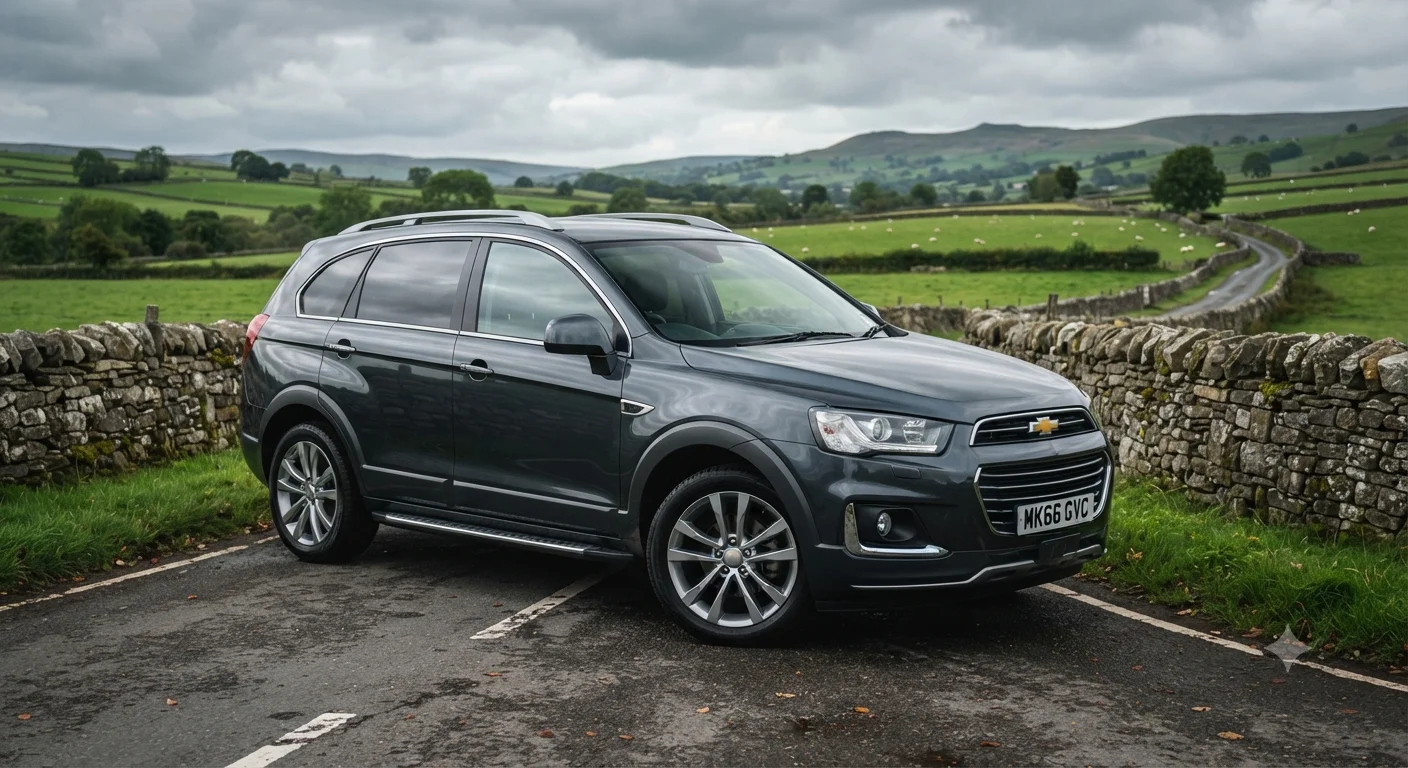
The Chevrolet Captiva is a large seven-seat SUV that once offered UK families a cut-price alternative to the Nissan X-Trail and Kia Sorento. Chevrolet pulled out of the UK car market at the end of 2015, so you won’t find a new Captiva at a dealership. What you will find is a used one usually cheap, usually diesel, and usually in need of a careful pre-purchase check.
This guide explains what the Captiva is, how it drives, which faults to watch for, what it costs to run in the UK today, and whether it’s still a sensible buy in 2026.
What Is the Chevrolet Captiva?

Quick answer: The Chevrolet Captiva is a mid-size, seven-seat SUV built by General Motors between 2006 and 2018, sold in the UK from 2007 until Chevrolet withdrew from the market in 2015.
It was designed as a family-friendly alternative to pricier SUVs, sharing its underpinnings with the Vauxhall/Opel Antara. In the UK, the Captiva was popular with buyers who wanted seven seats, four-wheel drive and a high driving position without paying premium-brand money.
Because Chevrolet no longer sells cars in Britain, every Captiva on UK roads today is a used car. That single fact shapes almost everything in this guide, from parts supply to servicing.
Chevrolet Captiva Generations and Types
Quick answer: UK buyers will mainly come across two versions: the pre-facelift Captiva (2007–2011) and the facelifted Captiva (2011–2015), both offered with petrol or diesel engines and manual or automatic gearboxes.
| Generation | UK Years | Engines | Notable Changes |
|---|---|---|---|
| Pre-facelift | 2007–2011 | 2.0-litre diesel, 2.4-litre petrol | Original styling, softer plastics inside |
| Facelift | 2011–2015 | 2.2-litre diesel (163 or 184PS), 2.4-litre petrol | New front end, upgraded diesel engines, revised interior |
Trim Levels
- LS – entry-level, basic equipment
- LT – mid-range, alloy wheels, better trim
- LTZ – top-spec, leather, climate control, parking sensors
Most used examples for sale in the UK are diesel LTZ automatics, since these were the best sellers when new. If you’re weighing up diesel against petrol, our petrol vs diesel guide breaks down the running-cost differences in more detail.
How The Chevrolet Captiva Works?

Quick answer: The Captiva is a body-on-unibody SUV with either front-wheel drive or switchable four-wheel drive, powered by a diesel or petrol engine driving through a manual or six-speed automatic gearbox.
Four-wheel drive versions can send power to the rear wheels automatically when the front wheels lose grip, which suits UK winter driving on wet or icy roads (see our winter car maintenance guide for seasonal prep tips). The seven-seat layout uses a 60/40 split second row plus a folding third row, giving genuine (if tight) space for two extra passengers or a folded-flat boot for luggage.
Benefits Of The Chevrolet Captiva

Quick answer: Low purchase price, seven-seat practicality, four-wheel drive availability and a commanding driving position are the Captiva’s biggest selling points.
- Affordable entry into SUV ownership – used prices are among the lowest in the seven-seat SUV class
- Practical interior – flexible seating and a large boot with the third row folded
- Four-wheel drive option – useful for rural UK roads and winter conditions
- High driving position – good visibility in traffic
- Decent standard equipment on LTZ trim – leather, climate control and parking sensors were generous for the price when new
Common Problems And Reliability
Quick answer: The Chevrolet Captiva is best known for timing chain wear on both petrol and diesel engines, diesel particulate filter (DPF) blockages, automatic gearbox faults and various electrical niggles.
| Problem Area | Typical Symptom | Affected Versions |
|---|---|---|
| Timing chain | Rattling noise on start-up, rough idle | Both diesel and V6 petrol engines |
| DPF (diesel filter) | Warning light, loss of power, smoky exhaust | 2.0 and 2.2-litre diesel |
| Automatic gearbox | Jerky or delayed gear changes, slipping | Automatic models |
| Electrics | Key sticking in ignition, battery drain, window/lock faults | All model years |
| Corrosion | Bubbling paint around tailgate and trim edges | Older, high-mileage cars |
These are widely reported issues across owner forums and independent used-car reviews, not one-off faults. That doesn’t mean every Captiva will suffer them, but it does mean a thorough check before buying is essential.
Signs, Symptoms And Causes Of Faults
Quick answer: Most Captiva problems trace back to worn timing chains from missed oil changes, DPFs clogged by short journeys, and general age-related wear on a car that’s now over a decade old.
Timing Chain Wear
- Signs: rattling on cold start, engine misfires, check engine light
- Cause: the chain stretches over time, especially if oil changes were skipped or delayed
DPF Blockages
- Signs: DPF warning light, reduced power, black smoke from the exhaust
- Cause: diesel particulate filters need regular high-speed or motorway driving to burn off soot; frequent short trips around town cause blockages
Gearbox Issues
- Signs: hesitant or jerky gear changes, occasional slipping between gears
- Cause: wear in older automatic units, sometimes worsened by irregular fluid changes
Electrical Faults
- Signs: ignition key sticking, sudden battery drain, malfunctioning windows or central locking
- Cause: ageing wiring, connectors and switches common on any car of this age
Solutions and Repair Options
Quick answer: Most Captiva faults are fixable with proper servicing, but because Chevrolet left the UK in 2015, finding a specialist who knows the model (or one familiar with the mechanically similar Vauxhall Antara) makes repairs easier and cheaper.
- Timing chain: replace early at the first sign of noise; ignoring it risks expensive engine damage
- DPF blockages: a forced regeneration or professional clean can often resolve early-stage blockages; persistent problems may need a replacement DPF
- Gearbox faults: a full fluid and filter service can help; persistent slipping usually needs specialist diagnosis
- Electrical faults: an auto-electrician can trace most issues; battery and connector checks are a sensible first step
Because parts and dealer support for the Captiva have thinned out since 2015, some owners use independent garages that also service the Vauxhall/Opel Antara, which shares many components. Our car spare parts comparison and mobile mechanic near me UK guides can help you find the right options.
Chevrolet Captiva Running Costs in the UK
Quick answer: A used Chevrolet Captiva typically costs between roughly £3,000 and £6,000 to buy in the UK in 2026, with insurance, fuel and maintenance costs broadly in line with other ageing seven-seat SUVs.
| Cost Type | Typical UK Range (2026) |
|---|---|
| Used purchase price | £3,000–£6,500 depending on age, mileage and trim |
| Fuel economy (diesel) | Around 35–46 mpg |
| Fuel economy (petrol) | Around 25–30 mpg |
| MOT test | Up to £54.85 (petrol/diesel cars) |
| Annual servicing | £150–£350 depending on garage and work needed |
| Road tax (VED) | Varies by registration date and CO2 band |
Always get an independent inspection before buying, since repair bills on a high-mileage Captiva can quickly outweigh the savings on the purchase price. For more on what the test covers, see our UK MOT test 2026 guide, and check our insurance premium guide for how used SUVs are typically rated.
Maintenance Tips
Quick answer: Regular oil changes, occasional longer motorway drives for diesel models, and prompt attention to warning lights are the best ways to keep a Captiva running reliably.
- Stick to the manufacturer’s oil change intervals, or shorten them if the car does mostly short journeys
- Take diesel models on a regular motorway run to help the DPF regenerate properly
- Listen for chain rattle at cold start and get it checked immediately if you hear it
- Keep the automatic gearbox fluid serviced according to schedule
- Check for early rust bubbling around the tailgate and trim edges
- Test all electrical items (windows, locks, lights) during routine servicing
Buying Guide And Checklist

Quick answer: Choose a facelifted (2011–2015) diesel with full service history, check for timing chain noise and DPF warning lights, and always arrange an independent inspection before you buy.
Buying Checklist
- Full service history, ideally with oil changes on schedule
- No timing chain rattle on cold start
- No DPF warning light (diesel models)
- Smooth, hesitation-free gear changes
- No bubbling paint around the tailgate or trim
- All electrical items working correctly
- Confirmation any relevant recalls have been carried out
- Independent mechanical inspection completed
- Valid MOT with no advisories relating to major components
Which Model to Choose
Facelifted diesel models (2011–2015) with the 163 or 184PS 2.2-litre engine are generally considered a stronger buy than the earlier 2.0-litre diesel, thanks to a more refined and slightly improved engine.
Mistakes to Avoid
Quick answer: The most common mistakes are skipping an inspection, ignoring engine noise, buying a neglected diesel with heavy town use, and underestimating parts and repair costs since Chevrolet left the UK.
- Buying without an independent mechanical check
- Ignoring a rattling engine at cold start
- Choosing a diesel that’s only ever done short trips
- Assuming parts will be as easy to source as for a current Vauxhall or Ford
- Overlooking service history in favour of a slightly cheaper price
Pros And Cons
| Pros | Cons |
|---|---|
| Low purchase price | Chevrolet no longer supports the UK market |
| Seven-seat practicality | Known timing chain and DPF issues |
| Four-wheel drive available | Parts availability can be patchy |
| Spacious, comfortable interior | Weak resale value |
| Simple, easy-to-drive controls | Below-average reliability reputation |
Myths Vs Facts
| Myth | Fact |
|---|---|
| “All Captivas have the same problems” | Reliability varies by engine, year and how well the car was maintained |
| “Diesel is always cheaper to run” | Diesel DPF issues can add unexpected repair costs, especially with town driving |
| “You can’t get parts for a Captiva anymore” | Parts are harder to find than for current models, but independent suppliers and Antara cross-compatibility help |
| “The facelift and pre-facelift are identical” | The facelifted 2.2-litre diesel is a meaningfully different, generally improved engine |
Chevrolet Captiva Vs Rivals
| Model | Seats | Typical Used Price (UK) | Reputation |
|---|---|---|---|
| Chevrolet Captiva | 7 | £3,000–£6,500 | Budget price, below-average reliability |
| Nissan X-Trail | 5–7 | £6,000–£15,000 | Strong reliability, higher price |
| Kia Sorento | 7 | £6,000–£16,000 | Long warranty history, solid reputation |
| Hyundai Santa Fe | 7 | £6,000–£16,000 | Well-regarded, better resale value |
The Captiva’s main advantage over these rivals is price. If reliability and long-term ownership costs matter more than upfront savings, a Kia Sorento or Hyundai Santa Fe of similar age is generally a safer bet.
Conclusion
The Chevrolet Captiva can still make sense in 2026 for buyers who want cheap seven-seat practicality and are realistic about its age, its known faults, and the fact that Chevrolet no longer operates in the UK. Choosing a well-documented, facelifted diesel and paying for an independent inspection are the two things that matter most. Skip those steps, and the Captiva’s low price can disappear quickly into repair bills.
Call to Action
Thinking about buying a used Chevrolet Captiva? Get an independent inspection booked before you commit, and compare it against similar seven-seat SUVs to make sure you’re getting the right car for your budget.
Frequently Asked Questions
What is the Chevrolet Captiva?
The Chevrolet Captiva is a seven-seat SUV built by General Motors and sold in the UK from 2007 to 2015, before Chevrolet withdrew from the UK market.
Is the Chevrolet Captiva still sold new in the UK?
No. Chevrolet stopped selling cars in the UK at the end of 2015, so all Captivas available in Britain today are used.
How much does a used Chevrolet Captiva cost in the UK?
Prices typically range from around £3,000 to £6,500 depending on age, mileage, trim and condition.
Is the Chevrolet Captiva reliable?
It has a below-average reliability reputation, with known issues including timing chain wear, DPF blockages and automatic gearbox faults, though well-maintained examples can still perform well.
Is the Chevrolet Captiva worth buying in 2026?
It can be worth buying if you find a well-documented example and budget for an independent inspection, but buyers wanting stronger reliability may prefer a Kia Sorento or Nissan X-Trail.
What engines were available in the Chevrolet Captiva?
The Captiva was sold with a 2.0-litre diesel, a 2.2-litre diesel (post-2011 facelift), and a 2.4-litre petrol engine.
Does the Chevrolet Captiva have four-wheel drive?
Yes, four-wheel drive was available alongside front-wheel-drive versions.
What are the most common Chevrolet Captiva problems?
Timing chain wear, diesel particulate filter (DPF) blockages, automatic gearbox faults and general electrical issues are the most commonly reported problems.
How many seats does the Chevrolet Captiva have?
The Captiva seats up to seven people, with a folding third row.
Is it hard to find parts for a Chevrolet Captiva in the UK?
Parts are harder to source than for current models since Chevrolet left the UK, though independent suppliers and shared components with the Vauxhall/Opel Antara help.
What should I check before buying a used Chevrolet Captiva?
Check for timing chain noise, DPF warning lights, smooth gear changes, rust around the tailgate, full service history, and arrange an independent inspection.
What is Chevrolet Captiva fuel economy like?
Diesel models typically return around 35–46 mpg, while petrol versions return around 25–30 mpg.
Why did Chevrolet leave the UK market?
Chevrolet’s parent company, General Motors, restructured its European operations and withdrew the Chevrolet brand from the UK and most of Europe at the end of 2015 to focus on Opel/Vauxhall.
Is the diesel or petrol Chevrolet Captiva better?
The diesel is more common and generally more fuel-efficient, but it comes with DPF-related risks if mostly used for short journeys; the petrol avoids DPF issues but uses more fuel.
How much is Chevrolet Captiva insurance in the UK?
Insurance costs vary by driver, location and cover level, but as an ageing budget SUV, the Captiva typically sits in a mid-range insurance group rather than at the expensive end.