If you drive in the UK, you’ll use a parking lot almost every single day whether it’s outside a supermarket, at work, or in a multi-story in the city center. Yet most drivers never think about how these spaces are designed, priced, regulated or maintained until something goes wrong: a dent from a badly parked car, a surprise parking charge notice, or confusion over disabled bay rules.
This guide breaks down everything you need to know about a parking lot in the UK what it is, the different types you’ll come across, typical costs, common problems, safety tips and the mistakes most drivers make. It’s written in plain English so it’s useful whether you’re a new driver or you’ve been on the road for decades.
What Is A Parking Lot?

Quick answer: A parking lot (called a “car park” in most UK signage) is a designated outdoor or indoor area where vehicles are left temporarily or long-term, marked with individual bays for organised, safe parking.
In the UK, you’ll more commonly hear “car park” than “parking lot,” but they mean exactly the same thing. A parking lot can be.
- Surface-level (open-air, tarmac or gravel)
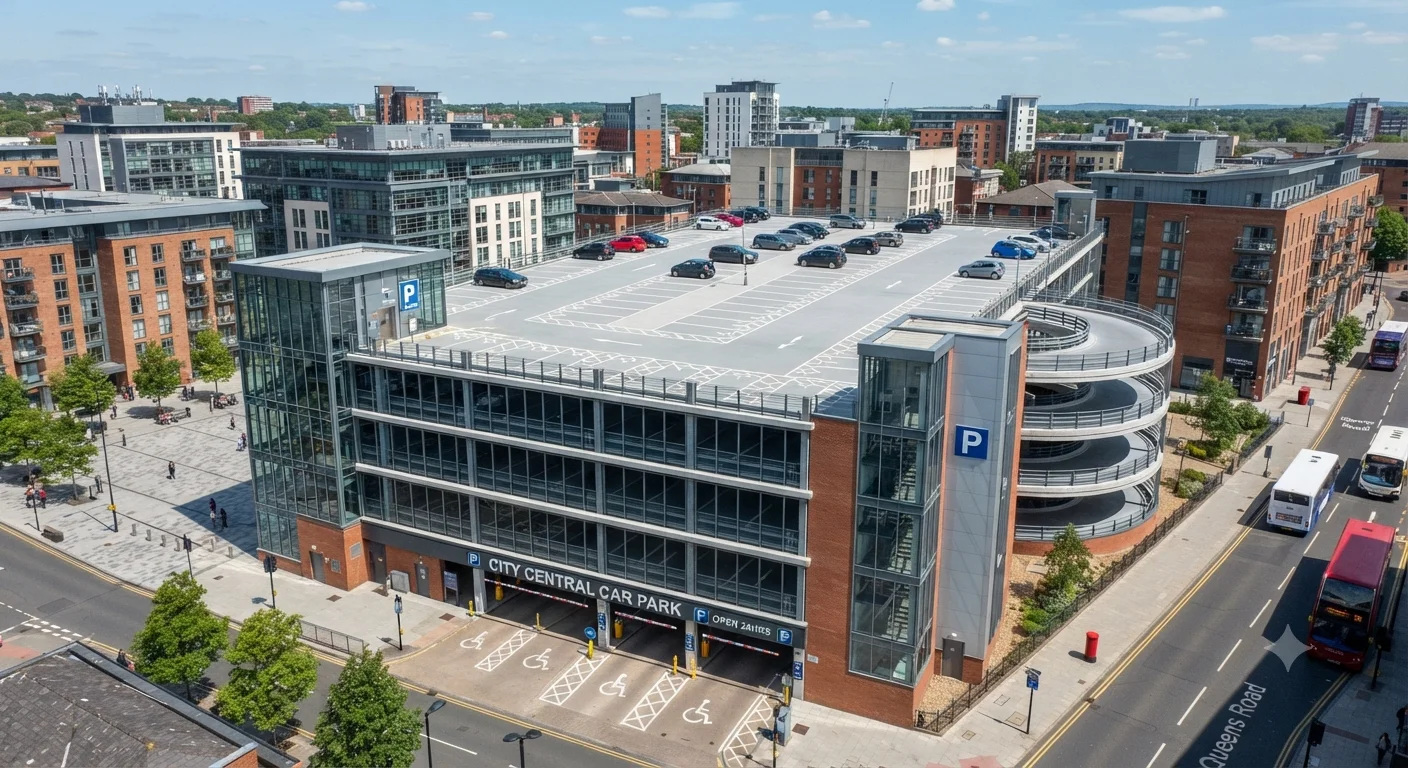
- Multi-storey (several levels stacked vertically)
- Underground (beneath a building or shopping centre)
Every parking lot is designed with marked bays, access routes, and often payment machines or barrier systems to manage who comes in and out.
How A Parking Lot Works?
Quick answer: Most UK parking lots operate on a pay-and-display, ANPR (Automatic Number Plate Recognition), or barrier-entry system, charging by the hour or offering flat daily rates.
Here’s the typical flow for a pay-and-display or ANPR car park.
- Entry – You drive in through an open entrance or barrier.
- Camera capture – ANPR cameras photograph your number plate on entry.
- Parking – You park in any available marked bay.
- Payment – You pay via machine, app, or phone before leaving (or on exit for barrier systems).
- Exit – ANPR checks your plate against payment records, or a barrier lifts once a ticket is validated.
Council-run car parks, supermarket car parks, and private operators (like NCP or Q-Park) all use variations of this system.
Types Of Parking Lot In The UK

Quick answer: The main types are surface car parks, multi-storey car parks, underground car parks, park and ride facilities, and residential or workplace parking.
| Type | Typical Location | Best For |
|---|---|---|
| Surface car park | Supermarkets, retail parks | Quick, short stays |
| Multi-storey car park | City centres | High-density urban parking |
| Underground car park | Shopping centres, offices | Weather protection, security |
| Park and Ride | Edge of towns/cities | Avoiding city centre traffic and charges |
| Residential parking | Housing estates, driveways | Long-term, overnight parking |
| Workplace car park | Business parks, offices | Staff parking during work hours |
Disabled and Accessible Bays

All UK parking lots with more than a handful of spaces are expected to provide clearly marked disabled bays, positioned close to entrances, in line with Blue Badge scheme guidance. These bays are wider to allow wheelchair access and should never be used without a valid Blue Badge displayed.
EV Charging Bays

With electric vehicle uptake rising steadily, most modern parking lots now include EV charging bays, often positioned near the entrance with dedicated charge points. Some councils reserve these exclusively for charging, with penalties for non-EVs parking there.
Benefits Of Well-Designed Parking Lots
Quick answer: A good parking lot improves safety, reduces congestion, supports local business, and makes accessible parking possible for disabled and elderly drivers.
- Safety – Clear markings and lighting reduce accidents and theft.
- Traffic flow – Organised bays prevent chaotic, blocked roads.
- Accessibility – Dedicated bays support disabled and elderly drivers.
- Business support – Retail and hospitality venues benefit from convenient customer parking.
- Environmental planning – Modern lots increasingly include EV points and drainage systems to manage rainwater.
Common Problems In Parking Lots

Quick answer: The most common issues are potholes, faded line markings, poor drainage, inadequate lighting, and vehicle damage from other drivers.
- Potholes and cracked surfacing
- Faded or missing bay markings
- Standing water from poor drainage
- Broken or flickering lighting
- Car park scrapes, dents and door dings
- Overcrowding during peak hours
- Malfunctioning payment machines or barriers
Signs Of A Poorly Maintained Parking Lot
Quick answer: Watch for cracked tarmac, pooling water, unclear bay lines, dim lighting, and broken kerbs all signs a car park needs urgent maintenance.
If you manage or use a car park regularly, these warning signs suggest maintenance is overdue.
- Visible cracks spreading across the surface
- Puddles that don’t drain within a few hours of rain
- Bay lines that are hard to see, especially at night
- Dead or flickering overhead lights
- Loose gravel or broken kerb stones
- Rusting or damaged barrier equipment
Causes Of Parking Lot Damage
Quick answer: Weather, heavy footfall, poor original construction, tree root growth, and lack of routine resurfacing are the leading causes of parking lot damage in the UK.
- UK weather – Frost, rain and freeze-thaw cycles are especially harsh on tarmac surfaces.
- Vehicle weight – Constant heavy traffic, particularly from vans and lorries, wears surfaces down faster.
- Poor drainage design – Water pooling weakens the sub-base over time.
- Tree roots – Roots beneath the surface can crack tarmac from below.
- Age – Most surface car parks need resurfacing every 15–20 years.
Suggestion
Rough surfaces and potholes can also affect your suspension over time worth keeping in mind before your next MOT test.
Solutions and Repair Options
Quick answer: Common repair options include pothole patching, full resurfacing, line remarking, drainage improvements and lighting upgrades.
| Problem | Repair Option |
|---|---|
| Potholes | Cold or hot asphalt patching |
| Faded lines | Thermoplastic or paint remarking |
| Poor drainage | New drainage channels, gully repairs |
| Cracking | Surface dressing or full resurfacing |
| Dim lighting | LED lighting upgrades |
| Broken barriers | Mechanical servicing or replacement |
For minor damage like a small pothole or scuffed lines, patch repairs are usually enough. For a car park older than 15 years with widespread cracking, full resurfacing tends to be more cost-effective long-term than repeated patch jobs.
Cost of Parking in the UK

Quick answer: UK parking costs vary widely expect roughly £1–£3 per hour in most towns, £4–£8 per hour in major city centers, and £15–£30+ for a full day in London.
| Location Type | Typical Hourly Cost | Typical Daily Cost |
|---|---|---|
| Small town car park | £0.80–£1.50 | £4–£8 |
| Supermarket car park | Free (time-limited) | Free (time-limited) |
| City centre car park | £3–£6 | £15–£25 |
| Central London car park | £6–£10+ | £30–£50+ |
| Airport parking (pre-booked) | N/A | £8–£20 |
| Park and Ride | N/A | £3–£6 (plus bus fare) |
Costs shown are general 2026 estimates and can vary by operator, location and demand always check signage or the operator’s app before parking.
Parking Lot Maintenance Tips

Quick answer: Regular sweeping, prompt pothole repairs, repainting faded lines every 2–3 years, and clearing drains after autumn leaf fall keep a parking lot safe and functional.
- Inspect the surface for cracks or potholes every few months
- Repaint bay lines every 2–3 years, or sooner if heavily worn
- Clear drains and gullies regularly, especially in autumn
- Service barriers and payment machines quarterly
- Check lighting fortnightly, especially in winter
- Trim nearby trees to prevent root damage and leaf litter
Buying Or Leasing A Parking Space: A Quick Guide
Quick answer: When buying or renting a parking space in the UK, check ownership rights, access hours, security features, and whether it’s freehold, leasehold, or a simple rental licence.
If you’re considering purchasing or renting a dedicated parking space (common in cities like London, Manchester or Edinburgh), check.
- Ownership type – Freehold, leasehold, or licence to use
- Access – 24/7 or restricted hours
- Security – CCTV, gated access, lighting
- Location – Proximity to your home or workplace
- Running costs – Service charges or ground rent, if leasehold
- Insurance – Whether the space is covered under your car insurance policy terms
Mistakes To Avoid When Parking
Quick answer: Avoid parking over the lines, ignoring time limits, ignoring disabled bay rules, and forgetting to display valid tickets or permits.
- Parking across two bays or over the line
- Overstaying the paid or free time limit
- Parking in a disabled bay without a Blue Badge
- Blocking EV charging bays without charging
- Leaving valuables visible inside the car
- Forgetting to note your bay number in large multi-storeys
- Ignoring “resident permit only” signage
Expert Tips For Stress-Free Parking

- Take a photo of your bay number and floor level in multi-storey car parks
- Use official apps (like RingGo or PayByPhone) to top up time remotely and avoid overstay fines
- Park under working lights in the evening for visibility and safety
- Reverse into a bay where possible for a quicker, safer exit
- Check the operator’s terms before parking private car park fines can be pursued even on private land
Parking Lot Comparison Table
| Feature | Surface Car Park | Multi-Storey | Underground |
|---|---|---|---|
| Weather protection | None | Partial | Full |
| Typical cost | Lower | Medium | Medium–High |
| Security | Variable | CCTV common | Usually high |
| Accessibility | Easy | Ramps/lifts needed | Ramps/lifts needed |
| Space efficiency | Low | High | High |
Parking Checklist
Before you leave your car in any parking lot:
- Ticket displayed or payment confirmed via app
- Doors locked and windows closed
- Valuables out of sight
- Handbrake applied (and gear engaged for manual cars)
- Bay number and level noted
- Not blocking another vehicle, exit, or disabled bay
Pros And Cons Of Different Parking Lots
Surface Car Parks
- ✔ Cheaper, easy in-and-out access
- ✘ No weather protection, often further from entrances
Multi-Storey Car Parks
- ✔ Space-efficient, central locations
- ✘ Tighter bays, can feel less secure at night
Underground Car Parks
- ✔ Weather protection, often better security
- ✘ Can be claustrophobic, sometimes pricier
Myths vs Facts
| Myth | Fact |
|---|---|
| “Private car park fines aren’t legally enforceable.” | They can be pursued through civil courts if signage and contract terms are clear. |
| “You can always park in a disabled bay for a couple of minutes.” | Enforcement can apply immediately in many car parks, regardless of duration. |
| “Supermarket parking is always completely free.” | Many now use ANPR with time limits, and overstaying can trigger a charge. |
| “Multi-story car parks are always more expensive than surface ones.” | Pricing depends more on location and demand than the type of car park. |
Frequently Asked Questions
What is a parking lot?
A parking lot, known in the UK as a car park, is a marked area where vehicles are parked temporarily or long-term, either outdoors or in a multi-story or underground structure.
How much does parking cost in the UK?
Costs typically range from around £1 an hour in small towns to £6–£10+ an hour in central London, with daily rates often between £4 and £50 depending on location.
Is parking free at UK supermarkets?
Many supermarket car parks offer free parking within a set time limit (commonly 2–3 hours), but overstaying can result in a parking charge notice from the operator.
Can I challenge a parking charge notice?
Yes. You can appeal directly with the operator, and if unsuccessful, escalate to an independent appeals service such as POPLA for many private car parks.
What’s the difference between a car park and a parking lot?
Nothing functionally “car park” is the British English term, while “parking lot” is the American English term for the same type of facility.
Do I need a Blue Badge to use a disabled parking bay?
Yes, a valid Blue Badge must be clearly displayed to use a designated disabled parking bay legally.
How do ANPR car parks work?
Cameras photograph your number plate on entry and exit, and payment is matched against your plate rather than requiring a physical ticket in some systems.
Is it safe to leave valuables in my car in a parking lot?
It’s best practice to remove or hide valuables, as visible items increase the risk of break-ins, particularly in poorly lit or unmonitored car parks.
How often should a car park be resurfaced?
Most surface car parks need resurfacing roughly every 15–20 years, though this depends on traffic volume and weather exposure.
Can I park in an EV charging bay if I’m not charging?
Generally no. Many car parks and councils enforce rules restricting these bays to actively charging electric vehicles, with fines for misuse.
What should I do if my car is damaged in a parking lot?
Take photos immediately, note the time, check for CCTV coverage, and report it to the car park operator or, if another vehicle is involved, exchange details if possible.
Are multi-story car parks safe at night?
Most are equipped with CCTV and lighting, but it’s still wise to park near well-lit areas, stay alert, and use marked pedestrian routes.
What is Park and Ride?
Park and Ride schemes let drivers park on the edge of a town or city and take a bus into the center, reducing congestion and often costing less than central parking.
Do parking lot fines expire?
Unpaid parking charge notices can escalate and, in some cases, be pursued through debt recovery or small claims processes, so it’s best to deal with them promptly rather than ignore them.
Can businesses be held liable for potholes in their car park?
Yes, if a vehicle or pedestrian is injured due to poor maintenance and the business failed to address a known hazard, liability claims can arise.
Conclusion
A parking lot might seem like a simple stretch of tarmac, but as this guide shows, there’s a lot going on beneath the surface literally and figuratively. From understanding the different types of car park and how pricing works, to knowing your rights around parking charge notices and disabled bays, being informed makes parking safer, cheaper and far less stressful.
Whether you’re parking at the supermarket for twenty minutes or leasing a dedicated space in the city, the basics stay the same: check the signage, know the cost, park considerately, and keep an eye out for maintenance issues that could affect your vehicle.
Call to Action
Got a parking question we haven’t covered, or dealing with a parking charge dispute? Drop a comment below or get in touch and don’t forget to check out our related guides on UK car maintenance and driving essentials.