Quick answer: Double white lines mark the center of UK roads under Rules 128–129 of the Highway Code. If the line nearest your side is broken, you may overtake when safe. If it’s solid, you must not cross it except to pass a stationary vehicle, enter a side road, or overtake a cyclist, horse, or road maintenance vehicle doing 10 mph or less. Crossing illegally carries 3 penalty points and a fixed penalty fine (offence code TS20).
Double white lines are one of the most misunderstood road markings in the UK and one of the easiest ways to pick up 3 penalty points without realizing you’ve done anything wrong. If you’ve ever slowed down behind a cyclist or a tractor and wondered whether it’s actually legal to nudge past, this guide answers that and everything else the Highway Code says about them.
What Are Double White Lines?
Double white lines are two parallel lines painted along the centre of the road, used to control overtaking on stretches where visibility is limited or where crossing to the other side is dangerous.
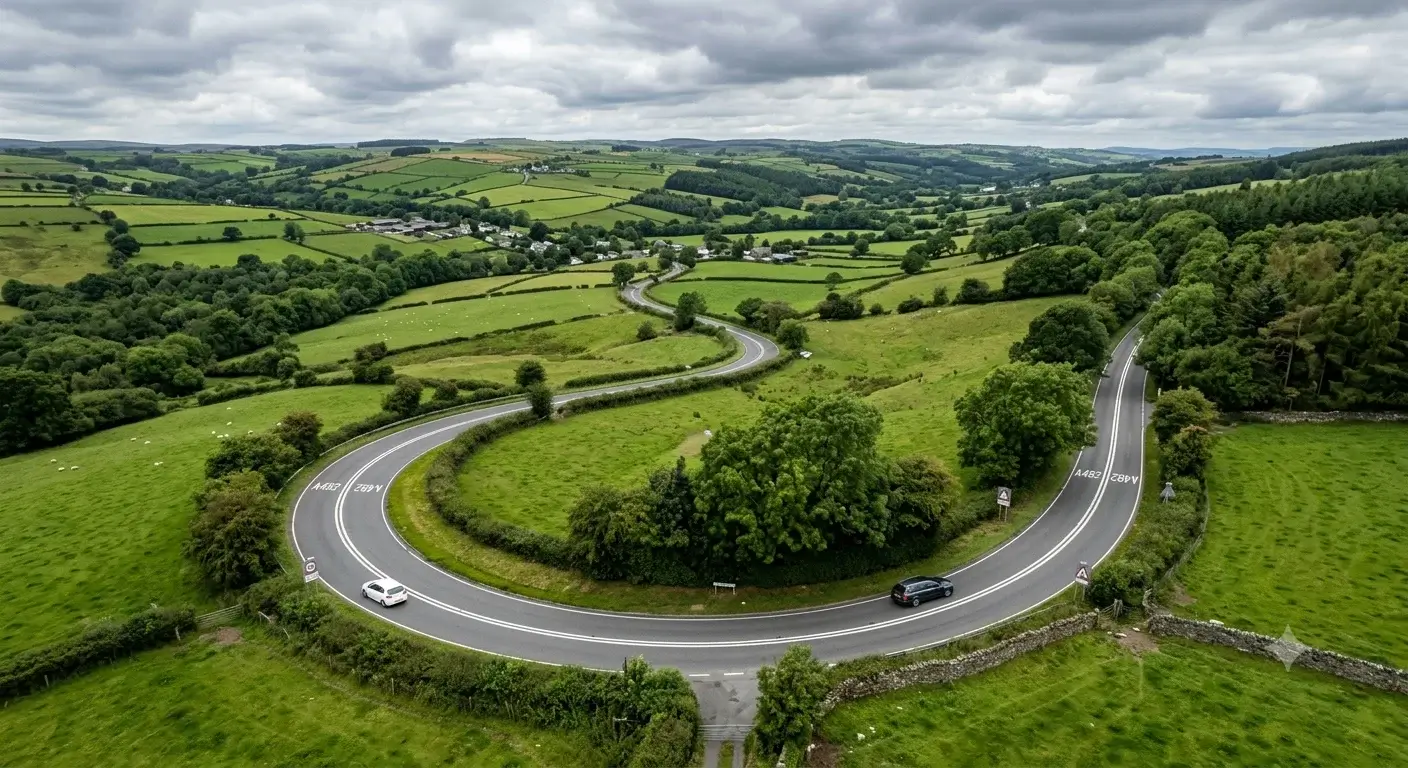
They appear on rural A-roads, winding country lanes, and dual-use routes across the UK, typically at bends, brows of hills, and approaches to junctions where oncoming traffic can’t be seen in time to overtake safely.
Double white lines are covered by Rules 128 and 129 of the Highway Code, and they carry legal force under the Road Traffic Act 1988 (Section 36) and the Traffic Signs Regulations and General Directions (TSRGD) 2016. That means ignoring them isn’t just poor driving it’s a road traffic offence.
Quick definition: Double white lines mark the centre of the road and tell you whether overtaking is permitted at that point, depending on which line is solid and which is broken.
How Double White Lines Work?

The system works on a simple principle: the line closest to your side of the road tells you what you’re allowed to do.
- If the line nearest you is broken, you may cross to overtake when it’s safe.
- If the line nearest you is solid, you must not cross or straddle it, except in specific permitted circumstances.
This means two vehicles travelling in opposite directions on the same stretch of double white lines can have different rules applying to them at the same moment one driver might be legally allowed to overtake while the oncoming driver is not.
Local authorities set these markings based on visibility surveys, accident data, and road geometry, so a double white line system on one road may look slightly different from another depending on where visibility genuinely opens up.
Types of Double White Line Markings

| Marking Type | What It Looks Like | What It Means |
|---|---|---|
| Broken line nearest you | Dashes on your side, solid line on the far side | You may overtake if safe (Rule 128) |
| Solid line nearest you | Continuous line on your side | You must not cross except in permitted cases (Rule 129) |
| Both lines solid | Two continuous lines | No overtaking from either direction |
| Hazard warning line | A single broken line that lengthens and gaps shorten | Hazard ahead — don’t overtake unless the road is clearly clear |
Double Solid White Line
A double solid white line (both lines continuous) is the strictest version. Neither direction of traffic may cross it to overtake, no matter how clear the road looks. This is typically used on the most dangerous stretches sharp bends, blind brows, or narrow sections with no safe passing distance.
When You Can Legally Cross Them?

You may cross a solid white line nearest to you in four specific situations, provided it’s safe to do so.
- To enter or exit a property, side road, or junction
- To pass a stationary vehicle
- To overtake a cyclist, horse, or road maintenance vehicle travelling at 10 mph or less
- When the line nearest you is broken and you’re overtaking safely
You must always be able to complete the manoeuvre and return to your side of the road before reaching any solid section again, and you must have a clear, unobstructed view of the road ahead.
Step-by-Step: Safely Overtaking on a Broken Line
- Check the line nearest to you is broken, not solid
- Confirm you have a clear view well ahead no bends, brows, or junctions obscuring oncoming traffic
- Signal your intention in good time
- Check mirrors and blind spots
- Complete the overtake decisively, keeping within the broken section
- Return to your lane before the line becomes solid again
When You Must Not Cross Them?
You must not cross or straddle a solid white line nearest to you simply to overtake a moving vehicle that isn’t a cyclist, horse rider, or slow road maintenance vehicle. This applies even if the road looks completely empty the marking exists precisely because sightlines at that point are unreliable, often due to a bend or dip that isn’t obvious from inside the car.
You also must not stop or park on a road marked with double white lines, except in a genuine emergency or breakdown, because doing so blocks the carriageway on a stretch specifically designated as unsafe for slow manoeuvres.
Penalties, Fines And Points

| Offence | Penalty |
|---|---|
| Crossing/straddling solid double white lines illegally | 3 penalty points and a fixed penalty fine |
| Offence code | TS20 – Failing to comply with double white lines |
| Points validity | Stay on your licence for 4 years from the offence date |
| Contested cases | Can proceed to court, with higher fines possible |
If you’re a new driver within two years of passing your test, accumulating 6 points from any combination of offences including this one results in your license being revoked under the New Drivers Act, meaning you’d need to retake both your theory and practical tests. Check current fine amounts on the GOV.UK penalty points guidance before publishing, as fixed penalty amounts are periodically revised.
Common Mistakes Drivers Make
- Assuming an empty road means it’s safe to cross a solid line. The line exists because visibility is deceptive at that exact spot, not because a human checked and found the road always busy.
- Overtaking a cyclist at speed on a solid line. The 10 mph exception only applies if the cyclist themselves is travelling at 10 mph or less not if you’re simply going slowly.
- Confusing hazard warning lines with double white lines. A single broken line with longer dashes and shorter gaps is a hazard warning, not an invitation to overtake.
- Not checking which line is on your side. Drivers sometimes glance at the far line rather than the one nearest to their own lane.
- Stopping to check a map or phone on double white line sections. These are almost always no-stopping zones by design.
Double White Lines vs Other Road Markings
| Marking | Meaning | Can You Cross? |
|---|---|---|
| Single broken white line | Centre line, normal road | Yes, when safe |
| Double white line (broken nearest you) | Overtaking zone | Yes, when safe |
| Double white line (solid nearest you) | Restricted overtaking | Only in permitted exceptions |
| Double solid white line (both sides) | High-risk zone | No, from either direction |
| Double yellow lines | Parking/waiting restriction | Not a driving-lane marking relates to stopping, not overtaking |
| Chevrons/diagonal stripes (Rule 130) | Traffic separation or right-turn protection | Avoid entering unless bordered by broken white line and necessary |
Expert Tips for Driving Near Double White Lines
- Read the road, not just the paint. Double white lines are placed where a bend, dip, or junction genuinely hides oncoming traffic treat the marking as confirmation of a real hazard, not a bureaucratic inconvenience.
- Plan overtakes well before the solid section begins. Rushing a manoeuvre as the broken line is about to end is a leading cause of head-on near-misses on rural A-roads.
- Be patient behind farm vehicles and cyclists. On solid double white lines, you’re legally required to wait until either the road opens into a broken section or the slower road user pulls over.
- In wet or low-light conditions, treat all double white lines as solid. Reduced grip and visibility erode your margin for error even where overtaking is technically permitted.
- Check your mirrors for tailgaters before slowing for a cyclist. A common cause of rear-end collisions on these roads is a following driver misjudging why you’ve slowed down.
Double White Lines And The Driving Test

Examiners specifically watch for how learners respond to double white lines, particularly on rural test routes. Crossing a solid line without a valid reason even briefly, even without incident is typically marked as a serious or dangerous fault, which results in an automatic test failure.
If you’re approaching a stretch of double white lines and you’re unsure which side is solid, the safest test-day approach is simple: assume you cannot overtake unless you can clearly confirm the broken line is on your side.
Myths vs Facts
| Myth | Fact |
|---|---|
| “It’s fine to cross if there’s no other traffic in sight.” | You may only cross a solid line in the specific permitted circumstances an empty road isn’t one of them. |
| “Double white lines only apply to cars.” | They apply to all motor vehicles, including motorcycles. |
| “You can stop on double white lines briefly to check directions.” | Stopping is prohibited except for a genuine emergency or breakdown. |
| “The 10 mph cyclist rule means you can overtake any slow-moving vehicle.” | It specifically covers cyclists, horses, and road maintenance vehicles, not general slow traffic. |
| “Double white lines and double yellow lines mean the same thing.” | White lines govern overtaking; yellow lines govern parking and waiting. |
Checklist Before You Overtake
- Is the line nearest to me broken, not solid?
- Can I see far enough ahead to complete the overtake safely?
- Is the vehicle ahead a cyclist, horse, or road maintenance vehicle travelling at 10 mph or less (if the line is solid)?
- Will I return to my lane before the line becomes solid again?
- Are conditions (light, weather, road surface) good enough to overtake safely?
- Have I checked mirrors and blind spots?
Frequently Asked Questions
What do double white lines mean?
Double white lines mark the center of the road and control overtaking. The line nearest your side of the road tells you whether you’re permitted to cross it broken means you may overtake when safe, solid means you generally may not.
What is the rule for double white lines?
Rule 129 of the Highway Code says you must not cross or straddle a solid white line nearest to you unless it’s safe and necessary to enter a side road or property, pass a stationary vehicle, or overtake a cyclist, horse, or slow road maintenance vehicle at 10 mph or less.
Can you overtake on double white lines?
Only if the line nearest to your side is broken, or if one of the specific exceptions applies to a solid line such as passing a stationary vehicle or a cyclist travelling at 10 mph or less.
What happens if you cross double white lines illegally?
You can receive 3 penalty points and a fixed penalty fine under offence code TS20. Points remain on your license for 4 years.
Is it illegal to cross a solid white line?
It is illegal to cross a solid white line on your side of a double white line system except in the permitted circumstances set out in Rule 129.
Do double white lines apply to motorbikes?
Yes, the rules apply equally to motorcyclists as they do to car and van drivers.
What is the difference between a single and double white line?
A single broken line simply marks the center of a normal two-way road with no special overtaking restriction. Double white lines specifically indicate a stretch where overtaking is restricted or controlled due to limited visibility.
Can you cross double white lines to overtake a cyclist?
Yes, if the cyclist is travelling at 10 mph or less and it’s safe to do so, even where the line nearest you is solid.
What does it mean when both lines are solid?
Neither direction of traffic may overtake at that point it’s used on the highest-risk stretches of road.
Can you stop on double white lines?
No, stopping or parking on a road marked with double white lines is prohibited except in a genuine emergency.
How many points do you get for crossing double white lines?
Three penalty points, under offence code TS20, alongside a fixed penalty fine.
Do double white lines mean no overtaking at all?
Not necessarily it depends on which line is nearest to you. Only a solid line nearest your side (or both lines solid) restricts overtaking.
What’s the difference between double white lines and double yellow lines?
Double white lines control overtaking on the carriageway. Double yellow lines are a parking and waiting restriction and have no bearing on overtaking.
Can new drivers lose their license for crossing double white lines?
Yes under the New Drivers Act, 6 points within two years of passing your test leads to license revocation, and 3 points from this offence would count towards that total.
Why are double white lines used instead of a single line?
They’re used on roads where a local authority’s visibility assessment shows that safe overtaking distance isn’t consistently available, giving drivers a clearer, more specific signal than a standard center line.
Conclusion
Double white lines exist because someone has already assessed that stretch of road and found the sightlines aren’t reliable enough for casual overtaking. Reading which line sits nearest your side broken or solid tells you everything you need to know about what’s legally permitted at that exact point. Get it wrong and you’re not just risking a head-on collision with a vehicle you never saw coming; you’re also looking at 3 penalty points and a fine that stays on your record for years.
Call to Action: Brushing up on your Highway Code road markings before your next test or long drive? Bookmark this guide and share it with any learner drivers in your life it could save them a serious fault on test day, or worse, on the road itself.