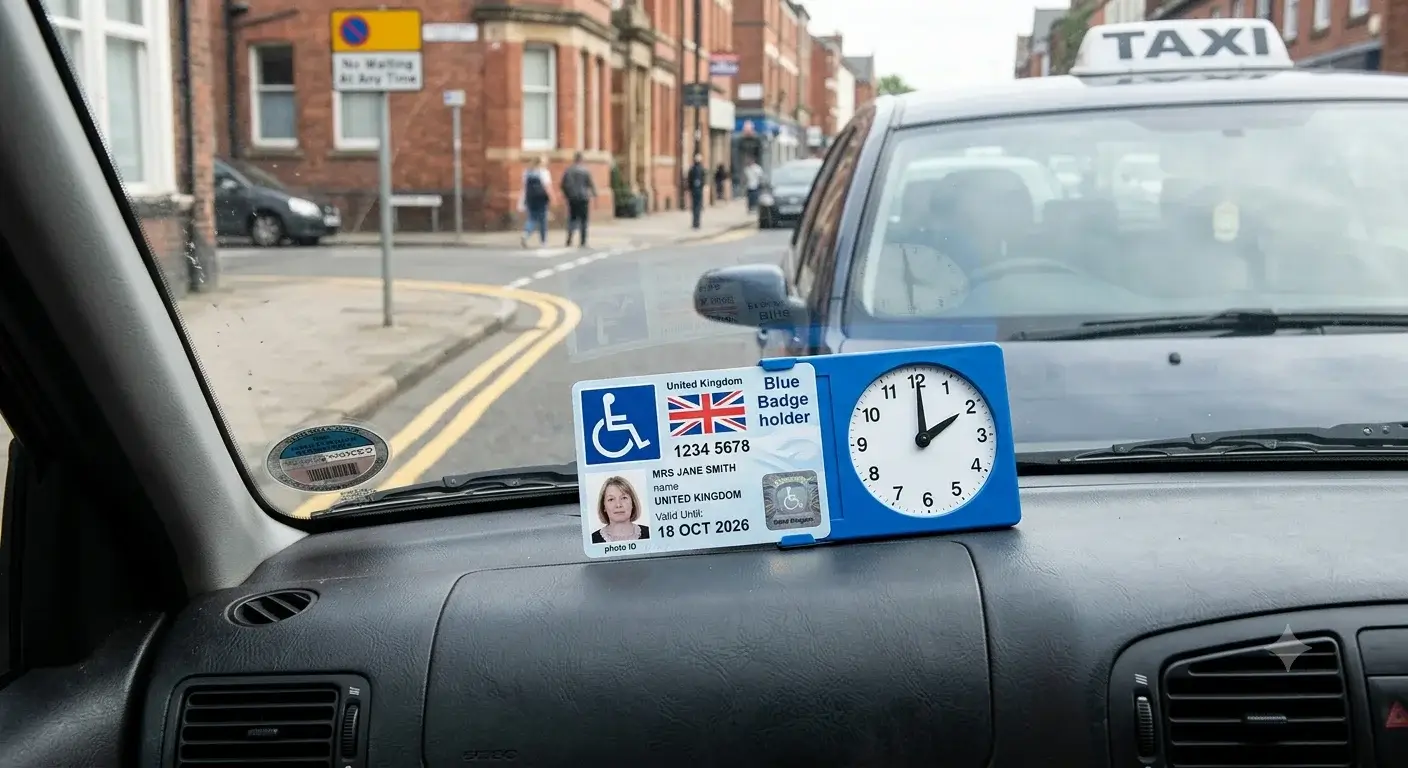
Yes, you can park on double yellow lines with a Blue Badge in the UK. In England, Wales and Northern Ireland you’re allowed up to three hours, provided there’s no loading ban in force. In Scotland, there’s generally no time limit at all, as long as you’re not causing an obstruction. You must always display your Blue Badge and, where required, a parking clock clearly on the dashboard.
That’s the short answer. But the details matter, because getting them wrong is one of the most common ways Blue Badge holders end up with an unfair Penalty Charge Notice (PCN). This guide covers everything you need to know, region by region, so you can park with confidence and avoid a ticket.
What Double Yellow Lines Actually Mean?
Double yellow lines mean no waiting at any time, for any vehicle, regardless of the time of day or day of the week. Unlike single yellow lines, which only restrict parking during specific hours shown on a nearby sign, double yellow lines apply round the clock and don’t need a time plate to be enforceable.
For most drivers, double yellow lines are a hard no. They mark roads where stopping would cause an obstruction, block sightlines, slow down traffic, or interfere with emergency access. Local councils use them on high streets, junctions, bends, bus routes and narrow residential roads.
Here’s what’s important for Blue Badge holders to understand early on: double yellow lines are a general traffic restriction, not a blanket ban. The Blue Badge scheme carves out a specific, legally recognized exemption to this rule but it comes with its own set of conditions.
Double Yellow Line Meaning: Quick Reference
| Marking | What It Means | Applies To |
|---|---|---|
| Double yellow line | No waiting at any time | All vehicles, 24/7 |
| Single yellow line | No waiting during times on sign | All vehicles, restricted hours only |
| Yellow kerb dashes (1 or 2) | No loading or unloading | All vehicles, including Blue Badge holders |
| Red route lines | No stopping, stricter enforcement | All vehicles (limited Blue Badge exemptions apply locally) |
Can You Park on Double Yellow Lines With a Blue Badge?
Yes. The Blue Badge scheme specifically exempts badge holders from the standard “no waiting at any time” restriction on double yellow lines. This is one of the scheme’s most valuable concessions, because dedicated disabled bays aren’t always available, especially in busy town centres.
However, this exemption is not unconditional. Three things always apply.
- You must not cause an obstruction. Even with a valid badge, parking that blocks a junction, blocks a driveway, or narrows the road to the point traffic can’t pass safely is not protected.
- Loading restrictions still apply. If the kerb has yellow dashes indicating a loading ban, a Blue Badge does not override it.
- There’s a time limit in most of the UK (with Scotland being the main exception more on that below).
Official Government Rules on Blue Badge Parking
Before relying on any summary (including this one), it’s worth going straight to the source. These are the official government publications the rules in this guide are based on:
- England The Blue Badge scheme: rights and responsibilities in England (GOV.UK)
- Scotland The Blue Badge scheme: rights and responsibilities in Scotland (Scottish Government / mygov.scot)
- Northern Ireland Blue Badge parking rules and contravention codes (nidirect.gov.uk)
- General guidance Apply for or update a Blue Badge (GOV.UK)
- Citizens Advice summary Using your Blue Badge
Local councils can also publish their own supplementary guidance for their area (particularly relevant for central London boroughs and Scottish local authorities), so it’s worth checking your specific council’s website too if you’re parking somewhere unfamiliar.
Blue Badge Rules by UK Nation

Parking law in the UK is devolved, which means the rules aren’t identical everywhere. This is the single biggest source of confusion among Blue Badge holders what’s true in Manchester isn’t necessarily true in Edinburgh.
England
- Park on single or double yellow lines for up to 3 hours.
- Display the Blue Badge and a parking clock showing your arrival time.
- Wait at least 1 hour before parking on the same stretch of road again.
- Loading bans (yellow kerb dashes) still apply.
- Exception: the City of London and some central London boroughs (Westminster, Kensington & Chelsea, parts of Camden) run their own local schemes and don’t offer the same yellow-line concession always check local signage first.
Wales
- Same core rule as England: up to 3 hours on single or double yellow lines, with a parking clock displayed.
- Loading restrictions and the 1-hour return rule apply in the same way.
Scotland
- This is where things differ most. There is generally no time limit for Blue Badge holders parking on single or double yellow lines in Scotland.
- You still can’t park where there’s a loading or unloading restriction, and you must not obstruct the road.
- Some local authorities have chosen to apply their own restrictions, so it’s worth checking with the specific council if you’re travelling somewhere unfamiliar.
- A parking clock isn’t generally required in Scotland, though carrying one is sensible if you regularly cross the border into England.
Northern Ireland
- Mirrors England and Wales: up to 3 hours on single or double yellow lines.
- Northern Ireland’s enforcement guidance builds in a 10-minute grace period a PCN can only be issued once the vehicle has been parked for 3 hours and 10 minutes.
- Loading bans still apply.
Blue Badge Yellow Line Rules: UK Comparison Table
| Nation | Time Limit | Parking Clock Required | Loading Ban Exempt? | Local Exceptions |
|---|---|---|---|---|
| England | 3 hours | Yes | No | Central London boroughs |
| Wales | 3 hours | Yes | No | Some council-specific schemes |
| Scotland | No general limit | Not usually required | No | Some councils apply local limits |
| Northern Ireland | 3 hours (+10 min grace) | Yes | No | None widely reported |
What Counts as a Loading Restriction?

This is where a lot of otherwise careful Blue Badge holders come unstuck. A loading restriction overrides the Blue Badge exemption completely no badge, however valid, changes that.
Loading restrictions are shown by:
- One yellow kerb dash no loading during specific times, shown on a nearby plate.
- Two yellow kerb dashes no loading at any time.
- A rectangular plate on a post or wall nearby, listing the exact restricted hours.
If you see kerb dashes, don’t rely on the Blue Badge. Even a five-minute stop can result in a PCN if you’re parked (rather than actively loading or unloading) in one of these zones. Genuine loading and unloading physically moving goods to or from the vehicle is usually permitted for all drivers, but simply leaving the car to run an errand is treated as parking, not loading.
How to Display Your Blue Badge and Parking Clock Correctly?
Correct display is a legal requirement, and it’s one of the easiest things to get wrong under pressure especially if you’re juggling a wheelchair, shopping, or a passenger who needs help.
Step-by-Step: Displaying Your Badge Properly
- Position the badge face-up on the dashboard or fascia panel, so the photo, expiry date and hologram are clearly visible through the windscreen from outside the vehicle.
- Set the parking clock to the quarter-hour period in which you arrived (where one is required England, Wales, Northern Ireland).
- Place the clock next to the badge, not hidden underneath it or in a door pocket.
- Double-check visibility by walking around to the front of the car if a traffic warden can’t read it easily, it doesn’t count as displayed.
- Note your street and arrival time somewhere (a photo on your phone works well) in case you need to prove compliance later.
A dedicated Blue Badge wallet, which holds both the badge and the clock in a fixed, visible position, removes a lot of the guesswork and is a small investment that pays off the first time it saves you a ticket.
Where a Blue Badge Won’t Help You?
A Blue Badge is powerful, but it isn’t a universal parking pass. It does not apply in the following situations.
- Off-street car parks supermarkets, hospitals, shopping centers and multi-storey car parks set their own rules. Many offer discounted or free disabled bays, but this isn’t automatic and isn’t governed by the national Blue Badge scheme.
- Loading ban zones as covered above.
- Resident permit bays and zones in most areas, a Blue Badge doesn’t override a residents-only restriction.
- Some central London boroughs the City of London, Westminster, Kensington & Chelsea and parts of Camden run local schemes instead of the national yellow-line concession.
- Locally restricted schemes some councils exclude specific streets from the yellow-line concession entirely (usually signposted, and sometimes listed on the council’s own website).
- Anywhere causing an obstruction junctions, bends, bus stops, and places that would block emergency vehicle access.
Blue Badge vs No Badge: Double Yellow Line Comparison
| Situation | Blue Badge Holder | Standard Driver |
|---|---|---|
| Parking on double yellow lines | Up to 3 hrs (no limit in Scotland) | Not permitted at any time |
| Loading ban zone | Not permitted | Not permitted (except active loading) |
| On-street pay and display | Usually free, no time limit | Must pay and observe time limit |
| Disabled parking bay | Permitted, often unlimited time | Not permitted |
| Resident permit bay | Not usually permitted | Not permitted without a permit |
| Off-street car park | Depends on operator’s own rules | Standard rules apply |
Common Mistakes That Lead to a PCN

Even experienced Blue Badge holders slip up occasionally. These are the mistakes that come up again and again.
- Forgetting the parking clock. The badge alone isn’t enough in England, Wales or Northern Ireland without the clock showing arrival time, wardens have no way to verify you’re within the time limit.
- Missing a loading restriction. Kerb dashes are easy to overlook, especially in poor light or heavy traffic.
- Overstaying by a few minutes. The 3-hour limit is enforced strictly in most areas; Northern Ireland’s 10-minute grace period is the exception, not the rule.
- Re-parking on the same road too soon. The 1-hour rule exists precisely to stop badge holders treating a yellow-line stretch as unlimited free parking by moving the car a few metres.
- Assuming Scotland’s rules apply in England (or vice versa). This is one of the most frequent sources of genuine confusion, especially for people who travel across the border regularly.
- Parking somewhere that clearly obstructs traffic, even within the time limit and without a loading ban.
- Displaying the badge upside down or in a shaded spot where it can’t be read from outside the car.
Real-World Scenarios: How These Rules Play Out?
The rules above look simple on paper, but the situations that actually trip people up tend to follow a few common patterns. These illustrative scenarios (composites based on common council guidance and typical PCN appeal cases, not individual verified reports) show how the rules apply in practice.
Scenario 1: The Loading Ban Trap
A Blue Badge holder parks on a double yellow line outside a row of shops to collect a prescription. The badge and clock are displayed correctly, and they’re back within 15 minutes well inside the 3-hour limit. But the kerb has two yellow dashes indicating a 24-hour loading restriction, easy to miss at a glance.
Because loading bans override the Blue Badge exemption entirely, a PCN is issued despite full compliance with every other rule.
Lesson: always scan the kerb itself, not just the road markings, before leaving the car.
Scenario 2: The Cross-Border Assumption
A driver based in Scotland, used to parking on double yellow lines with no time limit, drives a relative to a hospital appointment in Carlisle, England. They park for four hours without a clock displayed, assuming the same rules apply. Because England enforces the 3-hour limit and requires a visible parking clock, this results in a ticket that a clock and earlier return would have avoided.
Lesson: default to the stricter England/Wales/NI rules whenever you’re unsure which nation’s rules apply.
Scenario 3: The Successful Appeal
A badge holder parks on a double yellow line for 2 hours 40 minutes, badge and clock both correctly displayed, no loading restriction nearby. A PCN is issued anyway, apparently because an enforcement officer’s photo didn’t capture the clock clearly. The badge holder challenges the ticket, submitting their own timestamped photo showing the badge and clock in position at the time of parking. The council cancels the PCN on review.
Lesson: photographing your own display setup each time is a simple habit that directly resolves this exact type of dispute.
What to Do If You Get an Unfair Ticket?
If you believe a PCN was issued incorrectly for example, you were within the 3-hour limit, there was no loading restriction, and your badge and clock were properly displayed you have the right to challenge it.
- Don’t ignore it. Even a ticket you believe is wrong needs a formal response within the stated deadline.
- Gather evidence. Photos of the badge and clock in position, timestamped photos of the vehicle and surrounding signage, and your own notes on arrival time all help.
- Submit an informal challenge to the issuing council first most PCNs can be appealed directly and free of charge.
- Escalate if needed. If the informal challenge is rejected, you can appeal formally, and ultimately to an independent tribunal (in England and Wales, this is the Traffic Penalty Tribunal or London Tribunals, depending on the area).
- Keep copies of everything correspondence, evidence and reference numbers.
Councils do get this wrong sometimes, particularly around loading restrictions that are poorly signed or where a Blue Badge holder’s clock wasn’t clearly visible in photos taken by an enforcement camera.
Blue Badge Parking Checklist
Use this before you leave the car.
- Badge displayed face-up, photo and expiry visible from outside
- Parking clock set correctly and placed next to the badge (where required)
- Checked kerb for yellow loading dashes
- Checked for a nearby loading restriction plate
- Confirmed you’re not blocking a junction, driveway or bus stop
- Noted or photographed your arrival time and location
- Checked whether you’re in a local exception zone (central London boroughs, resident schemes)
- If in Scotland, checked whether the local council applies any additional restriction
Myths vs Facts
| Myth | Fact |
|---|---|
| “A Blue Badge lets you park anywhere.” | It doesn’t override loading bans, resident zones, or obstruction rules. |
| “There’s no time limit anywhere in the UK.” | Only Scotland generally has no time limit; England, Wales and NI cap it at 3 hours. |
| “You don’t need a parking clock if you have a badge.” | In England, Wales and NI, the clock is required alongside the badge on yellow lines. |
| “Off-street car parks always honour the Blue Badge scheme.” | They set their own rules many are generous, but it’s not guaranteed nationally. |
| “You can park in the same spot again once your 3 hours is up.” | You must wait at least 1 hour before returning to the same stretch of road. |
Expert Tips From Experienced Blue Badge Users
- Carry a spare parking clock, or use a Blue Badge wallet that combines both losing or forgetting the clock is a surprisingly common reason for tickets that shouldn’t have happened.
- Photograph your parked car and the surrounding signage every time you park somewhere unfamiliar, including a clear shot of your badge and clock as displayed. This single habit resolves most disputed PCNs quickly.
- When travelling between UK nations, default to the stricter England/Wales/NI rules (3 hours, clock displayed) even if you’re not sure which set applies it keeps you compliant everywhere.
- Check your specific council’s website before visiting an unfamiliar town, particularly in city centres where local schemes sometimes replace the national concession.
- Renew your badge in good time. An expired badge offers no protection at all, even if every other condition is met.
Frequently Asked Questions
Can you park on double yellow lines with a Blue Badge?
Yes. In England, Wales and Northern Ireland you can park for up to 3 hours; in Scotland there’s generally no time limit. Loading restrictions and obstruction rules still apply everywhere.
Can disabled badge holders park on double yellow lines without a parking clock?
Not in England, Wales or Northern Ireland the clock must be displayed alongside the badge to show your arrival time. Scotland doesn’t generally require one.
How long can you park on double yellow lines with a Blue Badge?
Up to 3 hours in England, Wales and Northern Ireland (with a 10-minute grace period in NI). There’s generally no fixed limit in Scotland.
Do double yellow line rules apply to Blue Badge holders at night?
Double yellow lines apply at all times, but the Blue Badge exemption also applies at all times the same 3-hour (or unlimited, in Scotland) rule holds regardless of the hour.
Can you park on double yellow lines with a Blue Badge near a loading bay?
No. If yellow kerb dashes or a loading restriction sign are present, the Blue Badge exemption doesn’t apply, regardless of time of day.
What do double yellow lines indicate?
They indicate a “no waiting at any time” restriction for standard drivers, enforced 24/7 without needing a time plate.
What happens if I overstay the 3-hour limit?
You may receive a Penalty Charge Notice. Some areas (like Northern Ireland) apply a short grace period, but most enforce the limit strictly.
Can I park on a double yellow line to drop someone off?
Briefly stopping to drop off or pick up a passenger is generally treated differently from parking, but you should not leave the vehicle unattended for an extended period without applying the Blue Badge rules.
Does a Blue Badge let you park on red routes?
Not generally red routes have stricter enforcement, though some London boroughs allow limited Blue Badge parking in marked boxes. Always check local signage.
Can you park on double yellow lines with a Blue Badge in a resident permit zone?
Usually not. Most councils exclude resident permit bays and zones from the Blue Badge yellow-line concession.
Is the Blue Badge rule the same in every UK city?
No. While the national framework applies across England, Wales and Northern Ireland, some cities and boroughs (notably parts of central London) run their own local schemes.
Do I need to return to my car after 3 hours or can someone else move it?
Either you or another authorised driver can move the vehicle, but it must not simply be re-parked on the same stretch of road within 1 hour.
Can you park on double yellow lines with a Blue Badge if the meter bay is full?
Yes if disabled bays and pay-and-display spaces are unavailable, the yellow-line concession still applies under the normal conditions.
Is a Blue Badge valid across the whole of the UK?
Yes, a Blue Badge issued anywhere in the UK is valid nationwide, but the specific parking rules you must follow depend on which nation you’re parked in.
Can you park on double yellow lines with a Blue Badge outside a hospital or shop?
Yes, provided it’s on-street, there’s no loading restriction, and you’re not causing an obstruction this is one of the scheme’s most practical everyday uses.
Conclusion
The short version: a Blue Badge does let you park on double yellow lines across the UK, but the fine print differs by nation. England, Wales and Northern Ireland cap it at 3 hours with a parking clock required; Scotland generally has no time limit at all. Loading restrictions, obstruction rules, and a handful of local exceptions (particularly in central London) apply everywhere, badge or no badge.
The safest habit is simple: check the kerb for loading dashes, display your badge and clock properly, don’t overstay, and know which nation’s rules apply to wherever you’re parking. Get those basics right and the Blue Badge scheme does exactly what it’s meant to giving you fair, practical access without the stress of an unfair ticket.
Call to Action: Always confirm current local restrictions on your council’s website before parking somewhere unfamiliar, and consider carrying a Blue Badge wallet with a clock as standard kit in the car.