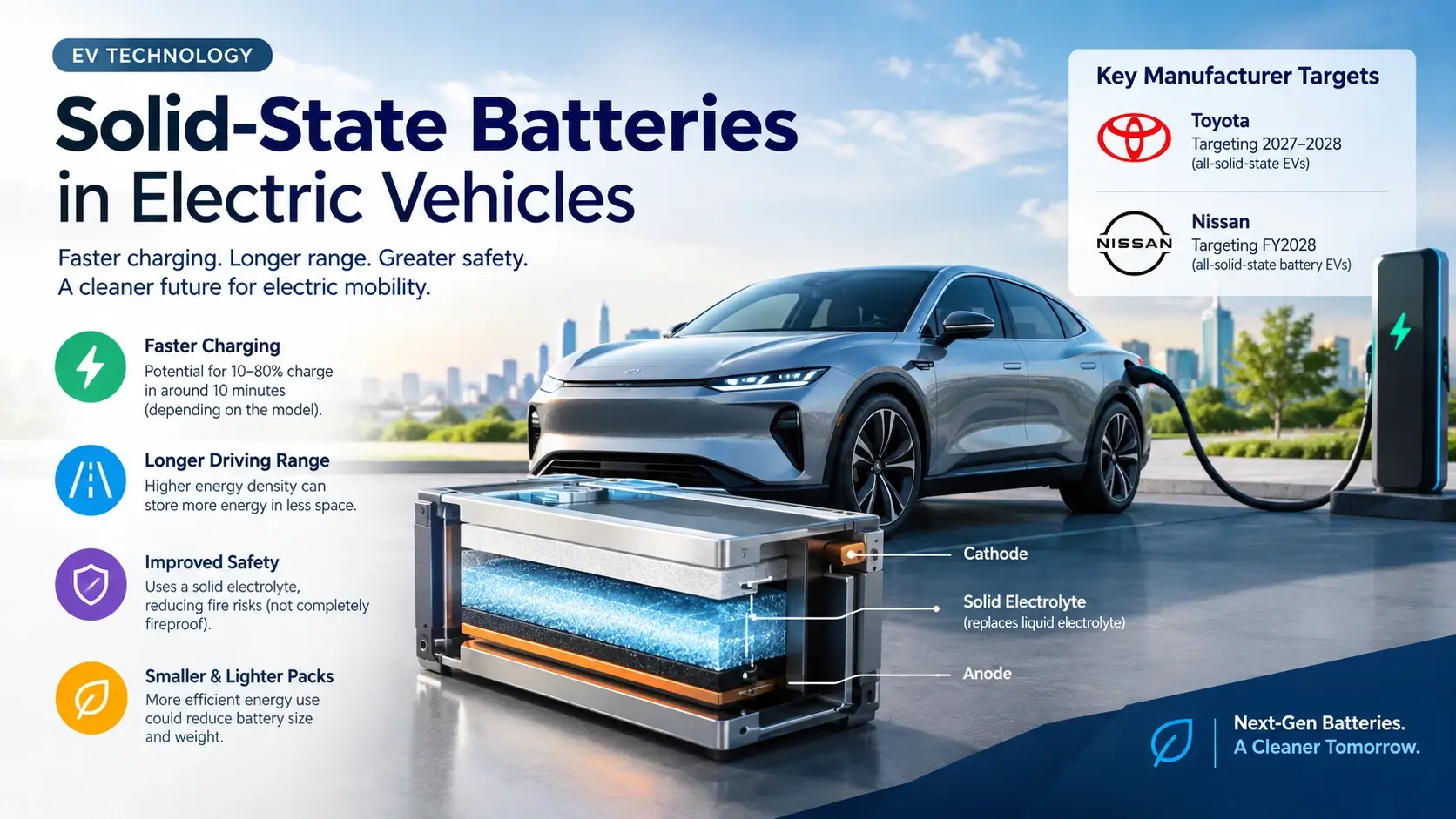
Solid-state batteries could make future electric vehicles charge faster, travel farther on a single charge and use battery space more efficiently. Several automakers are working to bring the technology into production, but buyers should not confuse a development target with a confirmed release date.
Toyota is targeting a market launch of electric vehicles with all-solid-state batteries in 2027–2028. Nissan has announced a goal of launching an EV with its own all-solid-state batteries by fiscal year 2028. These are manufacturer targets, not guarantees that affordable models will be available in every country by those dates.
For drivers deciding whether to buy an electric car now or wait, the real question is how much of the promised performance will reach production vehicles and at what price.
What Are Solid-State Batteries in Electric Vehicles?
A solid-state battery uses a solid electrolyte to conduct lithium ions between its electrodes. Conventional lithium-ion EV batteries generally use a liquid electrolyte.
This change in battery design could enable higher energy density, faster charging and improved resistance to certain fire risks. However, those benefits depend on the materials, cell design, manufacturing process and how the battery performs inside a complete vehicle.
The term also needs careful interpretation. Semi-solid and quasi-solid batteries may contain liquid or gel-like components. They should not automatically be treated as equivalent to an all-solid-state battery, which uses a solid electrolyte without a liquid electrolyte serving that function.
When Will Solid-State Batteries Be Released in EVs?
The first meaningful market introductions are expected around the latter part of this decade, although availability will depend on the manufacturer, vehicle and market.
Toyota: Targeting 2027–2028
Toyota has announced plans to introduce battery-electric vehicles using all-solid-state batteries in 2027–2028. Its development work includes improving battery materials, durability, manufacturing productivity and the supply chain needed for commercial production.
The company has described potential improvements in driving range and charging speed. These figures represent development goals, however, rather than independently confirmed performance figures for a retail vehicle.
Toyota’s target makes the period worth watching, but buyers should wait for a named production model, official specifications and market-specific launch details before making a purchase decision around the technology.
Nissan: Targeting Fiscal Year 2028
Nissan has also committed to developing all-solid-state batteries in-house, with a target of launching an EV equipped with the technology by fiscal year 2028.
The company has discussed potential energy density around twice that of conventional lithium-ion batteries, alongside shorter charging times and possible cost advantages from materials selection. These are expected benefits, not a guarantee that every production battery or vehicle will achieve them.
A fiscal-year target also should not be confused with a precise calendar-year showroom date. Actual availability may vary by region.
Will Solid-State EVs Be Widely Available by 2030?
Not necessarily. Early vehicles may be expensive, produced in limited numbers or restricted to premium segments while manufacturers improve production yields and reduce costs.
The International Energy Agency’s Global EV Outlook 2026 notes that solid-state batteries still face manufacturing and integration challenges. Wider adoption will depend on whether companies can produce reliable cells at automotive scale and offer a competitive price.
How Will Solid-State Batteries Improve EV Performance?
1. Potentially Longer Driving Range
Higher energy density means a battery can store more energy for a given weight or volume. If a production-ready solid-state battery delivers that advantage, an automaker could use it to extend driving range without proportionally increasing battery size.
The benefit will depend on the complete vehicle. Aerodynamics, weight, tyres, driving speed, weather and heating or air-conditioning use all influence real-world range.
A manufacturer’s projected range should therefore not be treated as a guaranteed distance under everyday driving conditions.
2. Faster Charging
Solid-state designs may support faster charging because of their electrochemical properties. Toyota has discussed a charging target of 10 minutes or less for a particular state-of-charge window in its battery development plans.
That is a target, not proof that every solid-state EV will charge that quickly. Actual charging speed depends on the battery chemistry, temperature, charging equipment, vehicle software and the portion of the battery being charged.
For drivers, the most useful future specification will be the time required to charge from a clearly stated starting percentage to a clearly stated ending percentage under defined conditions.
3. Improved Safety Potential
Many solid-state designs replace the conventional liquid electrolyte with a solid material, potentially reducing risks associated with flammable liquid electrolytes.
That does not make a battery automatically fireproof. Battery safety also depends on the electrodes, separators or interfaces, pack construction, thermal management, electrical controls and crash protection.
Solid electrolytes can introduce their own engineering challenges, including cracks, interface degradation and sensitivity to manufacturing conditions. Safety claims need to be evaluated using testing of the actual battery and vehicle, not just the material in isolation.
4. Potential Changes to Battery Size and Weight
If energy density improves, manufacturers may be able to achieve a given range with a smaller or lighter battery pack. Alternatively, they may keep the pack size similar and increase the vehicle’s range.
Neither outcome is guaranteed. Pack-level performance also depends on cooling systems, structural components, safety equipment and the mechanical requirements of the cells.
Solid-State vs Conventional Lithium-Ion Batteries
| Factor | Conventional lithium-ion | All-solid-state batteries |
|---|---|---|
| Electrolyte | Generally liquid | Solid |
| Commercial maturity | Established, large-scale production | Developing, with scale-up challenges |
| Driving range | Proven across many production EVs | Potential for improvement; vehicle results must be verified |
| Charging speed | Depends on chemistry and vehicle design | Potential for faster charging; production performance remains to be established |
| Safety | Mature safety engineering, but fire risks remain | Potential advantages, but not risk-free |
| Cost | Established supply chains and manufacturing | Early production may be expensive |
| Availability | Broad choice of models | Expected to expand gradually as commercialisation progresses |
The important distinction is that conventional lithium-ion batteries are already available in many vehicles, with known specifications and ownership histories. Solid-state batteries may deliver meaningful gains, but their cost, durability and performance must be demonstrated in production vehicles.
What Is Preventing Mass Production?
The technology faces several connected challenges.
- Manufacturing cost: New materials, specialised equipment and tightly controlled production environments can make early cells expensive.
- Durability: Electrodes and solid electrolytes can expand, contract or lose contact during repeated charging and discharging. Maintaining reliable performance over years of use is essential.
- Production scale: A battery that performs well in a laboratory cell must also work consistently across thousands or millions of cells, then inside complete battery packs.
- Supply chains: Manufacturers need dependable supplies of suitable materials and production capacity. They must also develop quality-control processes and repair or recycling pathways.
These challenges explain why a successful prototype does not automatically lead to an affordable electric car available worldwide.
Should You Buy an EV Now or Wait for Solid-State Batteries?
For most buyers, the decision should be based on current needs rather than an unconfirmed future release.
Consider buying an EV now if an available model meets your driving range, charging access, budget and warranty requirements. Current lithium-ion technology is established, and there is no need to postpone a purchase solely because a new battery type is approaching.
Waiting may make sense if you are specifically interested in early solid-state models, can keep your current vehicle for several more years and are comfortable with uncertainty around price and availability.
Before committing to a future model, look for a confirmed vehicle name, official market launch, independently tested range, charging figures under stated conditions, warranty terms and a clear purchase price.
You can also compare today’s options in our guide to the best electric cars before deciding whether to buy now or wait.
The Outlook for Solid-State EV Batteries
Solid-state batteries are a promising next step in electric-vehicle development, but their arrival will be a gradual process rather than a single industry-wide launch. Toyota’s 2027–2028 target and Nissan’s fiscal-year 2028 goal provide useful milestones to follow.
The technology could improve range, charging speed and packaging, but manufacturing cost, durability and real-world performance will determine its success. For buyers, the smartest approach is to follow confirmed vehicle announcements and compare tested specifications rather than rely on headline claims.
As production develops, the most important question will not simply be whether an EV has a solid-state battery. It will be whether that battery delivers a meaningful improvement in everyday driving at a price buyers are willing to pay.
Frequently Asked Questions About Solid-State Batteries
1. What is a solid-state battery in an electric vehicle?
A solid-state battery is an advanced battery that uses a solid electrolyte instead of the liquid electrolyte found in conventional lithium-ion batteries. This technology could improve energy density, charging speed and battery safety while potentially reducing battery size and weight.
2. When will Toyota release its first solid-state battery electric vehicle?
Toyota is targeting 2027–2028 for the market introduction of electric vehicles equipped with all-solid-state batteries. However, the actual launch date, vehicle specifications and availability will depend on production readiness and the markets Toyota chooses to serve.
3. Is Nissan launching a solid-state battery electric vehicle in 2028?
Nissan aims to launch an electric vehicle featuring its own all-solid-state battery technology by fiscal year 2028. The company expects improvements in energy density, charging performance and battery costs, although final production specifications have not yet been established.
4. Are solid-state batteries safer than conventional lithium-ion batteries?
Solid-state batteries could offer safety advantages because they use solid electrolytes instead of conventional flammable liquid electrolytes. However, they are not completely fireproof. Overall safety still depends on battery materials, cell design, thermal management and vehicle protection systems.
5. Will solid-state batteries increase electric vehicle driving range?
Solid-state batteries could increase EV driving range by storing more energy in the same amount of battery space or weight. However, actual range improvements will depend on battery energy density, vehicle design, driving conditions and the efficiency of the electric motor.
6. How much will electric vehicles with solid-state batteries cost?
The exact prices of solid-state battery electric vehicles have not been confirmed. Early models may be expensive because manufacturers still face material costs, specialised manufacturing requirements and production challenges. Prices could become more competitive as production increases and technology improves.
7. Should I wait for solid-state batteries before buying an electric vehicle?
Not necessarily. Current electric vehicles already offer established battery technology, practical driving ranges and widely available models. Waiting may make sense if you are interested in newer battery technology and can postpone your purchase for several years. Compare your current needs, budget and charging options before deciding.
Sources:
Toyota – All-Solid-State Battery Development