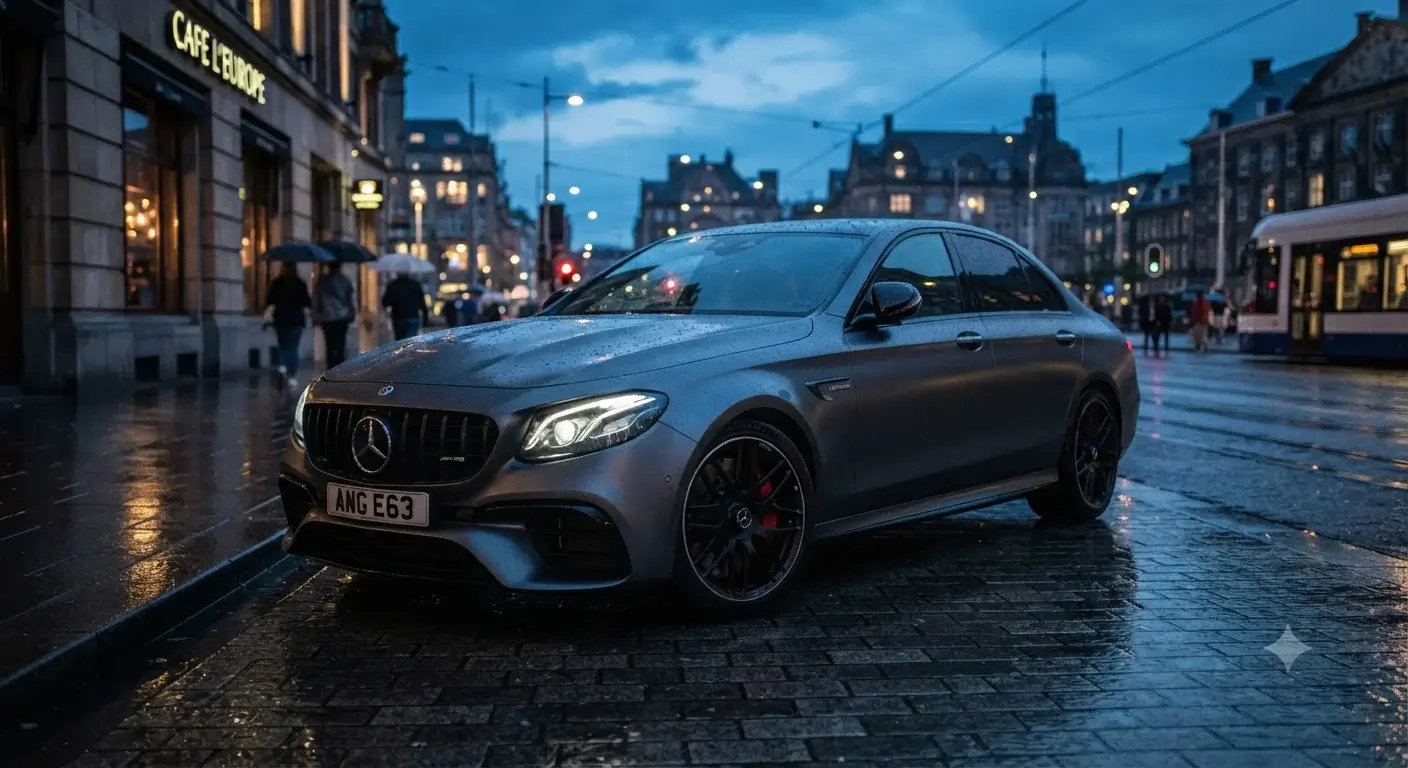
Mercedes AMG is the performance arm of Mercedes-Benz, responsible for the brand’s fastest, loudest and most desirable cars. If you’ve ever wondered what makes an AMG different from a standard Mercedes, what it costs to own one in the UK, or whether it’s actually worth the extra money, this guide answers all of it in plain English.
Mercedes AMG builds hand-finished, high-performance versions of Mercedes-Benz models, using upgraded engines, suspension, brakes and styling. Prices in the UK start from around £50,000 for an entry-level AMG A-Class and rise well beyond £150,000 for models like the AMG GT or G63.
1. What Is Mercedes AMG?

Mercedes AMG is Mercedes-Benz’s official performance and motorsport division, building high-output versions of the brand’s road cars.
AMG began life in 1967 as an independent tuning company, founded by two former Mercedes-Benz engineers, Hans Werner Aufrecht and Erhard Melcher. The name comes from their initials plus Aufrecht’s home town, Grossaspach. Mercedes-Benz gradually took a controlling stake through the 1990s and 2000s, and AMG is now a wholly owned subsidiary, still based at its original home in Affalterbach, Germany.
Today, “AMG” appears in two forms on Mercedes cars:
- Full AMG models (such as the C63, E63, GT and G63) built with bespoke, hand-assembled engines and heavily reworked mechanicals.
- AMG Line trim a cosmetic and styling package available on standard Mercedes models, which does not include the performance upgrades of a full AMG car.
This distinction trips up a lot of buyers, so it’s worth remembering: AMG Line is not the same as an AMG car.
2. How Mercedes AMG Works?

Full AMG engines are built using the company’s famous “One Man, One Engine” philosophy. A single technician hand-assembles each engine from start to finish and signs a plaque fitted to the top of it, taking personal responsibility for quality.
Beyond the engine, AMG engineering typically includes:
- Reinforced or fully bespoke engine blocks
- Upgraded turbochargers or superchargers
- Sport-tuned suspension, often with adaptive damping
- Larger brakes with uprated calipers
- Stiffer body mounts and additional chassis bracing
- AMG-specific gearbox tuning (usually AMG Speedshift automatic or manual)
- Aerodynamic changes such as wider arches, larger air intakes and rear diffusers
The result is a car that shares its bodyshell with a standard Mercedes but behaves very differently on the road.
3. Benefits Of Buying An AMG
- Serious performance most modern AMGs hit 0–60mph in under 4.5 seconds.
- Exclusivity production numbers are far lower than standard Mercedes models.
- Distinctive sound and styling AMG exhaust notes and bodywork are designed to stand out.
- Strong badge value AMG carries genuine prestige in the UK performance car market.
- Everyday usability unlike many rivals, most AMGs (bar the GT) are practical four- or five-seat cars usable every day.
4. Types Of Mercedes AMG Models

| Model | Segment | Typical UK Starting Price | Best For |
|---|---|---|---|
| A45 AMG / A45 S | Hot hatch | £55,000+ | Daily driving with serious pace |
| C43 / C63 AMG | Sports saloon/estate | £60,000–£90,000 | All-round performance saloon |
| E53 / E63 AMG | Executive performance saloon | £75,000–£110,000 | Long-distance comfort with power |
| GLC/GLE 43 & 63 AMG | Performance SUV | £70,000–£130,000 | Family-friendly performance |
| G63 AMG | Off-road performance SUV | £160,000+ | Status and off-road capability |
| AMG GT | Sports/GT car | £120,000–£200,000+ | Dedicated performance driving |
Prices are approximate UK retail guides and vary by specification, year and dealer.
5. Common Problems With AMG Cars
Like any high-performance vehicle, AMG models can develop faults, particularly as they age or if maintenance is skipped. The most commonly reported issues include.
- Air suspension faults (on models fitted with AIRMATIC or AMG Ride Control)
- Turbocharger wear on high-mileage cars
- Electrical and infotainment glitches
- Premature brake and tyre wear due to the extra power and weight
- Oil leaks from valve covers or turbo seals on older engines
- Timing chain tensioner wear on certain V8 engines from the mid-2010s
6. Signs, Symptoms And Causes Of AMG Faults
| Symptom | Likely Cause | Urgency |
|---|---|---|
| Car sitting unevenly or sagging at one corner | Air suspension strut or compressor failure | Book inspection soon |
| Whining or delayed power delivery | Turbocharger wear | Get diagnosed promptly |
| Dashboard warning lights (engine/transmission) | Sensor or software fault | Diagnose before driving further |
| Oil spots under the car | Valve cover or seal leak | Monitor and book a check |
| Juddering under braking | Warped brake discs | Address soon safety issue |
Common causes behind these faults are usually a mix of high mileage, infrequent servicing, short journeys that don’t let the engine reach optimal temperature, and the sheer mechanical stress that comes with AMG-level performance.
7. Solutions And Repair Options

- Independent AMG specialists often 30–50% cheaper than main dealers, and many use genuine or OEM-equivalent parts.
- Main dealer servicing recommended while under warranty, and useful for complex electrical or software issues.
- Extended warranties worth considering on used AMGs once the manufacturer warranty expires, given the cost of major repairs.
- Diagnostic checks before buying always have an AMG-experienced mechanic inspect a used car before purchase.
8. Mercedes AMG Running Costs In The UK

Running an AMG costs noticeably more than a standard Mercedes, largely due to the performance engineering involved.
| Cost Area | Typical UK Range |
|---|---|
| Annual servicing | £400–£900 |
| Insurance (varies hugely by age/postcode) | £1,000–£4,000+ per year |
| Road tax (VED) | Higher band due to emissions; expect £500+ in year one for new cars |
| Tyres (performance-rated, per set) | £600–£1,200 |
| Brake discs and pads (per axle) | £400–£900 |
| Fuel economy | Typically 20–30mpg depending on model and driving style |
These figures are general guidance rather than fixed quotes always get a specific quote for your model, age and postcode.
9. Maintenance Tips for AMG Owners
- Stick to the recommended service schedule usually every 12 months or 10,000–15,000 miles.
- Use fully synthetic, AMG-approved oil cheaper alternatives can shorten engine life.
- Let the engine warm up before hard driving, especially in cold weather.
- Check tyre pressures and tread regularly AMGs are harder on tyres than standard models.
- Have air suspension checked annually if fitted, as compressors and struts wear over time.
- Keep service history complete it significantly affects resale value.
10. Buying Guide: New Vs Used AMG

New AMG
The newest standout model from Mercedes-AMG is the ultra-exclusive rear-wheel-drive Mercedes-AMG CLE 646, a street-legal track monster powered by a 646-horsepower twin-turbo flat-plane crank V8:
- Full manufacturer warranty (typically 3 years/unlimited miles in the UK)
- Latest technology and emissions compliance
- Highest depreciation in the first 2–3 years
Used AMG
You can find a wide selection of used Mercedes-AMG models across the UK through platforms like Auto Trader UK and PistonHeads UK:
- Considerably cheaper entry point, especially at 3–6 years old
- Depreciation has already taken the biggest hit, often 40–50%
- Requires more careful inspection and service history checks
- Extended warranty strongly recommended
11. Mistakes To Avoid When Buying An AMG
Skipping a specialized pre-purchase inspection or ignoring high routine maintenance costs can turn an dream AMG purchase into a financial nightmare.
- Confusing AMG Line trim with a genuine AMG performance model
- Skipping an independent pre-purchase inspection
- Ignoring gaps in service history
- Underestimating insurance and running costs before buying
- Buying on looks alone without checking mechanical condition
12. Expert Tips From The Trade
The best way to buy a used Mercedes-AMG is to verify its history, check the costly components, and budget for running costs before you commit. These expert tips from the trade help you avoid expensive surprises and find a car that has been properly maintained:
- Ask for printed or digital service records, not just a verbal confirmation.
- Have the air suspension and turbo systems specifically checked on any used AMG.
- Budget for tyres and brakes as consumables, not optional extras they wear faster than on standard models.
- Join an AMG or Mercedes owners’ forum for UK-specific advice on trusted independent specialists.
13. Mercedes AMG Vs Standard Mercedes: Comparison Table
| Feature | Standard Mercedes | Mercedes AMG |
|---|---|---|
| Engine | Standard production unit | Hand-built or heavily upgraded |
| Performance | Everyday pace | Sports/supercar-rivalling pace |
| Suspension | Comfort-focused | Sport-tuned, often adaptive |
| Price premium | Baseline | 30–100%+ higher |
| Running costs | Lower | Significantly higher |
| Exclusivity | Common | Lower production numbers |
14. Pre-Purchase Checklist
A pre-purchase vehicle inspection checklist ensures you evaluate a used car’s documentation, mechanical health, and structural integrity before handing over any money:
- Confirm it’s a genuine AMG model, not AMG Line trim
- Full service history available
- Independent mechanical inspection completed
- Air suspension and turbo checked
- Tyres and brakes assessed for wear
- Insurance quote obtained before purchase
- MOT history reviewed (UK gov.uk MOT checker)
- Outstanding finance check completed
15. Pros And Cons Of Owning An AMG
Pros
- Genuine performance credentials
- Strong badge prestige
- Practical for daily use (most models)
- Distinctive design and sound
Cons
- High running and repair costs
- Faster depreciation on some models
- Insurance can be expensive, especially for younger drivers
- Higher fuel consumption than standard models
16. Myths Vs Facts
| Myth | Fact |
|---|---|
| “All Mercedes with AMG badging are true AMGs” | Many only have AMG Line styling, not AMG performance parts |
| “AMGs are unreliable” | They’re generally robust if serviced properly; issues usually stem from neglect |
| “AMG servicing must be done at a main dealer” | Reputable independent AMG specialists can service them to the same standard, often cheaper |
| “AMGs are impractical” | Most (aside from the GT) are full four/five-seaters suitable for daily use |
Frequently Asked Questions
What does AMG stand for?
AMG stands for Aufrecht, Melcher and Grossaspach the surnames of its two founders and the town where the company began.
What is the difference between AMG and AMG Line?
AMG models have genuine performance upgrades (engine, suspension, brakes). AMG Line is a styling package on standard Mercedes models with no mechanical changes.
How much does a Mercedes AMG cost in the UK?
Prices start around £55,000 for an entry-level A45 AMG and rise beyond £150,000 for models like the G63 or AMG GT.
Is Mercedes AMG reliable?
Generally yes, provided servicing is kept up to date. Common issues relate to air suspension, turbochargers and electronics on higher-mileage cars.
How much does it cost to service an AMG in the UK?
Typical annual servicing costs range from £400 to £900, depending on the model and where it’s serviced.
Is AMG insurance expensive?
Yes AMGs sit in higher insurance groups due to power output and repair costs, often ranging from £1,000 to £4,000+ per year depending on driver profile.
Are Mercedes AMG cars good for daily driving?
Most AMG saloons, estates and SUVs are practical for daily use. The AMG GT is more focused and less practical as a daily car.
What does AMG mean in a Mercedes?
AMG stands for Aufrecht, Melcher, and Großaspach, representing the surnames of the company’s two founders and the birthplace of one of them.
Is buying a used AMG a good idea?
Yes, if bought carefully. Used AMGs offer significant savings versus new, but require thorough inspection and complete service history.
How often should an AMG be serviced?
Typically every 12 months or 10,000–15,000 miles, whichever comes first, following Mercedes-Benz’s recommended schedule.
Is buying an AMG worth it?
Buying a Mercedes-AMG is worth it if you crave raw performance, distinct craftsmanship like hand-built engines, and an aggressive driving experience, but it is not worth it if you want low running costs or a simple daily commuter.
What’s the difference between AMG 43, 53 and 63 models?
The number broadly indicates performance tier 43 is the entry-level AMG performance tier, 53 sits in the middle (often with hybrid assistance), and 63 represents the top-tier V8 performance models.
Can I service my AMG at an independent garage?
Yes. A reputable independent AMG specialist can maintain the car to manufacturer standards, often at a lower cost than a main dealer, though warranty terms should be checked first.
Is Mercedes AMG worth the extra money?
For buyers who value performance, exclusivity and driving experience, yes. For those wanting Mercedes comfort and styling without the running costs, a standard model or AMG Line trim may suit better.
Which AMG is the cheapest?
The absolute cheapest Mercedes-AMG models you can buy are older, high-mileage used luxury sedans like the W203 C32 AMG (2002–2004) and early W220 S55 AMG (2000–2006), which can frequently be found on the used market for $5,000 to $10,000.
Conclusion
Mercedes AMG represents the performance pinnacle of the Mercedes-Benz range, built on genuine engineering upgrades rather than just styling. It offers real thrills, strong prestige and everyday usability in most models, but comes with higher running costs, insurance and maintenance demands than a standard Mercedes.
Whether an AMG is worth it depends on your priorities: if performance and exclusivity matter more than running costs, it’s a compelling choice. If not, a standard Mercedes or AMG Line model may offer a better balance for UK driving needs.
Call to Action
Thinking about buying a Mercedes AMG in the UK? Always get an independent pre-purchase inspection and a tailored insurance quote before committing it could save you thousands down the line.