Whether you are navigating the constant stop-start traffic of London’s busy streets or cruising on a long-distance motorway trip from Birmingham to Glasgow, your engine is constantly under immense pressure. In my experience, understanding how to check engine oil is the most vital “under-the-hood” skill any car owner can possess. It’s the difference between a smooth-running vehicle and an expensive breakdown.
Engine oil isn’t just a fluid; it’s the lifeblood of your car. It acts as a primary lubricant, reducing friction between high-speed moving parts while helping to dissipate heat. Given the UK’s unpredictable climate from damp, freezing winters to humid summer days, oil viscosity can change, directly affecting engine performance. Based on what I’ve seen in the automotive world, neglecting this 5-minute check is a leading cause of overheating and decreased fuel efficiency. At worst, it leads to a seized engine, which can easily cost thousands of pounds to replace an expense that is entirely avoidable.

Tools You’ll Need For The Job
The beauty of this maintenance task is that it requires almost no specialized equipment. Before you start, gather the following:
- A clean, lint-free rag or a roll of paper towels.
- A pair of disposable gloves (optional, but recommended to keep your hands clean).
- Your vehicle’s owner’s manual (to confirm oil type and dipstick location).
- A funnel (if you discover you need a top-up).
Step-By-Step Guide: How To Check Engine Oil?
Follow these steps to ensure an accurate reading every time.
1. Park On Level Ground
To get a true reading of the oil level, your car must be flat. Parking on a slope in a hilly area like Manchester will cause the oil to shift to one side of the pan, giving you a false low or high reading.
2. Prepare The Engine
Most manufacturers recommend checking the oil when the engine is warm but has been turned off for at least 5 to 10 minutes. This allows the oil in the upper parts of the engine to drain back into the sump.
3. Locate The Dipstick
Open the bonnet and look for the dipstick. It usually has a brightly coloured plastic handle (often yellow, red, or orange) with an oil can icon.
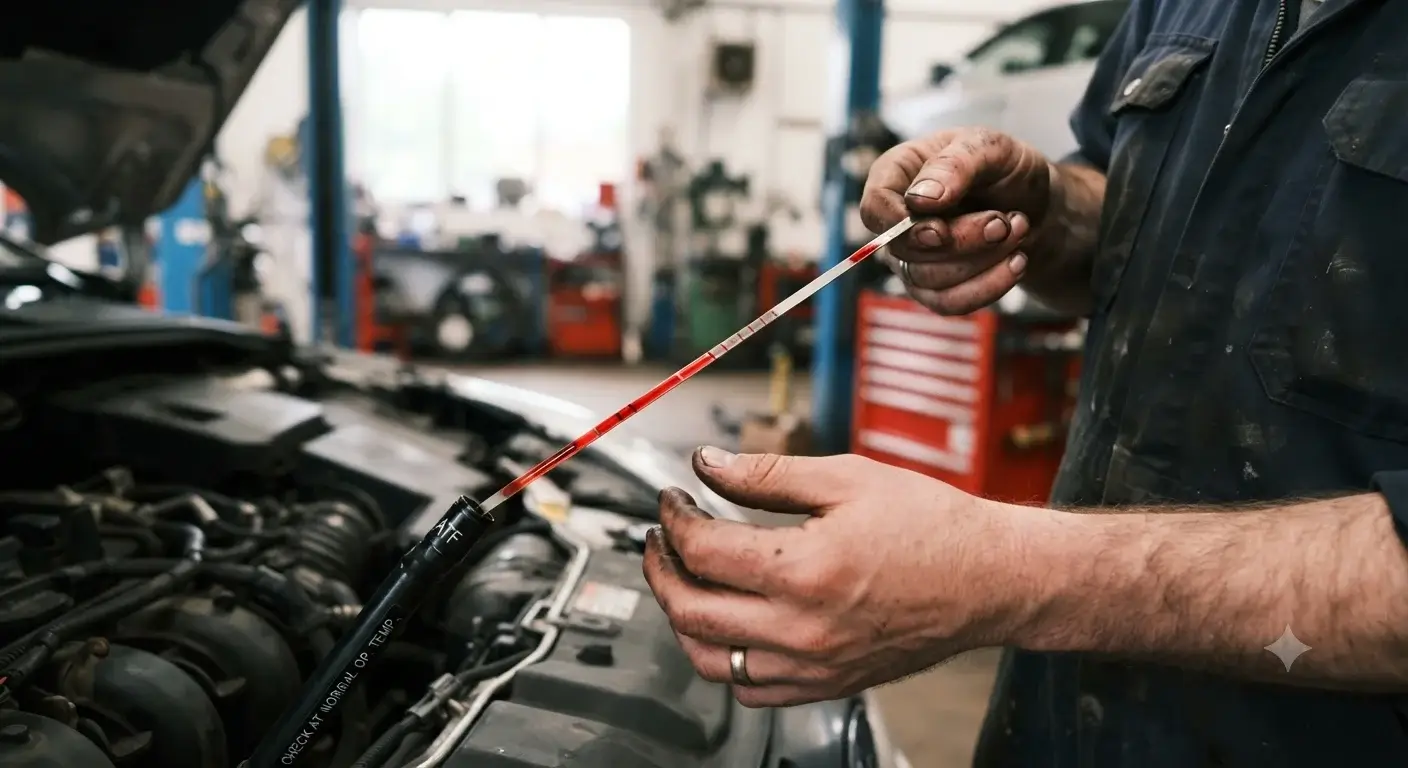
4. Pull, Wipe, And Reinsert
Pull the dipstick out fully and wipe it clean with your rag. You’ll notice two marks near the tip (often dots, lines, or a cross-hatched area). These represent the ‘Minimum’ and ‘Maximum’ levels.
Reinsert the dipstick fully back into its tube. If you don’t push it all the way in, your reading will be inaccurate.
5. Read The Level
Pull the dipstick out again and look at the oil film.
- Between the marks: Your oil level is perfect.
- Below the bottom mark: You need to top up immediately.
- Above the top mark: You have too much oil, which can cause pressure issues.
How Often Should UK Drivers Check Their Oil?
In the UK, it is a common myth that you only need to think about oil during your annual MOT or service.
Expert advice suggests checking your engine oil once a month or before any long-distance journey. Modern cars are more efficient, but they can still consume oil, especially if you frequently drive in “stop-start” traffic in cities like Leeds or Bristol.
Signs Of Low Or Dirty Engine Oil
Knowing how to check engine oil is half the battle; knowing what the oil is telling you is the other half.
- Colour: Fresh oil is amber and transparent. If it is pitch black and gritty, it is full of carbon deposits and needs changing.
- Consistency: If the oil looks like a “milky” coffee or has white foam, this could indicate a head gasket leak a serious issue in the UK automotive world.
- The Oil Light: If the oil pressure light flickers on your dashboard, pull over safely immediately.
Choosing The Right Engine Oil For Your Car
UK cars generally use specific grades like 5w30 or 0w30.
- Synthetic Oil: Best for modern engines and extreme temperatures.
- Check the Manual: Using the wrong oil can void your warranty and damage your DPF (Diesel Particulate Filter) if you drive a diesel.
- Popular UK Brands: Look for trusted names like Castrol, Shell, or Mobil 1, which meet European ACEA standards.
Common Mistakes To Avoid
- Checking while the engine is running: This is dangerous and will give a completely wrong reading.
- Overfilling: Adding too much oil can lead to “frothing,” where the oil cannot lubricate the engine properly.
- Ignoring the “Feel”: If you feel grit in the oil when wiping the dipstick, your oil filter is likely clogged.
Conclusion
Learning how to check engine oil is a 5-minute task that can save you a lifetime of mechanical headaches. By keeping your lubricant at the correct level, you ensure your car stays reliable, whether you’re navigating the M25 or the Scottish Highlands.
Check your engine oil today to avoid costly repairs tomorrow! If your oil looks dark or low, don’t wait for your next service top it up or book a professional oil change now.
My Personal Verdict: Why Maintenance Timing Is Everything?
In my experience, the “when” of vehicle maintenance is just as critical as the “how.” If you are driving a carburetor-based car, my golden rule is to always check your levels right before you start the engine for the day. Unlike modern EFI systems, these classic engines rely heavily on immediate, fresh lubrication. Catching a low level early is the simplest way to prevent a rough start or internal wear.
Furthermore, don’t just stop at the dipstick. I always tell fellow drivers: whenever the bonnet is open, check the radiator water level as well. In the UK’s varied climate, cooling systems in older vehicles are under constant stress. From what I’ve observed, most engine failures aren’t caused by one big disaster, but by neglecting these small 2-minute checks.
If your vehicle is an older model, my sincere advice is to change your engine oil every 3,000 to 4,000 KM. While it’s tempting to push it further to save a few pounds, frequent changes keep the engine internals pristine and significantly extend its lifespan. It’s a small investment that prevents a massive repair bill down the road.
FAQs
Q1: Should I check my oil when the engine is hot or cold?
Wait 10 minutes after driving. This ensures the engine is warm (allowing the oil to flow) but has settled in the sump for an accurate reading.
Q2: What does dirty engine oil look like?
Dirty oil is thick, dark black, and may have a burnt smell or gritty texture.
Q3: Can I mix two different types of engine oil?
In an emergency, yes, but it is not ideal. It is always better to use the exact grade (e.g., 5w30) specified by your manufacturer.
Q4: How long does an oil check take?
It takes less than 5 minutes. It’s the easiest DIY car maintenance task you can perform.
Q5: Why is my car consuming oil so fast?
Older cars or high-performance engines naturally use more oil. However, if you see blue smoke from the exhaust, you may have a leak or worn piston rings.