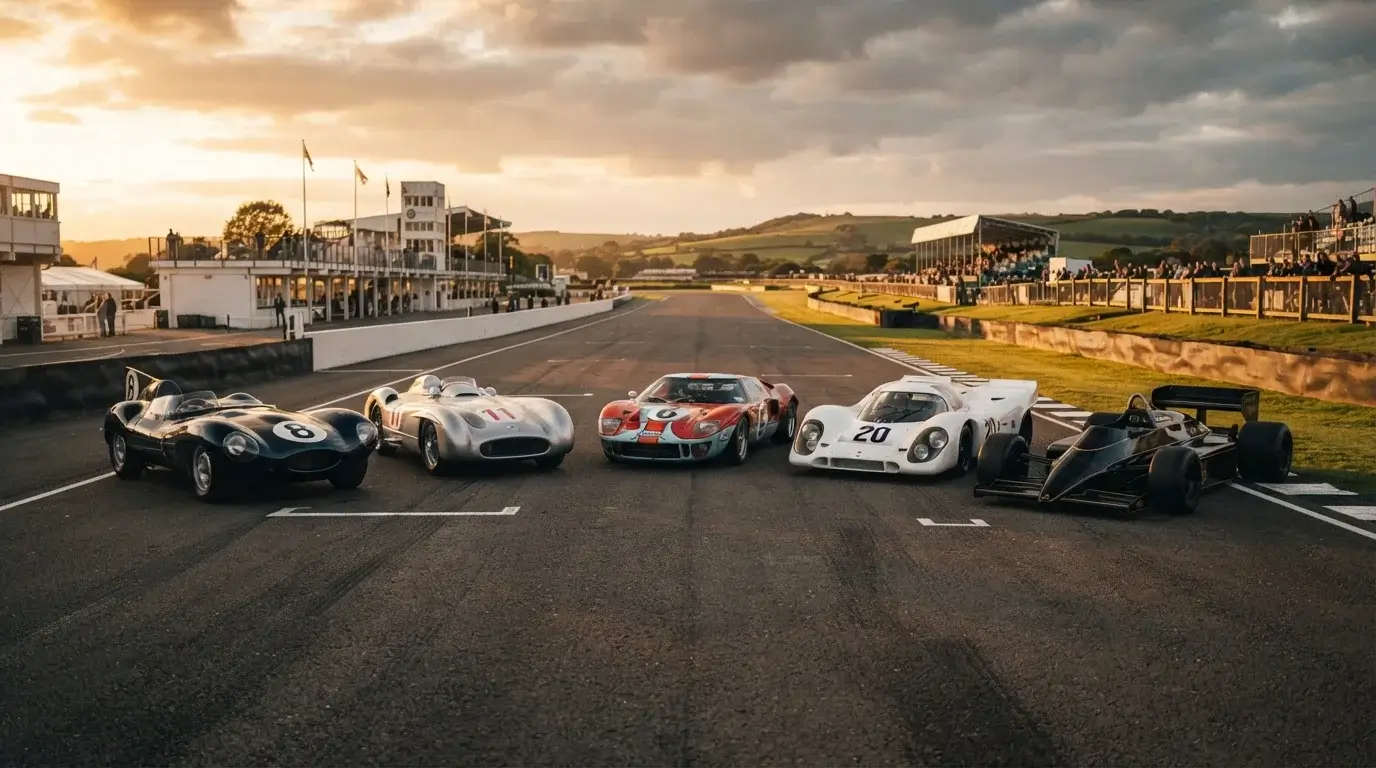
The most legendary race cars in motorsport history include the Ford GT40, the McLaren MP4/4, the Porsche 917, the Jaguar D-Type, and the Mercedes-Benz W196. Each of these cars didn’t just win races they changed engineering standards, shifted championship dominance, or redefined what a race car could achieve, and several have deep ties to British motorsport heritage.
This guide covers the race cars that shaped Formula 1, Le Mans, and endurance racing, with UK-relevant context on where these cars were built, raced, and are preserved today.
What Makes a Race Car “Legendary”?
A race car becomes “legendary” by combining major on-track victories, groundbreaking engineering, and a cultural story that outlasts its era.
- Championship dominance — it won multiple titles or races in a single era
- Engineering breakthrough — it introduced technology still used today (aerodynamics, turbocharging, ground-effect design)
- Cultural and historical significance — it’s tied to a driver, team, or moment that shaped motorsport’s story
The Most Legendary Race Cars in History

1. Ford GT40 Le Mans (1966–1969)
Built specifically to beat Ferrari at Le Mans after a failed buyout attempt, the GT40 won the 24 Hours of Le Mans four consecutive years. It remains one of the most famous underdog stories in racing history.
- Achievement: 1-2-3 finish at Le Mans in 1966
- Legacy: Directly inspired the modern Ford GT road car
2. McLaren MP4/4 Formula 1 (1988)

Driven by Ayrton Senna and Alain Prost, the MP4/4 won 15 of 16 races in the 1988 season still one of the most dominant single-season records in F1 history.
- Team base: Woking, England
- Engine: Honda turbo V6
3. Porsche 917 Le Mans (1970–1971)

The 917 gave Porsche its first overall Le Mans win and became iconic for both its speed and its danger, later immortalised in the film Le Mans starring Steve McQueen.
- Top speed: Over 240 mph on the Mulsanne Straight
- Legacy: Cemented Porsche’s endurance racing dominance for decades
4. Jaguar D-Type Le Mans (1954–1957)

A British engineering triumph, the D-Type won Le Mans three times and pioneered aerodynamic and monocoque chassis techniques still fundamental to race car design today.
- Innovation: Early monocoque construction, unusual for the era
- UK heritage: Built and raced by Jaguar, based in Coventry
5. Mercedes-Benz W196 Formula 1 (1954–1955)

Driven by Juan Manuel Fangio, the W196 dominated its era with innovative streamlined bodywork and fuel injection technology years ahead of competitors.
- Achievement: Won two consecutive F1 World Championships
- Auction record: A W196 sold for over £19 million in 2013, one of the most expensive cars ever sold
6. Lotus 49 Formula 1 (1967)

Designed by Colin Chapman, the Lotus 49 introduced the Ford Cosworth DFV engine as a stressed chassis member, a design principle that influenced F1 car construction for decades.
- UK heritage: Built by Lotus in Hethel, Norfolk
7. Williams FW14B Formula 1 (1992)

Featuring active suspension, traction control, and semi-automatic gearboxes, the FW14B was so technologically advanced it helped trigger F1’s later ban on driver aids.
- Driver: Nigel Mansell’s title-winning car
- UK heritage: Built at Williams’ Grove, Oxfordshire factory
Legendary Race Cars Comparison Table
| Race Car | Era | Key Achievement | UK Connection |
|---|---|---|---|
| Ford GT40 | 1966–1969 | 4x Le Mans winner | Developed partly at Ford’s UK operations |
| McLaren MP4/4 | 1988 | 15/16 race wins in one season | Built in Woking |
| Porsche 917 | 1970–1971 | First Porsche Le Mans win | Raced extensively at Brands Hatch, Silverstone |
| Jaguar D-Type | 1954–1957 | 3x Le Mans winner | British-built, Coventry |
| Mercedes W196 | 1954–1955 | 2x F1 World Championship | Raced at British Grand Prix |
| Lotus 49 | 1967 | Introduced stressed-member engine design | British-built, Norfolk |
| Williams FW14B | 1992 | Pioneered active suspension in F1 | British-built, Oxfordshire |
Britain’s Role in Motorsport History

The UK has produced some of the most influential race cars and teams in history McLaren, Williams, Lotus, and Jaguar are all British-founded, and circuits like Silverstone, Brands Hatch, and Goodwood remain central to global motorsport heritage.
This concentration of engineering talent is often referred to as “Motorsport Valley,” a cluster of teams and suppliers based across the English Midlands and South East.
Can You Buy a Legendary Race Car in the UK?

Yes, though prices for genuine historic race cars are extremely high, often ranging from hundreds of thousands to tens of millions of pounds depending on provenance and racing history.
Buying Checklist
- Confirm FIA Historic Technical Passport documentation for track-legal historic racers
- Verify chassis number provenance through official manufacturer or racing archives
- Budget for specialist transport, storage, and track insurance
- Factor in higher maintenance costs for period-correct mechanical parts
Myths vs Facts About Historic Race Cars
| Myth | Fact |
|---|---|
| All historic race cars are too fragile to drive | Many are actively raced in historic motorsport events like Goodwood Revival |
| Only millionaires can own any race-heritage car | Some period-correct replicas and lower-tier historic racers are more accessible |
| Older race cars are always less advanced | Cars like the Lotus 49 and W196 introduced technology still relevant today |
Mistakes to Avoid When Buying a Race Car
- Skipping independent chassis and provenance verification
- Underestimating running costs for period-correct engines and parts
- Buying without confirming eligibility for historic racing series if that’s the intent
- Overlooking transport and secure storage requirements
Expert Tips for Collectors and Track Enthusiasts
- Attend UK historic racing events (Goodwood Revival, Silverstone Classic) to see cars and meet specialists before buying
- Work with marque specialists for pre-purchase inspections
- Consider joining owner associations for access to parts networks and technical archives
Pros & Cons of Owning a Historic Race Car
Pros
- Strong long-term value retention, especially for cars with title-winning history
- Access to exclusive historic racing events and communities
- Direct connection to motorsport heritage and engineering history
Cons
- Very high purchase, insurance, and maintenance costs
- Limited parts availability for rare or one-off chassis
- Requires specialist knowledge to maintain and race safely
Conclusion

These race cars didn’t just win they changed how cars are built, raced, and understood. From Coventry’s Jaguar D-Type to Woking’s McLaren MP4/4, Britain’s motorsport engineering legacy runs through nearly every era of this list, making it a genuinely UK-relevant piece of automotive history.
Call to Action
Interested in performance and engineering history? Check out our guide on turbo vs supercharger engines and how a turbocharger works to understand the tech behind these machines.
Frequently Asked Questions
What is the most successful race car in Formula 1 history?
The McLaren MP4/4 holds one of the most dominant single-season records, winning 15 of 16 races in 1988.
Why is the Ford GT40 so famous?
It was built specifically to beat Ferrari at Le Mans and won the race four consecutive years from 1966 to 1969.
Which legendary race cars were built in the UK?
The McLaren MP4/4, Jaguar D-Type, Lotus 49, and Williams FW14B were all designed and built in Britain.
How much does a historic Formula 1 car cost today?
Prices vary enormously, from several hundred thousand pounds for lesser-known chassis to tens of millions for title-winning cars.
Can you drive a historic race car on UK roads?
Most historic race cars are not road-legal and are used exclusively on track or at approved historic racing events.
What made the Porsche 917 so dangerous?
Its high top speed and early aerodynamic instability made it notoriously difficult to control at speed, particularly in early versions.
What is “Motorsport Valley”?
It’s the informal name for the cluster of motorsport engineering companies and F1 teams based across the English Midlands and South East.
Which race car pioneered active suspension in F1?
The Williams FW14B, driven by Nigel Mansell in 1992, was among the first to feature advanced active suspension technology.
Why did the Jaguar D-Type matter for car design?
It pioneered early monologue chassis construction, a technique that became standard in racing and road car engineering.
Is it expensive to insure a historic race car in the UK?
Yes, specialist track and transport insurance for historic race cars is typically far higher than standard classic car cover due to value and risk.
What’s the record price paid for a legendary race car?
A Mercedes-Benz W196 sold for over £19 million at auction in 2013, one of the highest prices ever paid for a race car.