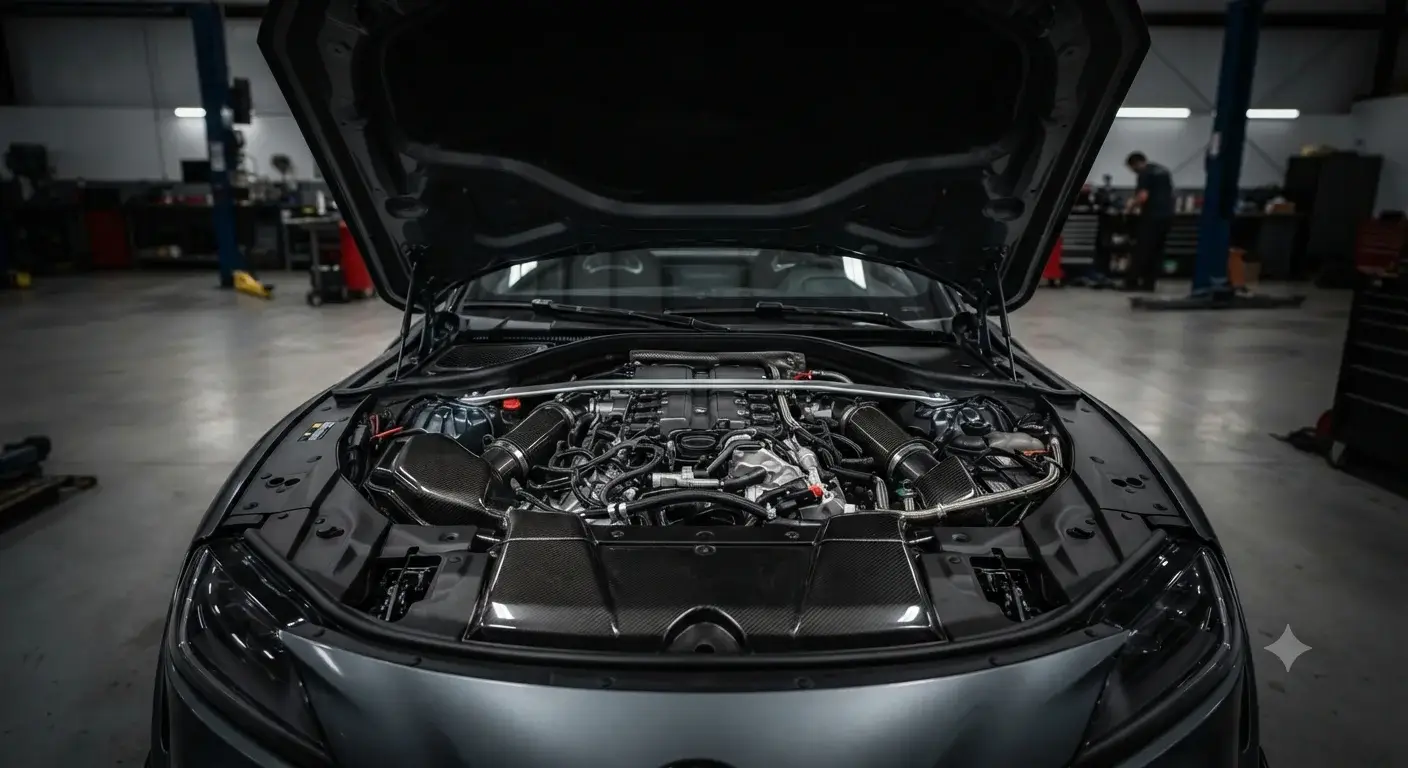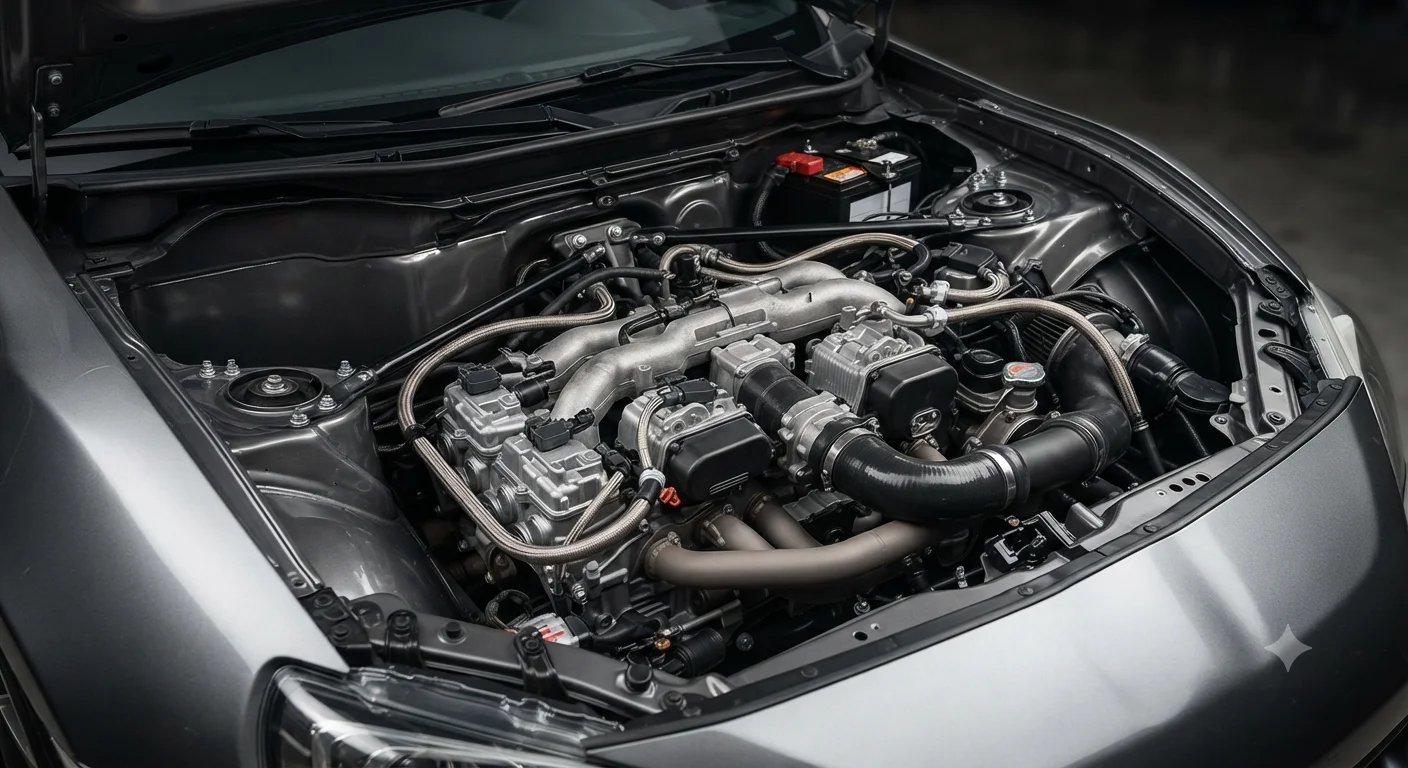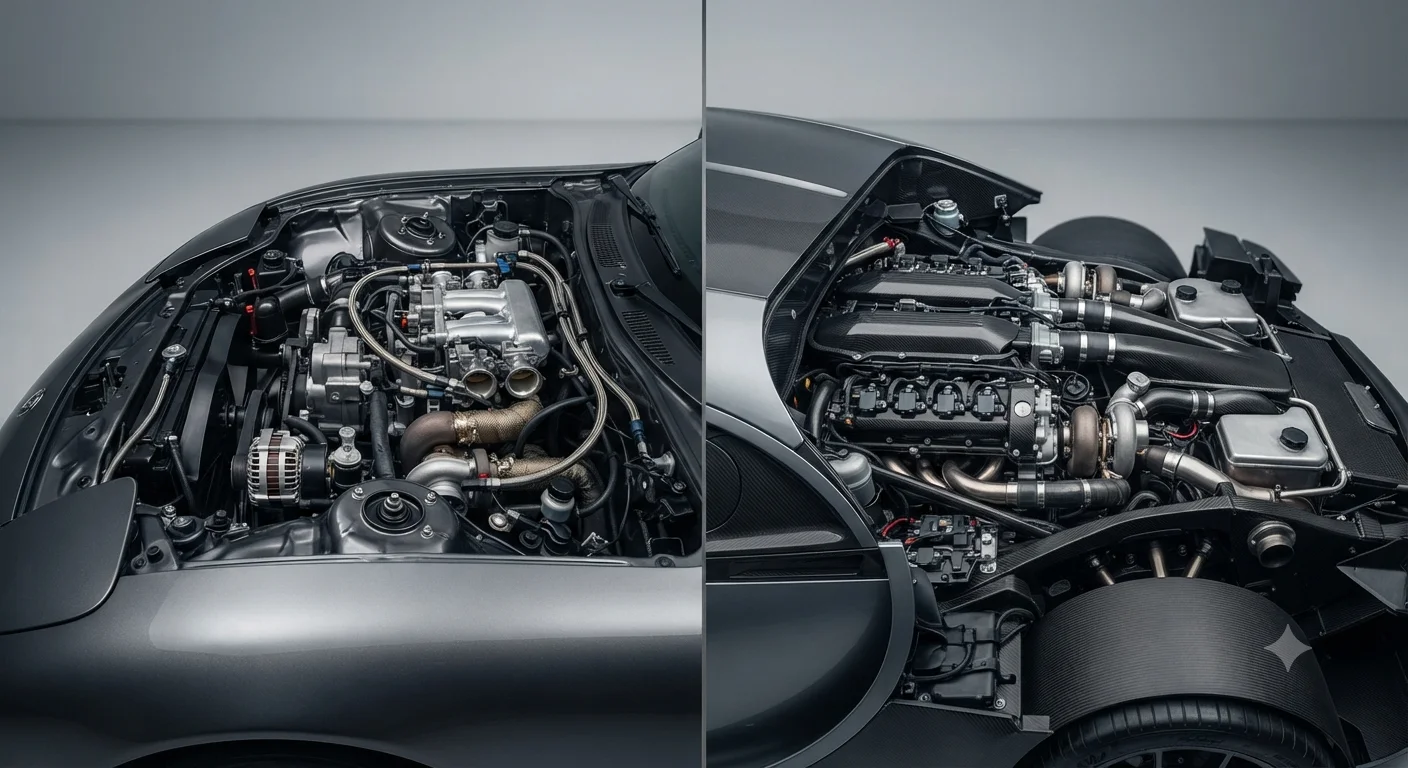
Rotary Engine Bugatti most engines in the UK car park are conventional inline or V-configuration units. But two very different engines sit at the extreme edges of automotive engineering: the Wankel rotary engine, famous for its spinning triangular rotor instead of pistons, and the Bugatti W16 engine, an eight-litre, quad-turbo monster built for one of the fastest production cars ever made.
They have almost nothing in common mechanically, but both get searched together because they represent engineering taken to its limits. This guide explains how each one actually works, which rotary engine Bugatti cars you can realistically buy or own in the UK, what tends to go wrong, and what it costs to keep either of these unusual engines running.
What Is A Wankel Rotary Engine?
Quick answer: A Wankel rotary engine uses a triangular rotor spinning inside an oval-shaped housing instead of pistons moving up and down, converting fuel combustion directly into rotational motion.
Invented by German engineer Felix Wankel in the 1950s, the design was most famously refined and mass-produced by Mazda, which used it in cars from the Cosmo Sport through to the RX-7 and RX-8. Because it has far fewer moving parts than a piston engine, it can rev extremely high and produce a distinctive, smooth power delivery but it also has quirks that piston engines don’t share.
How A Wankel Rotary Engine Works?

Quick answer: The triangular rotor turns inside an epitrochoid-shaped housing, and each of its three faces continuously moves through intake, compression, combustion, and exhaust phases as it rotates effectively running all four strokes at once, just in different chamber sections.
Here’s the cycle for one face of the rotor:
- Intake – As the rotor face passes the intake port, the expanding chamber draws in the air-fuel mixture.
- Compression – Continued rotation shrinks the chamber, compressing the mixture.
- Combustion – Spark plugs ignite the mixture near peak compression, and expanding gas pushes the rotor around.
- Exhaust – The rotor face reaches the exhaust port and expels spent gases as the chamber shrinks again.
Because the rotor has three faces, this happens three times per full rotation, giving a smoother, more continuous power pulse than a typical piston engine of similar size.
Related terms: Wankel engine, rotary engine, apex seals, epitrochoid housing, RX-7, RX-8, 13B engine, rotary combustion engine.
What Is The Bugatti W16 Engine?

Quick answer: The Bugatti W16 is an 8.0-litre, 16-cylinder, quad-turbocharged engine used in the Veyron and Chiron, arranged as two narrow-angle VR8 banks joined in a W-shape to keep the whole unit compact.
Unlike a conventional V16, which would be extremely long, Bugatti’s engineers effectively fused two VR8 engines (each bank already has a tight 15-degree cylinder angle) into a single W-shaped block. This kept the engine short enough to fit behind the passenger cabin while still delivering enormous power figures that have ranged from around 1,000 PS in the original Veyron up to figures well beyond 1,500 PS in later Chiron variants.
How The Bugatti W16 Works?
Quick answer: The W16 operates on the same four-stroke piston principle as any conventional petrol engine, but with four turbochargers and 16 cylinders working together to produce extreme, sustained power output at speeds most road cars never approach.
Key mechanical features:
- Four cylinder banks arranged in a W-configuration, each bank containing four cylinders.
- Four turbochargers, one feeding each bank pair, to build the huge boost needed for four-figure power outputs.
- Massive cooling requirements – the Veyron alone used ten radiators to manage heat from the engine, turbos, and transmission.
- Bespoke construction – each engine is largely hand-assembled and tested individually rather than mass-produced.
Snippet-ready summary: The Bugatti W16 is not a rotary engine at all it’s an ultra-complex conventional piston engine, and the “W16 vs Wankel” comparison is really a contrast between two opposite extremes of engineering philosophy: minimal complexity (rotary) versus maximal complexity (W16).
Wankel Rotary vs Bugatti W16 vs Conventional Piston Engines

| Feature | Wankel Rotary | Bugatti W16 | Conventional Inline/V Engine |
|---|---|---|---|
| Moving parts | Very few (no pistons/valves) | Very many (pistons, valves, turbos) | Moderate |
| Cylinders/rotors | Typically 1–2 rotors | 16 cylinders | Usually 3–8 cylinders |
| Redline | Very high (8,000–9,000+ rpm) | High for its size (~6,700 rpm) | Moderate (5,500–7,000 rpm) |
| Typical use | Sports cars (Mazda RX-7/RX-8) | Hypercars (Veyron, Chiron) | Almost all mainstream cars |
| Complexity | Mechanically simple | Extremely complex | Moderate |
| Fuel economy | Poor | Very poor | Generally good |
| UK servicing availability | Specialist only | Bugatti-authorised only | Widely available |
Benefits Of Rotary Engines
- Compact and lightweight for the power they produce, improving weight distribution in sports cars.
- Extremely smooth power delivery, without the reciprocating vibration of piston engines.
- High rev ceiling, giving a distinctive, free-revving character prized by enthusiasts.
- Fewer moving parts in principle, which simplified some aspects of manufacturing.
Types Of Rotary Engine Cars

Quick answer: The most significant rotary engine cars are the Mazda Cosmo Sport, RX-7 (all three generations), RX-8, and the more recent MX-30 R-EV, which uses a small rotary engine purely as a range-extending generator rather than to drive the wheels directly.
- Mazda Cosmo Sport (1967) – the first mass-produced rotary car.
- Mazda RX-7 (1978–2002) – three generations, the FD RX-7 (1992–2002) being the most celebrated among enthusiasts.
- Mazda RX-8 (2003–2012) – used the naturally aspirated Renesis 13B engine with distinctive rear-hinged “suicide” doors.
- Mazda MX-30 R-EV (2023–present) – a plug-in hybrid where a small rotary engine acts as a generator to extend electric range, not as the primary drive source.
- NSU Ro80 and Mazda Cosmo-era rivals – historically important but not commonly found on UK roads today.
Common Rotary Engine Problems
| Problem | Typical Cause | Common on Which Models |
|---|---|---|
| Apex seal wear | High heat, thermal stress | RX-7, RX-8 |
| Flooding on cold start | Poor starting technique, worn seals | RX-8 (Renesis) |
| High oil consumption | Design requirement (oil injection) | All Wankel-based Mazdas |
| Poor fuel economy | Inherent combustion chamber shape | All rotary engines |
| Compression loss | Apex/side seal wear over time | High-mileage RX-7/RX-8 |
Signs and Symptoms Of Rotary Engine Trouble
Quick answer: Difficulty starting from cold, a “wet” or fouled spark plug smell, visible white smoke, and a noticeable drop in power at higher revs are the classic warning signs of apex seal wear on a Wankel rotary engine.
- Hard starting, especially in cold or damp UK weather
- Rough idle or engine hesitation
- White or blueish exhaust smoke
- Reduced compression readings on a leak-down test
- Spark plugs fouling more frequently than expected
- Unusual rattling noise from a worn eccentric shaft bearing (less common, more serious)
Causes Of Rotary Engine Failures
- Apex seal wear – the seals sealing each rotor tip against the housing endure constant friction and heat, and are the rotary engine’s best-known weak point.
- Flooding – short journeys and cold starts without adequate warm-up encourage unburnt fuel to wash oil from the housing walls, accelerating wear.
- Oil starvation – rotary engines deliberately burn a small amount of oil for seal lubrication; running low between checks can cause rapid seal damage.
- Detonation from poor fuel quality – using low-quality or incorrect-octane fuel increases the risk of pre-ignition damage.
Repair Options and UK Costs
Quick answer: A full rotary engine rebuild on a Mazda RX-7 or RX-8 in the UK typically costs between £2,500 and £5,000+ at a rotary specialist, while Bugatti W16 servicing is generally reserved for the manufacturer’s own technicians and priced individually per car.
| Repair/Service | Estimated UK Cost |
|---|---|
| RX-7/RX-8 engine rebuild (specialist) | £2,500–£5,000+ |
| Apex seal replacement | £1,200–£2,500 |
| Routine rotary service | £150–£300 |
| Bugatti W16 major service | Bespoke pricing, typically five to six figures |
| Bugatti annual servicing/storage package | Often quoted individually by the manufacturer |
Figures are indicative averages drawn from typical UK rotary-specialist pricing in 2025–2026. Bugatti servicing costs are not publicly standardised and vary significantly by car, condition, and required work; always request a direct quote. (Source)
Maintenance Tips for Rotary Engine Owners
- Warm the engine properly before driving hard, especially in cold UK mornings.
- Check oil levels regularly – rotary engines consume oil by design and running low accelerates seal wear.
- Use quality fuel with the correct octane rating to reduce detonation risk.
- Avoid short journeys where possible, as they increase flooding risk and prevent the engine reaching optimal temperature.
- Service with a rotary specialist rather than a generalist garage, given the engine’s unusual maintenance requirements.
- Don’t let the car sit unused for long periods – rotary engines can develop starting issues after extended inactivity.
Buying Guide: What To Check On A Used Rotary Car?
Quick answer: Get a compression/leak-down test done by a rotary specialist, check for smoke on cold start, confirm recent servicing history, and avoid cars that have sat unused for long stretches without proper storage preparation.
Checklist before you buy:
- Compression or leak-down test results from a rotary specialist
- No visible white/blue smoke on cold start
- Documented service history with a rotary-experienced garage
- Confirmation of regular oil top-ups (expected, not a red flag)
- No signs of flooding or repeated hard-starting issues
- Clean spark plugs on inspection, without heavy fouling
Mistakes To Avoid
- Buying a rotary car without a specialist inspection general mechanics often misdiagnose normal rotary quirks as faults, or miss genuine ones.
- Ignoring oil consumption treating it as a problem to “fix” rather than understanding it’s part of normal operation.
- Short-tripping the car regularly without occasional longer, fully-warmed drives.
- Assuming Bugatti-level maintenance can be done at a standard garage W16 servicing requires manufacturer-level expertise and equipment.
- Comparing rotary fuel economy to a conventional engine and being surprised it’s inherently thirstier by design.
Myths vs Facts
| Myth | Fact |
|---|---|
| “Rotary engines are always unreliable.” | With correct maintenance and warm-up habits, rotary engines can be dependable, though seal wear is a genuine long-term consideration. |
| “The Bugatti W16 is a type of rotary engine.” | No — it’s a conventional piston engine with 16 cylinders arranged in a W-shape; it shares no rotary mechanical principles. |
| “All rotary engines burn oil because something’s wrong.” | Rotary engines are designed to consume a small, controlled amount of oil to lubricate the apex seals. |
| “Mazda has abandoned rotary technology completely.” | Mazda revived the rotary engine in the MX-30 R-EV, using it as a range-extending generator rather than the primary drive unit. |
Rotary Engine Checklist (Quick Reference)
- Confirm engine type (13B, Renesis, or other variant)
- Request a compression/leak-down test
- Check for smoke on cold start
- Review service history with a specialist
- Ask about oil top-up frequency
- Inspect spark plugs for fouling
- Confirm the car hasn’t sat idle for extended periods
Conclusion And Recommendation
The Wankel rotary engine and the Bugatti W16 engine represent two completely different philosophies of engineering one strips the internal combustion engine down to its simplest possible moving parts, while the other pushes conventional piston technology to its absolute limit.
If you’re considering one of the classic rotary engine Bugatti cars like an RX-7 or RX-8, the key to reliability is understanding the engine’s quirks rather than treating it like a standard piston engine proper warm-up, oil awareness, and specialist servicing make the real difference.
The Bugatti W16, by contrast, is a different conversation entirely: an engineering showcase most owners will never personally service, with costs and complexity to match its performance.
Call to Action: Thinking about buying a rotary-engined Mazda? Get a compression test from a rotary specialist before you commit, and ask specifically about apex seal condition and oil top-up history it’s the clearest indicator of what you’re really buying.
Frequently Asked Question
What is a Wankel rotary engine?
It’s an engine design that uses a triangular rotor spinning inside an oval housing instead of pistons, converting combustion directly into rotational motion.
How does a rotary engine differ from a normal piston engine?
A rotary engine has a spinning rotor performing intake, compression, combustion, and exhaust continuously in different sections of its housing, rather than pistons moving up and down in cylinders.
Is the Bugatti W16 a rotary engine?
No. Despite sometimes being mentioned alongside rotary engines in searches, the W16 is a conventional 16-cylinder piston engine arranged in a W-shape.
Which cars use a Wankel rotary engine?
The Mazda Cosmo Sport, RX-7, RX-8, and the modern MX-30 R-EV (as a range extender) are the best-known rotary engine cars.
How much does it cost to rebuild a rotary engine in the UK?
A full rebuild on an RX-7 or RX-8 typically costs between £2,500 and £5,000 or more at a specialist, depending on the extent of wear.
Why do rotary engines burn oil?
They’re designed to inject a small, controlled amount of oil to lubricate the apex seals, so some oil consumption is normal rather than a fault.
Are rotary engines bad for fuel economy?
Yes, generally. The combustion chamber shape and sealing design make rotary engines inherently less fuel-efficient than comparable piston engines.
Is the Bugatti W16 engine reliable?
Bugatti’s W16 engines are engineered and tested to an extremely high standard, but they require manufacturer-level servicing and are not comparable to mainstream reliability metrics due to their low production numbers and bespoke nature.
Why did Mazda stop making the RX-8?
Production ended in 2012, largely due to tightening emissions regulations that the naturally aspirated rotary engine struggled to meet economically.
Has Mazda brought back the rotary engine?
Yes the MX-30 R-EV uses a small rotary engine as a generator to extend the car’s electric driving range, rather than to power the wheels directly.
What are apex seals and why do they matter?
Apex seals sit at each tip of the rotor and seal it against the housing; they’re the rotary engine’s primary wear component and the main long-term reliability concern.
How many cylinders does the Bugatti W16 have?
Sixteen, arranged as two narrow-angle VR8 banks joined together in a W-configuration.
Can a normal garage service a rotary engine car?
It’s best handled by a rotary specialist, since general garages may not be familiar with rotary-specific maintenance needs like oil injection systems and seal wear checks.
Is buying a used RX-7 or RX-8 a good idea in the UK?
It can be, provided you get a specialist inspection first, confirm service history, and go in understanding the engine’s particular maintenance habits rather than treating it like a standard petrol engine.
What replaced the Bugatti W16 engine?
Bugatti has moved toward a new naturally aspirated hybrid V16 engine for its next-generation model, marking the end of the W16 era after its use in the Veyron and Chiron.