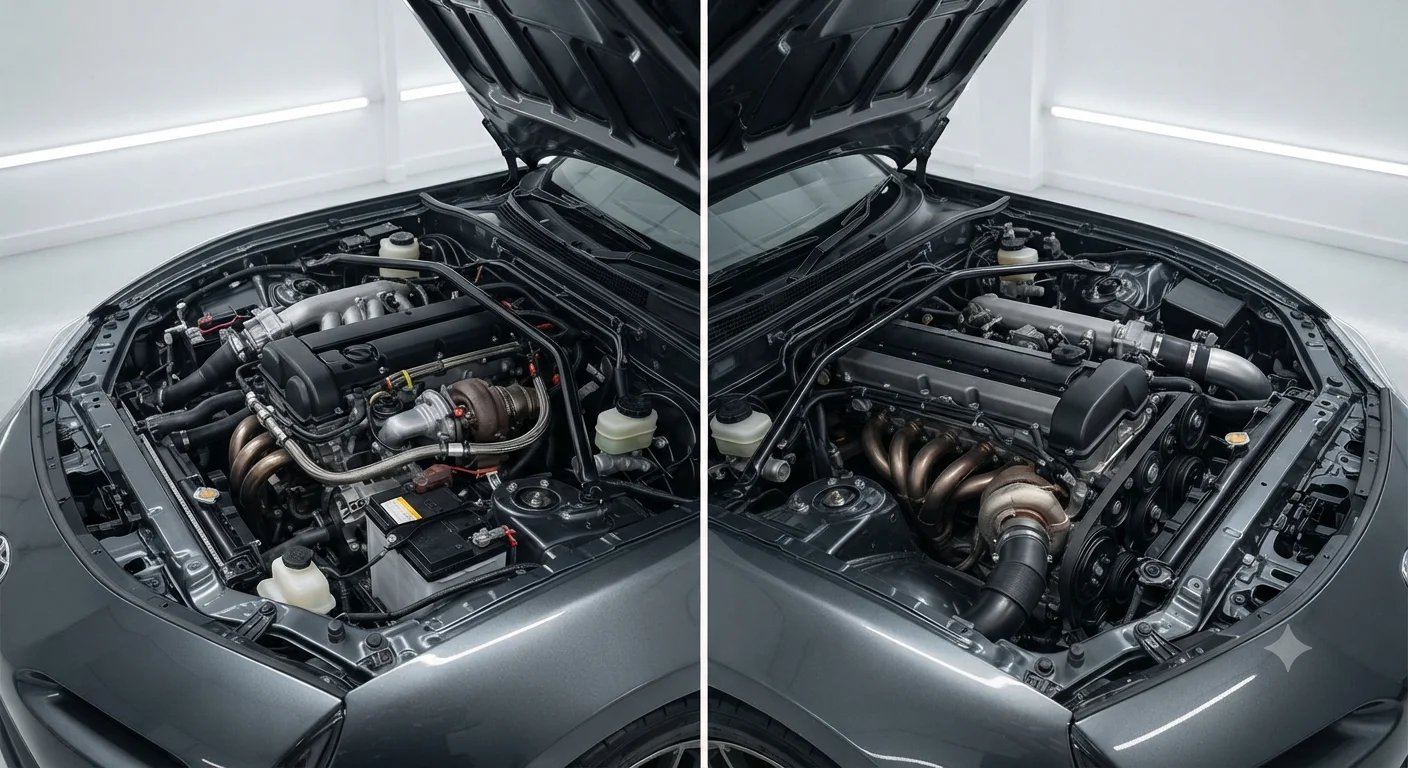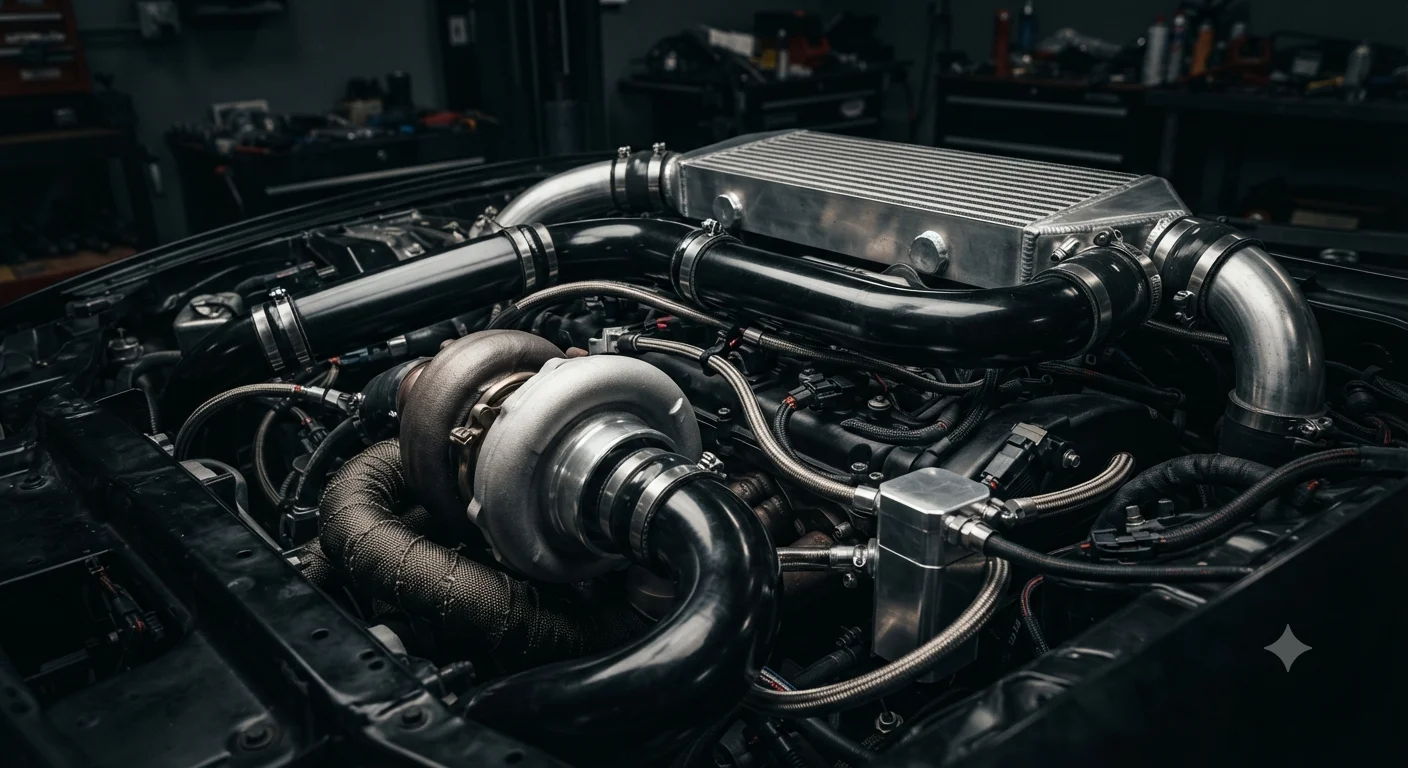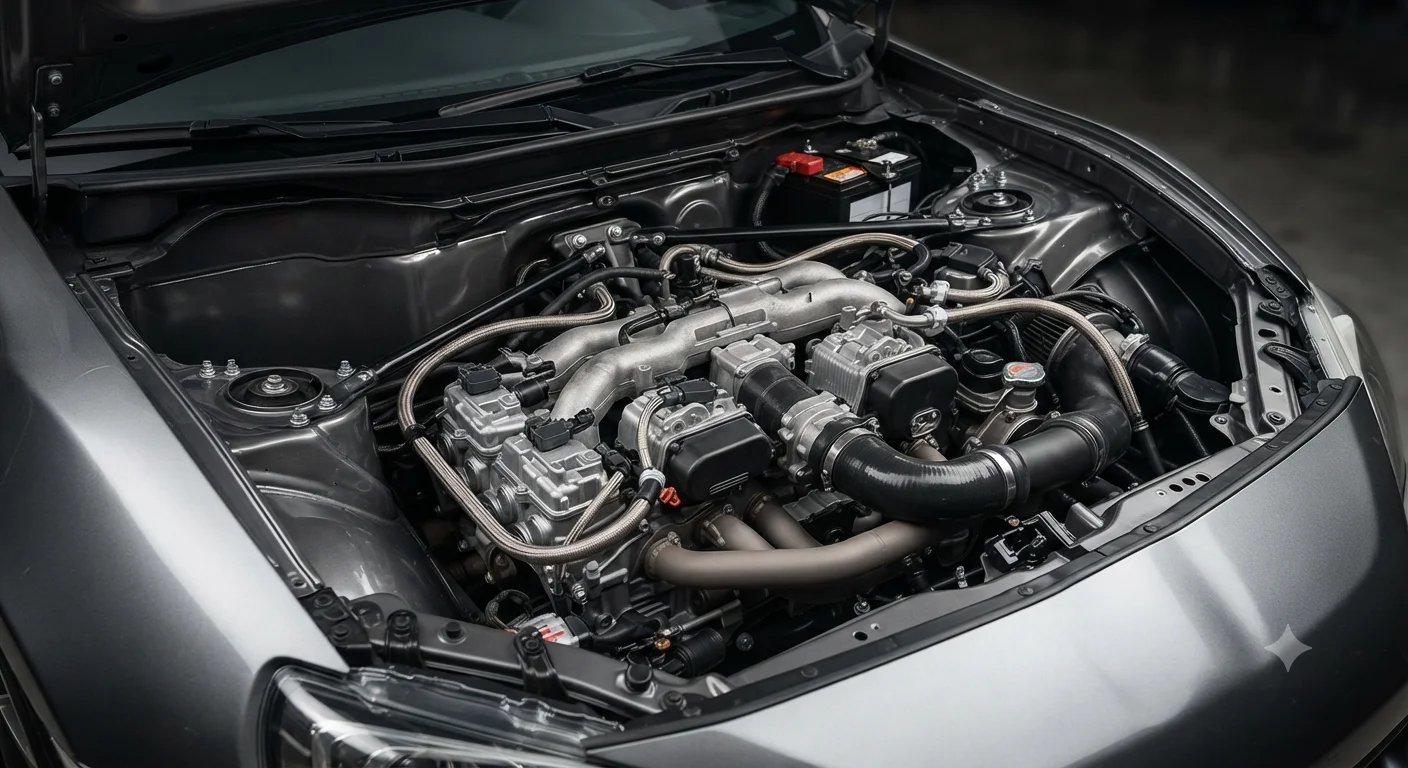
If you’ve been looking at a used Subaru Impreza, Forester, or Outback, you’ve probably run into the term boxer engine more than once. It’s the beating heart of nearly every Subaru ever built, and it’s also found in Porsche’s flat-6 sports cars.
But how does a flat 4 engine actually work, why does Subaru stick with the layout when almost every other mainstream manufacturer has moved on, and the question that really matters if you’re about to hand over your money how good is Subaru boxer reliability in the real world?
This guide answers all three questions plainly, with UK-specific costs, common failure points, and practical buying advice, so you can make a decision based on facts rather than forum folklore.
How A Flat-4 Engine Works?

Quick answer: A flat-4 has four cylinders laid flat in two opposing pairs of two. As one piston moves inward, its opposite number moves outward, balancing the engine’s forces without needing a heavy balancer shaft.
Here’s the mechanical sequence, step by step:
- Intake – The piston moves outward, drawing an air-fuel mixture into the cylinder.
- Compression – The piston moves inward, compressing the mixture.
- Combustion – The spark plug ignites the mixture, forcing the piston outward with power.
- Exhaust – The piston moves inward again, pushing spent gases out through the exhaust valve.
Because pairs of pistons fire and move in opposite directions simultaneously, the engine achieves inherent primary balance. This is a key reason boxer engines run smoothly even without additional counterweights.
Related terms you’ll see used interchangeably: flat-4, horizontally-opposed 4-cylinder, H4 engine, EJ engine (Subaru’s older boxer family), FA/FB engine (Subaru’s newer boxer family).
Boxer Engine vs Inline and V-Type Engines

| Feature | Boxer (Flat-4) | Inline-4 | V6 |
|---|---|---|---|
| Cylinder layout | Horizontally opposed | Upright, in a row | Two angled banks |
| Centre of gravity | Very low | Moderate | Higher |
| Vibration | Naturally low | Needs balance shafts | Moderate |
| Engine width | Wide | Narrow | Moderate |
| Engine height | Very short | Tall | Tall |
| Typical use | Subaru, Porsche | Most hatchbacks/saloons | Larger saloons, SUVs |
| Maintenance access | Harder (wide engine bay) | Easier | Moderate |
Snippet-ready summary: A boxer engine sits lower and wider than an inline-4 or V6, giving better weight distribution and handling balance, at the cost of trickier access for some maintenance jobs such as spark plug and head gasket work.
Benefits of the Boxer Layout
- Low center of gravity – improves handling and stability, particularly noticeable in Subaru’s AWD models on UK B-roads.
- Natural smoothness – opposing pistons cancel out primary vibrations without extra balancer components.
- Compact height – allows a lower bonnet line and lower vehicle centre of mass.
- Even weight distribution – pairs well with symmetrical all-wheel-drive systems.
- Distinctive exhaust note – the “boxer rumble” is a genuine part of the appeal for many Subaru and Porsche owners.
Types of Boxer Engines Subaru Has Used
Quick answer: Subaru’s main boxer families are the older EJ series and the newer FA/FB series, plus the FB-based turbo units in the WRX and the diesel EE20 boxer sold in Europe.
- EJ Series (1989–2019 in various markets): Used in classic Impreza, Legacy, and Forester models. The EJ20 and EJ25 are the most talked-about on forums, largely due to head gasket issues on early 2.5-litre versions.
- FA/FB Series (2011–present): Subaru’s modernised boxer family, found in current Impreza, Outback, Forester, and XV/Crosstrek models. Generally regarded as more robust than the older EJ25.
- FA20 Turbo: Powers the WRX and older BRZ (co-developed with Toyota), tuned for performance.
- EE20 Diesel Boxer: Sold in UK/European Subarus until around 2018–2019; a genuinely unusual diesel boxer engine, now discontinued.
Is Subaru Boxer Reliability Actually Good?
Quick answer: Modern Subaru boxer engines (FA/FB generation, post-2011) are generally reliable when serviced correctly, but the older EJ25 2.5-litre engines from the 1999–2010 era have a well-documented head gasket weakness that owners should budget for.
This is the honest, nuanced answer that most forum threads skip over. Reliability isn’t a single yes/no verdict it depends heavily on which generation and which specific engine you’re looking at.
What tends to hold true across most independent UK garage reports and owner surveys?
- Timing chains (used from the FA/FB era onward) are far less maintenance-intensive than the older timing belts on EJ engines, which needed replacing roughly every 100,000 miles or 10 years.
- Head gasket failures were most common on 2.5-litre EJ25 engines built before around 2004, largely resolved by later engine revisions.
- Oil consumption complaints have appeared on some FA20 and FB25 engines, particularly in higher-mileage examples, and are worth checking on a test drive and pre-purchase inspection.
- Subaru’s own build quality and parts consistency are generally well regarded by independent UK specialists such as marque-specialist garages.
In short: boxer reliability is good-to-strong on a well-maintained, correctly-serviced Subaru, but it is not immune to model-specific weak points, and buyers should treat it like any used car engine layout verify the service history rather than relying on brand reputation alone.
Common Subaru Boxer Engine Problems

| Problem | Most Affected Engines | Typical Mileage Seen |
|---|---|---|
| Head gasket failure | EJ25 (pre-2004) | 60,000–100,000 miles |
| Oil consumption | FA20, FB25 | 80,000+ miles |
| Timing belt wear (if not replaced) | EJ20, EJ25 | Around 100,000 miles |
| Piston ring wear | Early FA20 turbo | High-mileage/track use |
| Rear main oil seal leaks | EJ series | 100,000+ miles |
Signs and Symptoms of Boxer Engine Trouble
Quick answer: Watch for white or sweet-smelling exhaust smoke, coolant loss without visible leaks, a rough idle, or a rising coolant temperature gauge these are classic head gasket warning signs on older EJ engines.
- Sweet smell from the exhaust (coolant burning)
- White/grey smoke, especially on cold start
- Mayonnaise-like residue under the oil filler cap
- Coolant level dropping with no external leak
- Engine overheating on motorway runs
- Blue smoke on start-up (potential oil consumption/piston ring wear)
- Rough or uneven idle, particularly at low revs
Causes of Common Failures
- Head gasket wear – linked to the composite gasket material used on early EJ25 engines, which degraded faster than expected under UK stop-start and motorway driving cycles.
- Oil consumption – often traced to piston ring design on early FA20 units, addressed in later production revisions.
- Timing belt failure – almost always caused by missed replacement intervals rather than a design flaw; interference engines like the EJ25 can suffer serious internal damage if the belt snaps.
- Rear main seal leaks – simply age and mileage-related wear common to most engines, not unique to boxers.
Repair Options and UK Costs
Quick answer: A head gasket replacement on a Subaru boxer engine typically costs between £700 and £1,400 at an independent specialist in the UK, depending on parts and labour required.
| Repair | Estimated UK Cost (Independent Garage) |
|---|---|
| Head gasket replacement (both sides) | £700–£1,400 |
| Timing belt & water pump kit | £350–£600 |
| Full clutch replacement | £450–£700 |
| Oil consumption diagnosis | £80–£150 |
| Rear main seal replacement | £300–£500 |
| Routine service (oil, filters) | £150–£250 |
Costs are indicative averages based on typical UK independent garage rates in 2025–2026 and will vary by region, dealer vs specialist, and vehicle generation. Always get a written quote before committing to work.
Maintenance Tips to Maximise Reliability
- Stick to the service schedule – boxer engines reward consistent oil changes; aim for every 6,000–10,000 miles depending on oil type and driving style.
- Use the correct oil spec – Subaru specifies particular viscosity grades; using the wrong oil can accelerate wear.
- Replace the timing belt on schedule – if you own an older EJ-engined Subaru, don’t stretch beyond the 100,000-mile/10-year interval.
- Monitor coolant levels regularly – a slow, unexplained drop is often the earliest head gasket warning sign.
- Warm the engine gently – avoid hard acceleration on a cold engine, which is harder on boxer internals due to the wide cylinder spacing.
- Use a marque specialist – independent Subaru specialists often understand boxer-specific quirks better than general garages.
Buying Guide: What To Check On A Used Subaru?

Quick answer: Check full service history, inspect for coolant/oil mixing, verify the timing belt has been replaced on schedule (if applicable), and get a pre-purchase inspection from a Subaru specialist.
Checklist before you buy:
- Full documented service history, ideally with a specialist
- Evidence of head gasket replacement on high-mileage EJ25 models, or confirmation it hasn’t needed one
- Timing belt/chain replacement records
- No mayonnaise-like residue under the oil cap
- Clean coolant with no oily sheen
- No white smoke on cold start
- Even idle with no unusual knocking
- Independent pre-purchase inspection report
Mistakes To Avoid
- Skipping the pre-purchase inspection to save money this is the single most common regret among used Subaru buyers.
- Assuming all boxer engines share the same issues treating an FA20 the same as an old EJ25 leads to wrong conclusions.
- Ignoring a dropping coolant level because “it’s probably nothing.”
- Delaying timing belt replacement on older EJ-engined cars to save short-term cost.
- Using cheap, incorrect-spec oil to cut costs on routine servicing.
Myths vs Facts
| Myth | Fact |
|---|---|
| “All Subaru boxer engines have head gasket problems.” | Mainly an issue on pre-2004 EJ25 2.5-litre engines; later revisions largely resolved it. |
| “Boxer engines are impossible to maintain.” | They’re wider, so some jobs take longer, but routine servicing is comparable in cost to other engines. |
| “Boxer engines can’t be reliable long-term.” | Well-maintained FA/FB engines regularly cover well over 150,000 miles. |
| “Only Subaru makes boxer engines.” | Porsche also uses flat-6 boxer engines, and Volkswagen historically used flat-4 boxers in the Beetle. |
Boxer Engine Checklist (Quick Reference)
- Confirm engine generation (EJ vs FA/FB)
- Check for head gasket history or symptoms
- Verify timing belt/chain service records
- Inspect coolant and oil for cross-contamination
- Listen for unusual knocking or tapping
- Check for oil consumption between services
- Confirm servicing was done by a specialist
Conclusion And Recommendation
The boxer engine, and specifically the flat 4 engine design Subaru has championed for decades, offers genuine handling and balance advantages that are hard to replicate with a conventional inline or V-type layout.
As for Subaru boxer reliability, the honest picture is this: modern FA/FB-generation engines are solidly dependable with correct maintenance, while older EJ25 2.5-litre engines carry a known head gasket risk that any buyer should factor into their decision and their budget.
If you’re buying used, the engine generation matters more than the badge alone. A well-documented, specialist-serviced Subaru boxer engine can comfortably outlast many rivals but skipping the history check is where most reliability complaints actually originate.
Call to Action: Considering a used Subaru? Book an independent pre-purchase inspection with a Subaru specialist before you buy, and ask specifically for head gasket and timing belt history it’s the single best way to avoid an expensive surprise.
Frequently Asked Question
What is a boxer engine?
A boxer engine is a horizontally-opposed engine where pistons on either side move inward and outward in opposite directions simultaneously, balancing the engine’s vibrations naturally.
How does a flat-4 engine differ from a normal 4-cylinder engine?
A flat-4 lays its four cylinders flat in two opposing pairs, rather than standing them upright in a row like a conventional inline-4, giving a lower centre of gravity and smoother running.
Is Subaru boxer reliability actually good?
Yes, generally, for FA/FB generation engines from 2011 onward with proper servicing; older EJ25 2.5-litre engines (pre-2004) are more prone to head gasket failure.
How much does a Subaru head gasket replacement cost in the UK?
Typically between £700 and £1,400 at an independent specialist garage, depending on the model and extent of work required.
Which Subaru engines are most prone to head gasket failure?
The EJ25 2.5-litre engine used before around 2004 is the most commonly cited, though some later units have also been affected.
Do all boxer engines have head gasket problems?
No. This issue is specific to certain EJ25 production years, not a universal boxer engine flaw.
How often should a Subaru timing belt be replaced?
Around every 100,000 miles or 10 years on belt-driven EJ engines. Newer FA/FB engines use a timing chain, which doesn’t require scheduled replacement.
Is it worth buying a used Subaru with an EJ25 engine?
Yes, if it has full service history, confirmed head gasket work (or clean inspection results), and a specialist pre-purchase check.
Why does Subaru use boxer engines instead of inline engines?
Primarily for the lower centre of gravity and natural balance, which pairs well with Subaru’s symmetrical all-wheel-drive system for improved handling.
What does white smoke from a Subaru exhaust usually mean?
It often indicates coolant burning in the combustion chamber, a classic sign of head gasket failure, and should be inspected promptly.
Are boxer engines more expensive to maintain than inline engines?
Routine servicing costs are broadly similar, though some jobs like spark plug access can take longer due to the engine’s width, slightly increasing labour costs.
Does Porsche also use boxer engines?
Yes, Porsche’s 911 and Cayman/Boxster models use flat-6 boxer engines, sharing the same fundamental layout principle as Subaru’s flat-4.
How can I check if a used Subaru has had head gasket work done?
Ask for invoices specifically mentioning head gasket replacement, and request an independent inspection that checks for coolant/oil cross-contamination.
What mileage can a well-maintained Subaru boxer engine reach?
Many well-serviced FA/FB engines comfortably exceed 150,000–200,000 miles; EJ engines can too, provided the head gasket and timing belt are properly maintained.
Is a boxer engine worth it for a first car in the UK?
It can be, particularly on AWD Subaru models valued for stability in wet UK conditions, but new drivers should budget for insurance and factor in the head gasket history on older models.