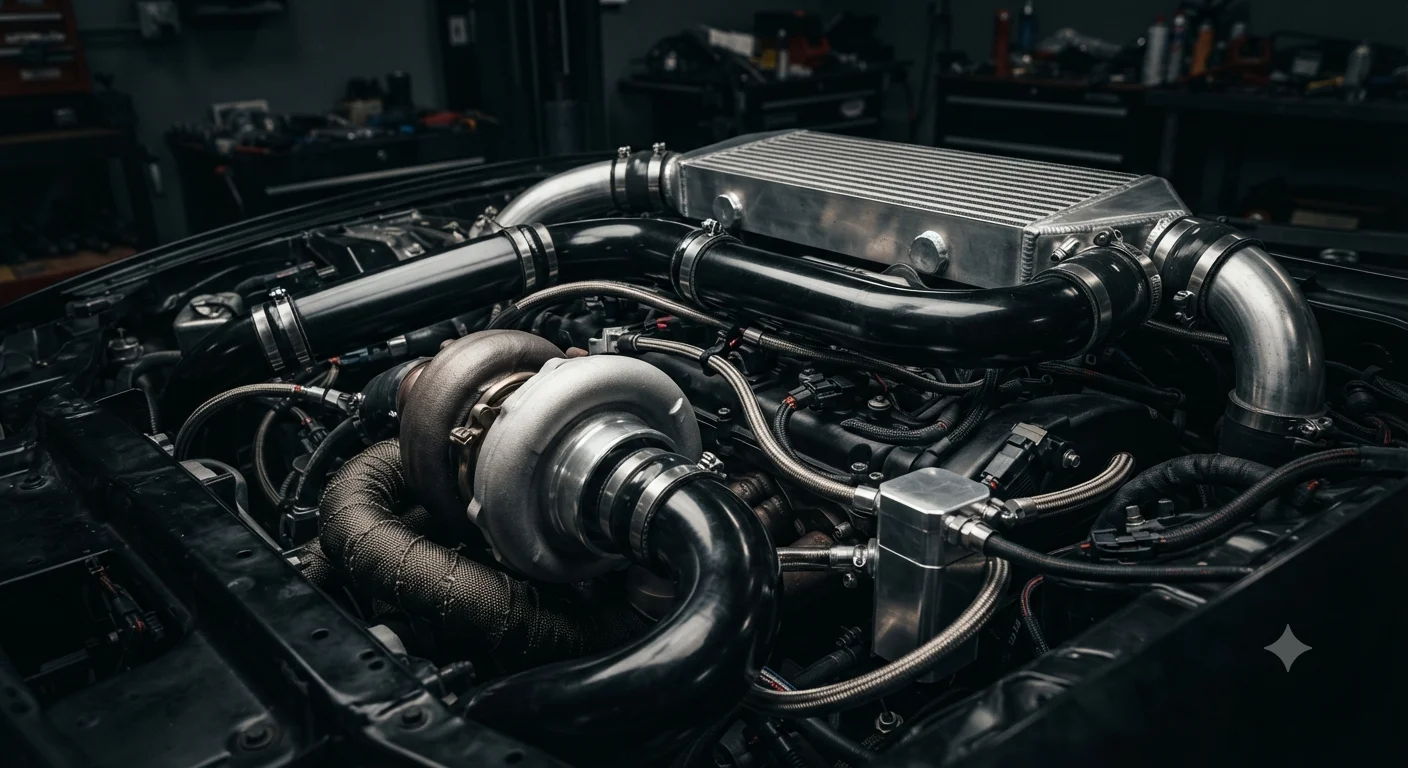
If you’re trying to understand how engines actually breathe and why some cars feel instantly punchy while others build power more gradually this guide covers it all in one place. We’ll go through naturally aspirated (NA) engines, how a turbocharger works, twin turbo setups, turbo lag, and the difference between roots and centrifugal superchargers, with clear comparisons throughout.
This is a pillar article, meaning it’s built to answer every major question in this cluster from basic definitions to detailed mechanical differences so you don’t need to piece the picture together from five different pages.
What Is a Naturally Aspirated Engine?

Quick answer: A naturally aspirated (NA) engine draws air into its cylinders using only atmospheric pressure created by the pistons’ downward movement, with no mechanical or exhaust-driven device forcing extra air in.
An NA engine is the simplest form of internal combustion engine architecture. As each piston moves down on the intake stroke, it creates a vacuum that pulls air (and fuel, in port-injection designs) into the cylinder. There’s no turbocharger or supercharger compressing that air beforehand the engine relies entirely on displacement and RPM to generate power.
How It Works?
- The piston moves down, creating negative pressure in the cylinder.
- Atmospheric air is drawn in through the intake valve.
- Fuel is injected and the mixture is compressed.
- A spark ignites the mixture, driving the piston down on the power stroke.
- Exhaust gases are expelled, and the cycle repeats.
Why Some Drivers Still Prefer NA Engines
- Linear, predictable power delivery with no lag or sudden boost surge
- Simpler mechanical design, generally fewer components to fail
- Distinctive engine note, often prized in performance and motorsport applications
- No reliance on boost pressure, so power output doesn’t fluctuate with altitude or temperature in the same way
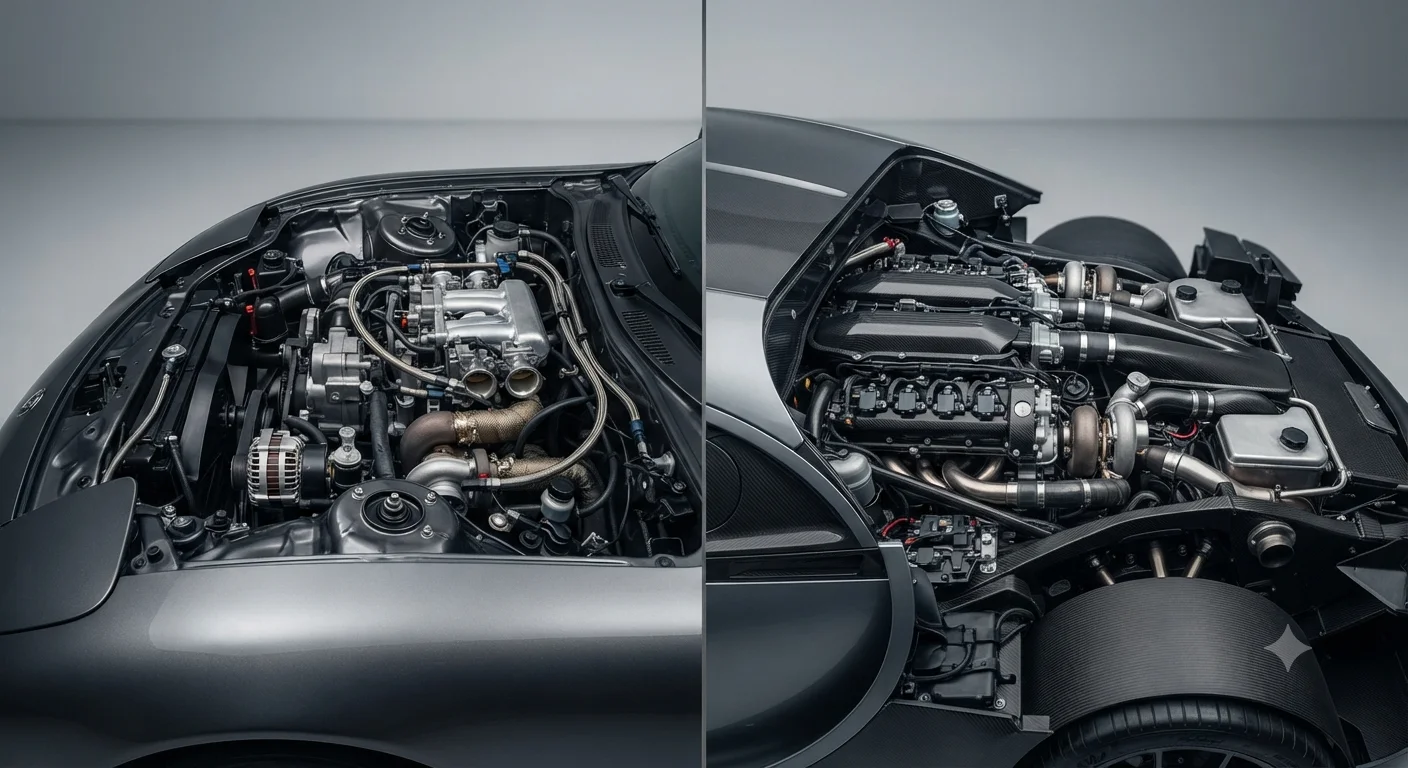
2. NA Engine vs Turbo: Key Differences
Quick answer: A naturally aspirated engine relies purely on atmospheric air pressure and typically needs larger displacement for the same power a smaller turbocharged engine can produce, while a turbo engine uses compressed air to extract more power from a smaller, often more fuel-efficient unit.
| Feature | Naturally Aspirated (NA) | Turbocharged |
|---|---|---|
| Air intake method | Atmospheric pressure only | Exhaust-driven compressor |
| Power delivery | Linear and predictable | Builds progressively, can surge once boost arrives |
| Typical efficiency | Lower power-to-displacement ratio | Higher power-to-displacement ratio |
| Response at low RPM | Immediate, no lag | Can lag slightly before boost builds |
| Mechanical complexity | Lower | Higher (turbine, wastegate, intercooler) |
| Sound character | Often considered purer, more consistent | Can include turbo whistle/blow-off characteristics |
| Common use case | Motorsport, classic performance cars, some sports cars | Most modern mainstream and performance cars |
The core trade-off is simplicity and predictability (NA) versus efficiency and outright power potential (turbo). Neither is objectively “better” it depends entirely on what you value in how a car drives.
Best NA Engines: What Makes One Stand Out?
Quick answer: The best naturally aspirated engines combine high-revving capability, precise throttle response, and a strong power-to-displacement ratio achieved without any forced induction assistance.
What separates a genuinely great NA engine from an average one usually comes down to a few specific engineering traits:
- High redline capability – Engines that rev higher can extract more power from the same displacement, since power is a function of both torque and RPM.
- Individual throttle bodies or advanced variable valve timing – These improve airflow efficiency without forced induction.
- Lightweight rotating assembly – Reduces internal resistance, allowing faster revving and sharper throttle response.
- Balanced torque curve – The best NA engines deliver useable power across a wide rev range, not just at the top end.
Naturally aspirated engines have historically been closely associated with performance and motorsport engineering, particularly in applications where linear throttle response and driver feedback are prioritised over outright peak power figures.
How a Turbocharger Works?

Quick answer: A turbocharger uses exhaust gas to spin a turbine connected to a compressor, which forces extra compressed air into the engine’s cylinders, allowing more fuel to be burned and more power produced from the same engine size.
Step-by-Step: How a Turbocharger Works?
- Exhaust gas exits the engine and flows into the turbocharger’s turbine housing.
- The turbine wheel spins, driven purely by the velocity and pressure of the exhaust gas.
- A shared shaft connects the turbine to a compressor wheel on the intake side.
- The compressor draws in and compresses fresh air, forcing it into the intake manifold.
- An intercooler cools the compressed air before it enters the cylinders, since compression increases air temperature and cooler air is denser.
- More oxygen enters the cylinder, allowing more fuel to be burned and generating significantly more power than the same engine could produce naturally aspirated.
- A wastegate regulates boost pressure, venting excess exhaust gas to prevent over-boosting the engine.
This system is why turbocharging is often described as “free” power it recycles energy from exhaust gas that would otherwise simply exit the tailpipe unused.
Twin Turbo Setups Explained

Quick answer: A twin turbo setup uses two turbochargers instead of one, either working together (parallel) to increase total airflow or working sequentially/at different sizes (sequential) to reduce lag while maintaining strong top-end power.
Types of Twin Turbo Setups
| Setup Type | How It Works | Typical Benefit |
|---|---|---|
| Parallel twin-turbo | Two identically sized turbos, each fed by half the engine’s cylinders | Balanced power delivery, common in V6/V8 engines |
| Sequential twin-turbo | A smaller turbo handles low-RPM response, a larger turbo takes over at higher RPM | Reduces lag while preserving high-RPM power |
| Twin-scroll turbo (sometimes grouped here) | A single turbo with separated exhaust pulse channels | Improves response without the cost of two full turbos |
Why Manufacturers Use Twin Turbo Systems?
- Reduced turbo lag, particularly with sequential setups, since a smaller turbo spools faster at low RPM
- Higher total airflow potential, useful in larger displacement performance engines
- Better packaging in V-shaped engines, where one turbo can serve each cylinder bank directly
The trade-off is added mechanical complexity and cost twin turbo systems have more components that can wear or fail compared with a single-turbo setup.
Turbo Lag Explained
Quick answer: Turbo lag is the short delay between pressing the accelerator and the turbocharger generating enough exhaust flow to spin the turbine fast enough to produce noticeable boost pressure.
Why Turbo Lag Happens?
At low engine speeds, exhaust gas flow isn’t strong enough to spin the turbine quickly. As RPM rises, exhaust flow increases, the turbine spins faster, and boost pressure builds but that build-up isn’t instant, creating a perceptible gap between throttle input and power delivery.
Factors That Affect Turbo Lag
- Turbo size – Larger turbos generally produce more peak power but take longer to spool, increasing lag.
- Turbine design – Twin-scroll and variable geometry turbines reduce lag by improving exhaust gas efficiency at low RPM.
- Engine displacement – Smaller, higher-revving engines often experience less perceptible lag than large, low-revving units paired with an oversized turbo.
- Turbo setup – Sequential twin-turbo systems are specifically engineered to minimise lag.
How Modern Engineering Reduces Turbo Lag?
- Variable geometry turbochargers (VGT) adjust turbine vane angles to optimise exhaust flow across different RPM ranges.
- Twin-scroll turbines separate exhaust pulses from different cylinders, improving turbine response.
- Electric turbo assist (e-turbo) technology, appearing in some newer performance and hybrid vehicles, uses an electric motor to spin the turbine before exhaust flow is sufficient, virtually eliminating lag.
Supercharger vs Turbo: Full Comparison

Quick answer: A supercharger is mechanically driven by the engine’s crankshaft and delivers power instantly with no lag, while a turbocharger is driven by exhaust gas, offering better efficiency but with a brief delay before boost builds.
| Feature | Supercharger | Turbocharger |
|---|---|---|
| Power source | Belt-driven by crankshaft | Exhaust gas |
| Lag | None instant boost | Present, though reduced in modern designs |
| Efficiency | Slightly lower (draws engine power to run) | Generally higher (uses otherwise wasted exhaust energy) |
| Heat generated | Lower | Higher |
| Low-RPM power | Strong immediately | Builds progressively |
| Common applications | Muscle cars, some performance V8s | Most modern turbocharged petrol and diesel cars |
| Sound | Distinct supercharger whine | Turbo spool/whistle, blow-off valve sounds |
Neither is universally superior a supercharger suits drivers who want predictable, instant response, while a turbocharger suits those prioritising efficiency and higher power-to-displacement ratios.
Roots Supercharger Explained

Quick answer: A Roots supercharger uses two meshing lobed rotors to trap and push air into the engine without compressing it internally, delivering strong low-RPM boost but with lower overall efficiency than other supercharger designs.
How a Roots Supercharger Works?
- Two intermeshing rotors (often shaped like figure-eights) spin in opposite directions.
- As they rotate, air is trapped between the rotor lobes and the housing.
- The trapped air is pushed through to the intake manifold, where it’s compressed by the resistance of the engine itself, rather than within the supercharger.
Characteristics
- Mounted on top of the engine, contributing to a taller engine profile
- Produces strong boost at very low RPM, ideal for off-the-line acceleration
- Generally less thermally and mechanically efficient than twin-screw or centrifugal designs, since air isn’t compressed internally before delivery
Roots-type superchargers remain popular in high-performance American V8 applications, where instant low-end torque is prioritised.
Centrifugal Supercharger Explained
Quick answer: A centrifugal supercharger looks and operates similarly to a turbocharger but is belt-driven rather than exhaust-driven, compressing air using a spinning impeller and building boost progressively with engine RPM.
How a Centrifugal Supercharger Works?
- A belt connects the supercharger to the engine’s crankshaft.
- Inside the unit, an impeller spins at very high speed, often via an internal gear step-up.
- Air is drawn in and flung outward by centrifugal force, compressing it.
- Compressed air is delivered to the intake manifold.
Characteristics
- Boost builds progressively with RPM, similar in feel to a turbocharger, though without exhaust-driven lag
- Generally more efficient than a Roots-type supercharger
- Compact design makes it easier to package in some engine bays compared with Roots-type units
This design is often chosen by tuners who want strong high-RPM power delivery with the reliability of a mechanically driven system.
Common Problems Across All Three Engine Types
| Engine Type | Common Problem | Cause | Solution |
|---|---|---|---|
| Naturally aspirated | Reduced power over time | Worn valves, carbon build-up, or ignition issues | Regular servicing, injector/valve cleaning |
| Turbocharged | Turbo whine or power loss | Worn bearings, boost leaks, oil starvation | Inspect turbo seals, check oil supply and hoses |
| Supercharged | Reduced boost consistency | Worn or slipping drive belt | Replace belt at recommended intervals |
| All types | Rough idle or misfire | Spark plug or ignition coil wear | Replace plugs/coils per service schedule |
Cost Comparison (UK)
| Cost Item | Naturally Aspirated | Turbocharged | Supercharged |
|---|---|---|---|
| Typical servicing cost | Lower, fewer specialised components | Moderate to higher | Moderate to higher |
| Turbo/supercharger replacement | N/A | £500–£3,000+ | £800–£2,000+ |
| Belt replacement (supercharger only) | N/A | N/A | £100–£250 |
| Fuel economy (equivalent power output) | Often lower due to larger displacement needed | Generally better | Slightly lower than turbo due to parasitic drive loss |
| Insurance group impact | Often lower for standard NA models | Can be higher, especially performance turbo models | Can be higher, especially performance supercharged models |
Maintenance Tips by Engine Type

Naturally Aspirated Engines
- Keep to standard service intervals for spark plugs, filters, and fluids
- Monitor for carbon build-up on intake valves, particularly on direct-injection NA engines
- Address any unusual idle roughness promptly, as NA engines often show wear through subtle power loss
Turbocharged Engines
- Use the manufacturer-specified oil grade and stick to service intervals strictly
- Allow the engine to idle briefly after hard driving before switching off, to let the turbo cool
- Check intercooler piping and hose clamps periodically for boost leaks
Supercharged Engines
- Inspect the drive belt regularly for cracking, glazing, or slipping
- Check supercharger fluid or oil levels if the unit has a separate lubrication system
- Monitor for any change in boost sound or feel, which often signals early belt or bearing wear
Buying Guide and Checklist
- Decide what matters more to you: linear NA response, turbo efficiency, or supercharger instant power
- Check full service history, particularly oil change intervals on turbo and supercharged models
- Test drive and listen for unusual whining, whistling, or rough idle
- Ask whether any forced induction system is factory-fitted or an aftermarket conversion
- Consider insurance group differences between NA, turbo, and supercharged variants of the same model
- Factor in slightly higher servicing costs for turbo and supercharged engines when budgeting
- Research the specific twin-turbo or supercharger type fitted, since designs vary significantly in reliability and characteristics
Mistakes to Avoid
- Assuming turbo lag is the same across all turbocharged cars. Modern twin-scroll and VGT designs significantly reduce it compared with older single-turbo setups.
- Neglecting oil changes on turbocharged cars. This is the leading cause of premature turbo failure.
- Ignoring supercharger belt wear. A slipping belt gradually reduces performance before it fails outright.
- Buying a modified NA-to-turbo conversion without checking installation quality. Poorly executed forced induction conversions can seriously shorten engine life.
- Assuming bigger turbo always means better performance. An oversized turbo increases lag and can hurt everyday drivability.
Myths vs Facts
| Myth | Fact |
|---|---|
| Naturally aspirated engines are always more reliable than turbo engines | Both can be highly reliable with correct maintenance; NA engines simply have fewer forced induction components that can wear |
| All turbocharged cars have significant turbo lag | Modern twin-scroll, variable geometry, and electric-assist turbos have greatly reduced lag compared with older designs |
| Superchargers are always more powerful than turbos | Power output depends on the specific system’s size and tuning, not simply the induction type |
| Twin turbo setups always mean double the power | Twin turbo setups are often about improving response and airflow distribution, not simply doubling output |
| Roots superchargers are more efficient than centrifugal ones | Centrifugal superchargers are generally more efficient, since Roots-type units don’t compress air internally |
Which Engine Type Should You Choose?
Quick answer: Choose a naturally aspirated engine for linear, predictable response and mechanical simplicity; choose a turbocharged engine for the best balance of efficiency and power; choose a supercharged engine if instant, lag-free power delivery is your top priority.
- Choose NA if you value throttle predictability, engine sound character, and mechanical simplicity over outright efficiency.
- Choose turbo if you want strong power from a smaller, more fuel-efficient engine, and modern lag-reduction technology appeals to you.
- Choose supercharged if instant power delivery matters more than peak efficiency, particularly for performance driving.
Conclusion
Naturally aspirated, turbocharged, and supercharged engines all solve the same fundamental challenge getting air and fuel into the cylinders in genuinely different ways. NA engines prioritise simplicity and linear response, turbochargers prioritise efficiency and power-to-displacement ratio, and superchargers prioritise instant, predictable boost.
Twin turbo setups and different supercharger designs (Roots vs centrifugal) further shape how power actually feels behind the wheel. Understanding these differences puts you in a much stronger position, whether you’re buying, tuning, or just trying to understand what’s under the bonnet.
Call to Action
Weighing up NA, turbo, or supercharged for your next car or build? Check full service history, listen for warning noises on any test drive, and always budget for the specific maintenance needs of whichever induction system you choose.
Frequently Asked Question
What is a naturally aspirated engine?
A naturally aspirated engine draws air into its cylinders using only atmospheric pressure created by piston movement, without any turbocharger or supercharger forcing extra air in.
Is a naturally aspirated engine better than a turbo engine?
Neither is universally better NA engines offer simpler, more predictable power delivery, while turbo engines typically offer better efficiency and higher power-to-displacement ratios.
What are the best NA engines known for?
The best naturally aspirated engines are typically known for high-revving capability, precise throttle response, and strong power output achieved through engineering rather than forced induction.
How does a turbocharger work?
A turbocharger uses exhaust gas to spin a turbine connected to a compressor, which forces extra compressed air into the engine’s cylinders to increase power output.
What is a twin turbo setup?
A twin turbo setup uses two turbochargers, either working in parallel for balanced power or sequentially with different sizes to reduce lag while maintaining strong high-RPM output.
What is turbo lag?
Turbo lag is the brief delay between pressing the accelerator and the turbocharger generating enough boost pressure to noticeably increase power.
Can turbo lag be eliminated?
Turbo lag can be significantly reduced through technologies like variable geometry turbines, twin-scroll designs, and electric turbo assist, though it isn’t always eliminated entirely.
What’s the difference between a supercharger and a turbo?
A supercharger is mechanically driven by the engine’s crankshaft and delivers instant power with no lag, while a turbocharger is exhaust-driven and generally more fuel-efficient but has a brief lag.
What is a Roots supercharger?
A Roots supercharger uses two meshing lobed rotors to push air into the engine without compressing it internally, delivering strong low-RPM boost but with lower overall efficiency.
What is a centrifugal supercharger?
A centrifugal supercharger uses a belt-driven spinning impeller to compress air, building boost progressively with engine RPM, similar in feel to a turbocharger but without exhaust-driven lag.
Which is more efficient, Roots or centrifugal supercharger?
Centrifugal superchargers are generally more efficient than Roots-type units, since they compress air internally before delivery rather than relying on engine resistance.
Do turbocharged engines need more maintenance than naturally aspirated ones?
Yes, turbocharged engines generally require stricter adherence to oil change intervals and periodic inspection of components like intercoolers and wastegates that NA engines don’t have.
Are twin turbo cars more expensive to maintain?
Generally yes, since twin turbo systems have more components that can wear or require replacement compared with a single-turbo setup.
Why do some performance cars still use naturally aspirated engines?
Some manufacturers and enthusiasts prioritise the linear throttle response, distinctive sound, and mechanical simplicity that naturally aspirated engines offer over the efficiency benefits of forced induction.
Is a supercharger or turbo better for daily driving?
Turbocharged engines are generally better suited to daily driving thanks to better fuel efficiency, while superchargers are often favoured in dedicated performance applications where instant response is prioritised.