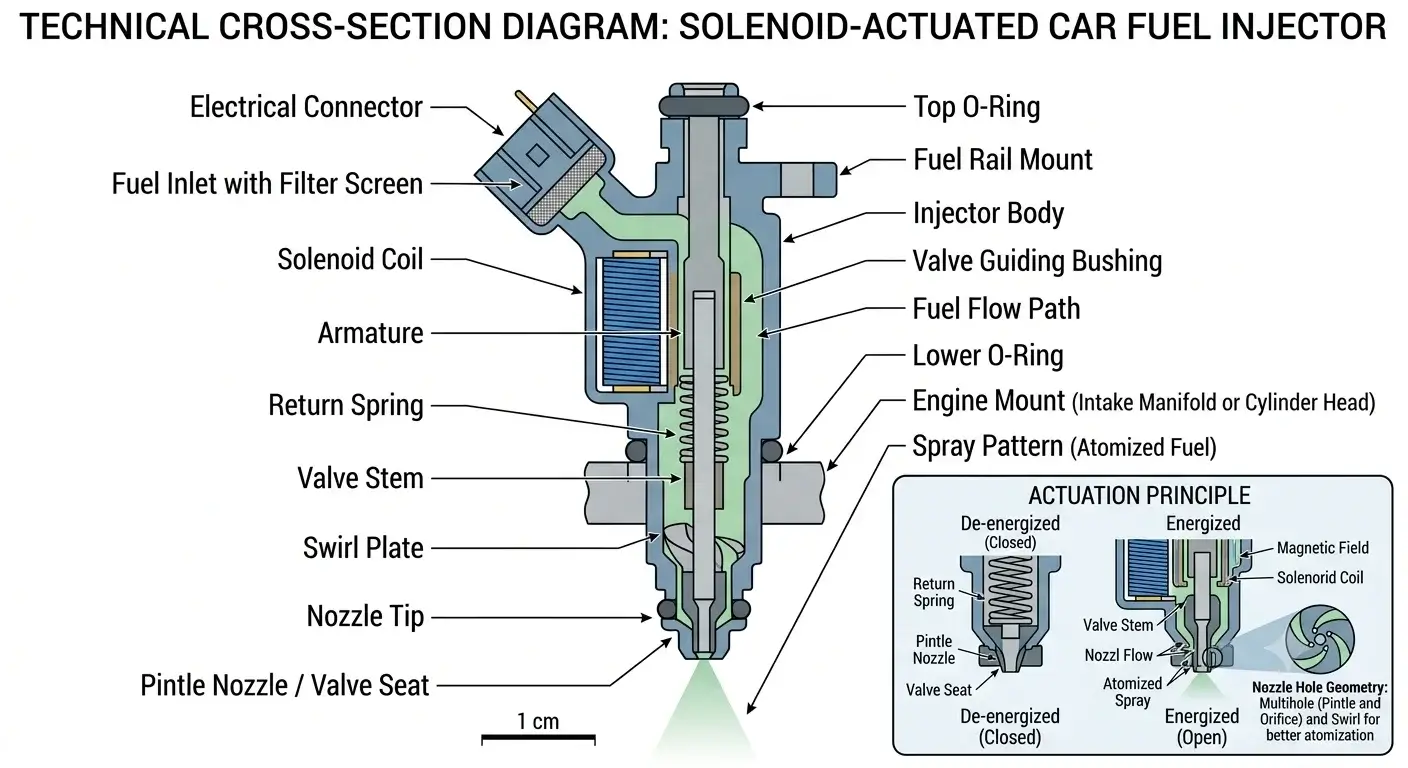

If your car is spluttering, using more fuel than usual, or the engine light has come on, a faulty fuel injector is one of the most common culprits. This guide explains exactly what a fuel injector does, how to spot the warning signs, what repairs cost in the UK, and how to keep yours running well for years.
Quick answer: A fuel injector is a small electronically-controlled valve that sprays a precise, fine mist of fuel into your engine at exactly the right moment. When it works properly, your engine runs smoothly, starts easily, and uses fuel efficiently. When it fails, you’ll typically notice rough idling, poor fuel economy, misfiring, or a flashing engine warning light.
1. What Is a Fuel Injector?

Direct answer: A fuel injector is a small nozzle-like component, usually made of metal and plastic, that delivers a measured spray of petrol or diesel directly into the engine’s intake or combustion chamber. It’s controlled by the car’s engine control unit (ECU), which tells it exactly how much fuel to release and precisely when to release it.
Every petrol or diesel car built in the last three decades relies on fuel injectors instead of the old-fashioned carburettor. There are usually one injector per cylinder, so a four-cylinder car has four injectors, a six-cylinder has six, and so on.
Think of a fuel injector like a very fast, very accurate tap. It opens for a few thousandths of a second at a time, hundreds of times per minute, to feed the engine exactly what it needs.
2. How Does a Fuel Injector Work?
Direct answer: The fuel pump pressurises fuel and sends it to the injectors. The ECU sends an electrical signal that opens a tiny valve inside the injector, allowing fuel to spray out in a fine mist through small nozzle holes. This happens in perfect time with the engine’s intake stroke.
Here’s the step-by-step process:

- Fuel pump pressurises the fuel – The fuel pump draws petrol or diesel from the tank and pushes it through the fuel lines under pressure.
- Fuel reaches the injector – Pressurised fuel sits ready at the injector, waiting for the signal to open.
- ECU sends an electrical pulse – Sensors around the engine (like the oxygen sensor, mass airflow sensor, and crankshaft position sensor) feed data to the ECU, which calculates the ideal fuel amount.
- The injector’s valve opens – A small electromagnet (solenoid) or, in newer engines, a piezoelectric element lifts a pintle or needle valve, letting fuel escape through tiny nozzle holes.
- Fuel atomises into a fine mist – This mist mixes with incoming air, making it easier to burn efficiently.
- The valve closes – The injector shuts almost instantly, ready for the next pulse.
This entire cycle repeats many times per second while the engine is running, which is why even a small fault can cause a noticeable performance drop.
3. Types of Fuel Injectors
Direct answer: The main types are port fuel injectors, direct injectors, and diesel injectors (including common rail types), each suited to different engine designs.

| Type | Where Fuel Is Sprayed | Common In | Key Feature |
|---|---|---|---|
| Port (Multi-Point) Injection | Into the intake manifold, just before the intake valve | Older and mid-range petrol cars | Simpler, cheaper, less precise than direct injection |
| Direct Injection (GDI/TFSI/TSI) | Directly into the combustion chamber | Most modern petrol cars (2010 onwards) | Higher pressure, better efficiency, more prone to carbon build-up |
| Diesel Common Rail Injectors | Directly into the combustion chamber at very high pressure | Nearly all modern diesel cars | Extremely high pressure (up to 2,500+ bar), very precise |
| Throttle Body Injection (TBI) | Into the throttle body, shared across cylinders | Older vehicles (largely obsolete) | Basic, low-cost, rarely used today |
4. Benefits of Modern Fuel Injection
Direct answer: Fuel injection improves fuel economy, reduces emissions, boosts power delivery, and makes cold starts far more reliable than older carburettor systems.
- Better fuel efficiency – Precise fuel delivery means less waste.
- Lower emissions – Cleaner combustion helps cars meet UK and EU emissions standards.
- Smoother performance – Consistent fuel delivery across all cylinders.
- Easier cold starts – The ECU adjusts fuel delivery automatically for temperature.
- Reduced maintenance versus carburettors – No manual tuning needed.
Warm up the engine gently Avoid heavy acceleration immediately after a cold start, especially in winter. See our winter car maintenance tips for more cold-weather advice.
5. Signs of a Faulty Fuel Injector
Direct answer: Common symptoms include a rough or uneven idle, engine misfires, poor fuel economy, a strong fuel smell, hesitation when accelerating, and an illuminated check engine light. “Check engine light – Often triggered by a misfire or lean/rich fuel trim code. Note: an unresolved fault light can also cause an MOT failure see our UK MOT test guide for details.

Look out for:
- Rough idling – The engine shakes or sounds uneven when stationary.
- Engine misfires – A noticeable jolt or stutter, especially under load.
- Poor fuel economy – You’re filling up more often than usual.
- Hard starting – The engine cranks longer than normal before firing up.
- Strong smell of fuel – Could indicate a leaking injector.
- Check engine light – Often triggered by a misfire or lean/rich fuel trim code.
- Loss of power – Hesitation or sluggish acceleration.
- Engine knocking – A clicking or tapping noise from a stuck or dirty injector.
- Black smoke from the exhaust – Common with diesel injectors delivering too much fuel.
6. What Causes Fuel Injectors to Fail
Direct answer: Fuel injectors typically fail due to carbon build-up, contaminated fuel, worn seals, electrical faults, or simple age-related wear.

| Cause | How It Affects the Injector |
|---|---|
| Carbon deposits | Clog the tiny nozzle holes, restricting or distorting the spray pattern |
| Poor quality fuel | Introduces impurities that block or corrode internal parts |
| Worn O-rings/seals | Cause fuel leaks around the injector base |
| Electrical faults | Damaged wiring or connectors stop the solenoid from firing correctly |
| High mileage wear | Internal components naturally degrade over 80,000–120,000 miles |
| Infrequent servicing | Allows deposits to build up unchecked over time |
7. How to Diagnose a Fuel Injector Problem
Direct answer: A mechanic will typically run a diagnostic scan for fault codes, perform a cylinder balance test, and physically inspect or test each injector’s spray pattern and resistance.

Typical diagnostic steps:
- OBD-II scan – Reads stored fault codes such as misfire codes (P0301–P0304) or fuel trim codes.
- Listen with a mechanic’s stethoscope – A healthy injector makes a steady clicking sound; silence or irregular clicking suggests a fault.
- Cylinder balance/power balance test – Identifies which cylinder is underperforming.
- Resistance test – Measures the injector’s electrical resistance against the manufacturer’s specification.
- Flow and spray pattern test – Checks whether the injector delivers the correct amount of fuel in the right pattern.
If you notice symptoms, it’s worth booking a diagnostic check promptly a small fault left unresolved can lead to more expensive engine damage.
8. Fuel Injector Repair Options
Direct answer: Depending on severity, options range from a fuel system cleaning additive, to professional ultrasonic cleaning, to full injector replacement.
| Option | Best For | Typical Outcome |
|---|---|---|
| Fuel additive/cleaner | Mild clogging, early symptoms | Can restore some performance; won’t fix mechanical faults |
| Ultrasonic injector cleaning | Moderate carbon build-up | Professionally cleans nozzles and tests flow rate |
| Injector reconditioning | Worn but salvageable injectors | Rebuilt with new seals/internals, tested to spec |
| Full replacement | Cracked, leaking, or electrically failed injectors | Restores full original performance |
Expert tip: If one injector has failed on a high-mileage engine, many independent garages recommend replacing all injectors in the set together, since the others are likely close behind and labour costs are largely shared.
9. Fuel Injector Replacement Cost in the UK
Direct answer: Replacing a single fuel injector in the UK typically costs between £150 and £450 including parts and labour, while a full set replacement can range from £400 to £1,200 or more depending on the vehicle.
| Job | Typical UK Cost (Parts + Labour) |
|---|---|
| Single injector (mainstream petrol car) | £150–£350 |
| Single injector (diesel/common rail) | £250–£500 |
| Full set (4-cylinder petrol) | £400–£900 |
| Full set (diesel common rail) | £600–£1,400 |
| Professional injector cleaning service | £80–£180 |
| Fuel additive/cleaner (DIY) | £10–£25 |
| Diagnostic fee (often deducted if repair proceeds) | £40–£90 |
Prices vary by garage, region, and vehicle make premium and performance cars with direct injection systems tend to sit at the higher end. Always ask for a written quote before work begins, and check whether genuine, OEM, or aftermarket parts are being used, as this affects both price and warranty.
10. Maintenance Tips to Extend Injector Life
Direct answer: Use good quality fuel, service your car on schedule, use an injector cleaner every 6,000–10,000 miles, and avoid running the tank near empty.
- Buy fuel from reputable, high-throughput stations – Reduces the risk of contaminated fuel.
- Use a fuel system cleaner periodically – Helps prevent carbon build-up, particularly in direct-injection engines.
- Keep up with scheduled servicing – Many manufacturers recommend fuel filter changes every 20,000–40,000 miles. For a full breakdown of routine checks, see our car maintenance tips guide.
- Avoid letting the tank run very low regularly – Sediment at the tank’s bottom can be drawn into the fuel system.
- Address warning signs early – A small injector issue is cheaper to fix than the misfire damage it can eventually cause.
- Warm up the engine gently – Avoid heavy acceleration immediately after a cold start.
11. Buying Guide: New vs Reconditioned vs Aftermarket
Direct answer: New OEM injectors offer the best reliability and warranty, reconditioned injectors are a solid mid-cost option, and aftermarket injectors are the cheapest but quality varies significantly.

| Option | Cost | Reliability | Warranty |
|---|---|---|---|
| New OEM (manufacturer) | Highest | Excellent | Usually 1–2 years |
| Reconditioned/remanufactured | Mid-range | Good, if from a reputable supplier | Often 6–12 months |
| Aftermarket (non-OEM) | Lowest | Variable depends heavily on brand | Often 3–12 months |
What to check before buying:
- Confirm the exact injector part number matches your engine code, not just your car model.
- Ask whether the injector has been flow-tested and calibrated.
- Check the warranty terms in writing.
- Favour reputable brands with a UK distribution and returns policy.
Still deciding between OEM, reconditioned, or aftermarket parts? Our car spare parts comparison guide covers this in more detail across different components.
12. Mistakes to Avoid
- Ignoring early symptoms – Rough idling or minor misfires rarely fix themselves.
- Using the cheapest unknown-brand injectors – Can cause poor performance or repeat failure.
- Replacing only the failed injector on very high mileage engines – Often leads to another failure soon after.
- Overusing fuel additives – They help maintenance, but won’t repair mechanical or electrical faults.
- Skipping a proper diagnostic – Guessing at the fault can lead to unnecessary part replacement.
- Mixing old and new injectors without a flow-matching check – Can cause uneven cylinder performance.
13. Fuel Injection vs Carburettor: Pros and Cons
| Feature | Fuel Injection | Carburettor |
|---|---|---|
| Fuel efficiency | High | Lower |
| Emissions | Low | Higher |
| Cold starting | Reliable, automatic | Often needs manual choke |
| Maintenance | Lower, but repairs can cost more | Higher, but parts are cheap |
| Modern availability | Standard on virtually all cars since the 1990s | Mostly classic cars only |
14. Myths vs Facts
| Myth | Fact |
|---|---|
| “Fuel additives can fix any injector problem.” | Additives help with mild carbon build-up but can’t repair cracked, leaking, or electrically faulty injectors. |
| “Only old cars get injector problems.” | Modern direct-injection engines are actually more prone to carbon build-up than older port-injected engines. |
| “Premium fuel always prevents injector issues.” | Higher octane fuel doesn’t necessarily contain more cleaning detergents check for fuels specifically labelled as containing injector-cleaning additives. |
| “You must always replace the whole set.” | Not always true for low-mileage cars, though it’s often recommended for older, higher-mileage vehicles. |
15. Maintenance Schedule
| Interval | Recommended Action |
|---|---|
| Every fuel fill-up | Use a reputable fuel station |
| Every 6,000–10,000 miles | Consider a fuel system cleaner |
| Every service (per manufacturer schedule) | Ask garage to check for fuel trim/misfire codes |
| Every 20,000–40,000 miles | Replace fuel filter (where applicable) |
| At first sign of symptoms | Book a diagnostic check promptly |
16. Buying Checklist
- Confirmed exact injector part number for your engine
- Compared new, reconditioned, and aftermarket pricing
- Checked warranty length and terms
- Verified the seller/garage has good UK reviews
- Asked whether flow-testing/calibration was carried out
- Requested a written quote before work begins
- Asked if all injectors should be replaced together (high-mileage cars)
17. Conclusion
A fuel injector is a small but essential part of your engine, and even a minor fault can lead to rough running, higher fuel bills, and costly damage if ignored. Spotting the early signs rough idling, misfires, poor fuel economy, or a warning light and acting quickly can save you money and keep your car reliable for years to come.

Call to Action: If you’re noticing any of the symptoms above, don’t wait for the problem to get worse. Book a diagnostic check with a trusted local garage to find out exactly what’s going on and get an accurate repair quote. If you’re noticing any of the symptoms above, don’t wait for the problem to get worse.
Find a trusted mobile mechanic near you to get an accurate diagnosis and repair quote.
Frequently Asked Questions
What is a fuel injector?
A fuel injector is an electronically controlled valve that sprays a precise mist of fuel into an engine’s intake or combustion chamber, allowing for efficient, clean combustion.
How much does a fuel injector cost to replace in the UK?
A single injector typically costs £150–£450 including labour, while a full set replacement can range from £400 to £1,400 depending on the vehicle and injector type.
Is it worth replacing a faulty fuel injector?
Yes, in almost all cases. A failing injector can cause poor fuel economy, misfires, and potential damage to the catalytic converter or engine over time, so replacement is usually worthwhile.
How long do fuel injectors last?
Most fuel injectors last well over 100,000 miles with good maintenance, though carbon build-up or contaminated fuel can shorten this.
Can I clean a fuel injector myself?
You can use a fuel additive designed for injector cleaning, but professional ultrasonic cleaning gives a far more thorough result and includes flow testing.
What are the signs of a bad fuel injector?
Rough idling, misfires, poor fuel economy, hard starting, a fuel smell, and an illuminated check engine light are the most common signs.
Can a faulty fuel injector damage my engine?
Yes. Prolonged misfiring can damage the catalytic converter, and a leaking injector poses a fire risk in severe cases, so it’s important not to ignore symptoms.
Do I need to replace all fuel injectors at once?
Not always, but it’s commonly recommended on higher-mileage vehicles, since the remaining injectors are often close to failing too.
What’s the difference between port injection and direct injection?
Port injection sprays fuel into the intake manifold before the valve, while direct injection sprays fuel straight into the combustion chamber at much higher pressure.
Can bad fuel damage a fuel injector?
Yes. Contaminated or low-quality fuel can introduce debris and deposits that clog or corrode the injector’s internal components.
How do I know if it’s the fuel injector or the fuel pump?
A diagnostic scan and a fuel pressure test can distinguish between the two a fuel pump fault usually affects the whole engine’s fuel supply, while an injector fault typically affects a single cylinder.
Is it safe to drive with a faulty fuel injector?
Short journeys may be possible, but driving for long periods with a known fault risks further engine damage and reduced safety, so it’s best to get it checked promptly.
Do fuel injector cleaners really work?
Good quality cleaners can help reduce and prevent carbon build-up, especially in direct-injection engines, but they’re a preventative measure rather than a repair for mechanical faults.
What causes a fuel injector to leak?
Worn O-rings or seals, cracked injector bodies, or age-related wear are the most common causes of leaks.
How much does a diagnostic check cost in the UK?
Diagnostic checks typically cost £40–£90, and many garages deduct this fee from the final bill if you proceed with the repair.